Red’s Cafe

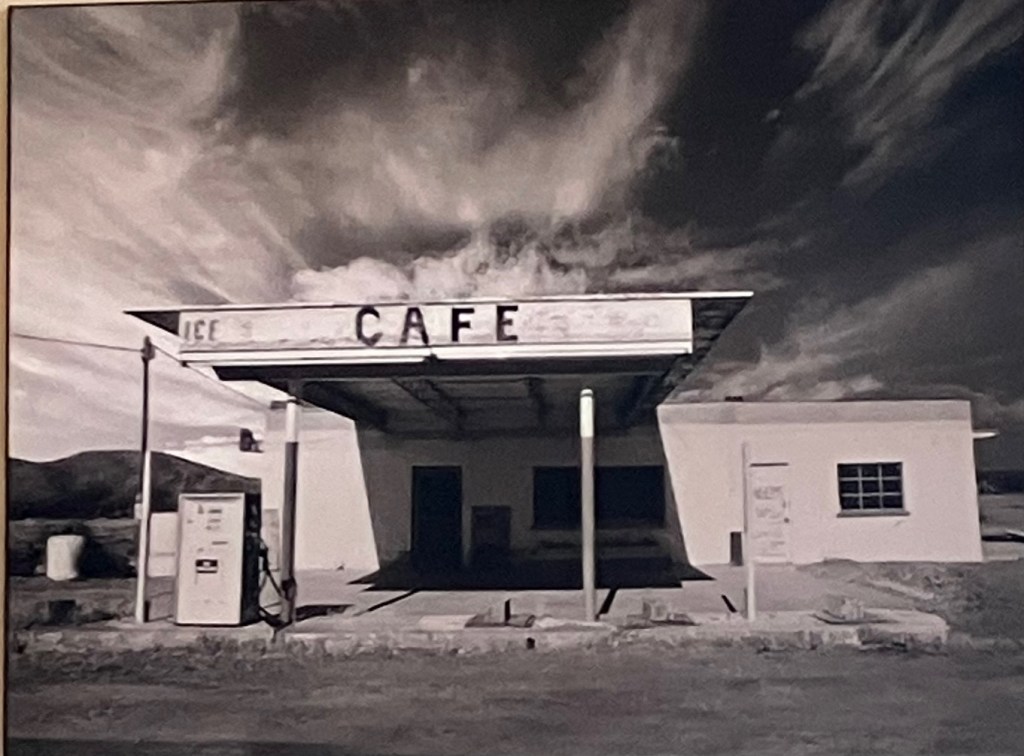
The photo above was used as the prompt for the Chatham Writers Group. It reminded me of the trip Barb and I took through the southwest and the sites we saw along Route 285 between Carlsbad and Santa Fe, then along sections of old Route 66 to Flagstaff. With that in mind, I wrote this piece of speculative fiction.

Red’s Cafe
On most days that it wasn’t raining or too cold, Pete and Lenny would shuffle out to the area called “the courtyard” and lay claim to two faded green plastic garden chairs to watch the sun set. As dusk fell, the art deco lights atop the building behind them would first hum then burst into brilliant white block letters noting “DOTTIE’S SENIOR LIVING”. Except for the letter “I” in senior. That had burned out a long time ago. Pete would chide Dottie’s manager 3 or 4 times a week. “Damn, it Reggie! Tell Dottie to fix that I. That’s why the men outnumber the women three to one in this place. People read that as Señor Living and think that it’s just old fart men living here.” 

They settled into their chairs, each gripping a plastic cup, 2/3 full of Coke. They waited until a group of residents accompanied by a few nurse’s aides trudged past them to smoke in the parking lot of the Evangelical church, generally referred to as St. Nicotine’s, next to Dottie’s, because Dottie didn’t allow smoking on her property.

When the coast was clear, Pete pulled a pint of Myer’s Rum from the inside pocket of jacket and said, “Here Lenny. Let me top off your Coke.” They tapped their cups, said “cheers” and sipped until the sun settled out of sight.

Lenny stood, placed his hand on Pete’s shoulder and said, “I’ll grab us a couple more Coke’s. There’s something I need to tell you, and you’re gonna need a stronger drink.”

Pete’s eyebrows raised, “What’s this about, Lenny?”

“Be right back,” was all he said.

When he returned, Pete was leaning forward in his seat. Lines of concern added to the creases in his brow.

“I’m going to tell you a story. It’s true. I hope you don’t think I’m nuts. The only other person who’s heard this was my wife, rest her soul. It really happened.”

Inwardly, Pete was relieved. For a moment he thought Lenny was going to tell him he was dying. “Go ahead, my friend. Now I’m intrigued,” was all he said.

“Okay. But no laughing! Remember that TV show, Route 66? Those two guys driving from Chicago to LA in a Vette?”

“Yes.”

“After I graduated from college, I did that. Started the summer driving Route 66 before getting a real job.”

“In a Vette? You dog Lenny! You never told me.” Pete looked wistful.

“No, sadly. In my dad’s 1960 Chevy Bel Air. Not a cool car, but a cool trip.”

“Yes! You lucky dog. I would have driven it in an Edsel.”

“Yeah. Well, what I am going to tell you next, Pete, is I don’t know if this was truly luck. Or something even bigger.”

“Okay.”

“I was going to stay in Holbrook, Arizona. A place called the Luna Moth Motel. I even made a reservation.”

“The Luna Moth? You’re joking right? This I gotta hear!” Pete took a sip of his drink and leaned forward, grinning.

“It’s not what you think. I’m driving on Route 66; the country is so flat. Three miles out of Holbrook. I see the lights and buildings at the edge of town. Good thing, ‘cause I was tired from driving all day and was pinching myself to stay awake.”

“Been there,” Pete said.

“Now the strange stuff begins, Pete. There’s a Cities Service station on the right side of the road. It looks abandoned. Only one pump where there used to be four. Signs faded and peeled. It had been called ‘Red’s Café and Auto Service. The only clear word was Café.”

“Go on,” said Pete.

“I’m about to cruise past and this old guy steps out from behind the only pump and waves at me like crazy. Motioning and yelling for me to pull in. He looked upset, so I brake hard and cut into the gas station’s driveway.”

“How old was the guy, Lenny? We’re old!” laughed Pete.

Lenny smiled and nodded, “Yeah, Pete. About how old we are now. His Cities Service uniform had faded to almost turquoise in color. Except for his name tag, it’s still bright green and in bright white cursive letters in the name ‘Red’.”

Lenny paused for a few moments, as though trying to remember. Softly, Pete asked, “What was up with Red?”

“Well, he asked me to help find a set of keys he dropped in the sage brush behind the station. He said his dog was locked in the office, and he needed to get him out. I agreed to help, but all the time we were looking, I didn’t hear a dog barking.”

“Were you worried it was a trick? That he was going to rob you. Or worse?”

“Yeah, a little. Anyway, 20 minutes later we still haven’t found the keys, and we’re back in front of the station. He stops and points towards the town and he says ‘look’. ‘At what?’ I ask. Suddenly there’s a bright flash, flames shoot out sideways and skyward. Three seconds later we hear the loud boom.”

“Fireworks?” asks Pete.

“No!” exclaims Lenny. “The old guy says, ‘Well, looks like the Luna Moth Motel just blew up. I guess they never did figure out where the gas leak was. Weren’t you supposed to be staying there? If I were you, I’d try the Wig Wam Motel, nicer place too.’”

“What happened next?”

“I turned to look at him and he’s gone. I never heard him walk away.”

“What do you mean, gone.”

“He disappeared. I called his name. No reply.”

“Lenny, if I heard you right, he pointed to the Luna Moth before it blew up.”

Lenny exhaled a big breath of air. Speaking slowly, he whispered, “Yes. I never told him I was staying there. I eventually get to the Wig Wam and I ask about Red’s Café. The clerk says, ‘Ahh, Red Olson. Really nice guy. He died a couple of years ago. Too bad nobody took over his business.’ Then he asks me if I’m ok. Tells me I look like I’ve seen a ghost.”

“Holy crap, Lenny! You did!”

“For sure, Pete. I did. A ghost that saved my life.”

Uncle Joe

I went to bed last Thursday evening having written a memoir for the prompt “Showing Up”, then was awake at 5:00 AM Friday morning with a completely different story in mind. I woke up thinking about someone I once knew, and whom I had not thought of in a very long time. As one memory of him after another unfolded, I thought about how his curious behaviors were because of mental health issues. My recollections began to fall together in a pattern that, surprisingly, fit the melody of the song “The Weight” by The Band. My memoir poem/lyrics follow.

Uncle Joe

©October 17, 2025

Ernie Stricsek

Off the bus at Henry Street

Looking for his sister’s place.

Straw hat, tan suit, wingtips on his feet

As weathered as his face.

“Hey kiddo, you’re Mary’s grandson!

Here, help me with my suitcase.

I’ll take my duffle, ‘cause it weighs nearly a ton.”

Joe, you just can’t do this

To just show up ain’t right

Joe, you just can’t drop in

You need to call or write

Joe would sip his coffee, in halts and starts he talked.

Of all the places he’d been to, he took the bus or walked.

“I’ve seen the Grand Canyon! And hiked the Black Hills.

Didn’t care much for Chicago, the Windy City gave me the chills.

Joe, this ain’t what you do

To show up out without a clue

That you were coming this way

And needed a place to stay

Of my grandmother’s brother, not much was ever said.

My grandfather would grumble,

“He’s nothing but a hobo, and not right in the head.”

“Do good in school!” My grandmother urged. “If you don’t’,

You’ll end up like Uncle Joe instead.”

Joe, you just can’t do this

To just show up ain’t right

Joe, you just can’t drop in

You need to call or write

It would be years before I learned more

Of my grandmother’s brother Joe.

He returned from the war, hero’s honors and a small amount of fame

“Joe became a cop, got hurt breaking up a fight.

Took a pipe to the head, then never was the same.”

Joe, this ain’t what you do

To show up out without a clue

That you were coming this way

And needed a place to stay

Was early June of ’67 that I saw Joe walk past my school.

Waved to him from the window, as he trudged on by.

His tanned face cracked a smile; he waved and mouthed “Hi.”

“Where’s Uncle Joe?” I asked when I entered the house.

“We sent him on his way; the man is but a louse.”

Joe, you just can’t do this

To just show up ain’t right

Joe, you just can’t drop in

You need to call or write

Then one day a letter did arrive, would Uncle Joe be coming for a stay?

My grandmother opened it and learned her brother had passed away.

She sobbed, “He died alone, and in a strange place.”

For the rest of my life, I’ll remember his wave and the smile on his face.

Joe, this ain’t what you do

To show up out without a clue

That you were coming our way

And needed a place to stay

A Bridge Between

Well, after a brief hiatus, it was time for me to get back into the saddle and start scribbling stories and memoirs. I can’t remember the last time I was able to join the Monday Chatham Writers Group at the Eldredge Library. This week the prompt to write to was a picture of a bridge. I struggled with what I was going to write about, I had a couple of ideas, but finally settled on a Civil War era story with my characters, the Yankee Captain James Bartlett and his one time close friend, Redmond Downs, a Rebel Major. The prompt image is below. In my story, I added a couple of people to the bridge.

On either side of the trickling stream that divided the dense forest of pines and scrub oaks the locals called “The Wilderness”, two men stood silent, horses tied to the trees behind them. They wore the uniforms of bitter enemies: one Union blue, the other Confederate gray. The air was tense, though the muskets of their respective armies were miles away. Here, only the creek ran between them – and a memory neither could drown in time.

     Captain James Bartlett stepped down from the slight rise on his side of the stream. He moved slowly, hat in hand, a peace gesture for a private meeting that was arranged through a series of messages passed through cautious picket lines. On the other bank of the stream stood Major Redmond Downs, arms crossed over his chest, his LeMat revolver still holstered, his eyes roaming the woods behind Bartlett.

     “Hello Red,” Bartlett said first, his voice quiet, almost reverent. “It’s been a long time.”

     Downs didn’t exactly smile, but the corner of his mouth twitched. “Since the spring of 1862, I reckon. The day I saw you hauled off to Libby Prison.”

     Bartlett let out a breath that was almost a laugh. “You should’ve seen me get out of that old tobacco warehouse!”

     “I heard about that. They reported you were shot while trying to escape, and a passing side-wheeler chopped your body to pieces. Glad to see that was not the case.”

     “I reckon we have a truce for a bit, I suppose. I’ve got some of that good Yankee coffee and pot to boil it in. Mind if I come over and sit for a spell, Red?”

     They sat together on the bank. Golden sunlight filtered through the branches. Bartlett raised his coffee cup. “A toast, to when were friends, before the war. Before everything.”

     “To when we were friends, and before you took a liking to Miss Lizzie Haw,” Downs said, his mug tapping Bartlett’s.

     “I suppose that’s what brought us here,” said Bartlett.

     Downs barked out a sharp laugh. “We’re not here because of the war? No, of course, it’s Lizzie Haw! Still, the only cause either of us has ever really bled for.”

     They sat for a moment, not saying anything. The only sounds were of the stream and the buzzing of the late spring insects. Bartlett broke the silence.

     “I didn’t know she had written to you, too,” he said.

     “She didn’t,” Downs replied, his voice low. “I saw her in Richmond last spring. Volunteering at the hospital. She looked tired. Strong still. But worn in a way she never was before.”

     “I got a letter from her two months ago,” Bartlett said. “She’s in Baltimore now, working in a field hospital. She… she asked me not to hate you.”

     Downs looked up from his coffee mug, startled. “She said that?”

     Bartlett nodded. “She wrote that hate was too easy now. That it was pulling people apart faster than bullets could. She asked me to remember you as the man I taught how to swim.”

     Downs chuckled. “Taught me how to swim? You saved my life, Jimmy. I was floundering in the Hudson, going down for the last count. I…. I never said thank you.”

     “You didn’t need to, Red. You were my friend.”

     Down’s face broke into a wry smile, “We weren’t friends yet. You barely knew me. You risked your life to save mine.”

     Another moment of silence passed. Bartlett stood, unhooked his saddlebag and pulled out a rolled-up scroll of paper.

     “What’s this? Are you handing me one of your maps, Jimmy?”

     “It’s a drawing,” Bartlett answered. “Something I did in camp a few nights ago.”

     Downs unrolled the scroll. Although drawn on rough army paper, the sketch was beautiful. It showed a wooden bridge, with boxes of flowers on either side, arching across a narrow stream. He looked around the space where they were drinking coffee and realized this was the same spot depicted in the drawing. There were two figures on the bridge, standing in the middle, each wearing a different uniform. They were shaking hands.

     “I have always believed that bridges were a kind of promise,” Bartlett said. “Not just a way across, but a way to say that I’m willing to meet you in the middle.”

     Downs looked at the drawing for a long time before rolling it back up. He cleared his throat but couldn’t hide his emotion. “You always were the sentimental one, Jimmy.”

     Bartlett didn’t argue. “Maybe I still am.”

     The afternoon light deepened, shadows beginning to stretch long and quiet over the ground.

     “Do you think she loved us both?” Downs asked suddenly.

     Bartlett hesitated. “Yes,” he said. “But not in the same way. You were her fire. I was her calm. She needed both. Maybe, after all of this, she’ll need neither.”

     Downs took off his battered hat and ran his hand through his hair. “Do you still love her?”

     “I’ve never stopped,” Bartlett answered.

     Once again, they sat in silence, the stream the only voice between them.

     “I don’t know if there’s a future after this war,” Bartlett said finally. “Not for me. Not for Lizzie. Not for us. But I don’t want the past to go to waste because the present is broken.”

     Redmond Downs stood and stretched. He looked again at the scroll in his hand. “We won’t fix the world here today, Jimmy. But maybe we didn’t meet to fix anything.”

     Bartlett smiled and said, “Maybe we just came to remember.”

     They shook hands. Each hoped it wasn’t for the last time.

     As they turned to mount their horses, Downs stopped and glanced back. “Are you going to build that bridge you drew?”

     Bartlett gave a faint smile. “I believe I just did.”

     They rode away in opposite directions; the drawing of the bridge safely folded between memory and war.

Storm Larry

Image from radio station I95 blog.

On Sunday, February 5, 1978, every major news network and every AM and FM radio station was flooding the airwaves with dire predictions for a rapidly approaching, massive winter storm that was going to strike the New England states beginning Monday morning. This prediction followed a winter storm that blew through New England at the end of January. A storm that accelerated the fatigue failure of the roof of the Hartford Civic Center, causing to collapse onto the empty stands and rink for the Hartford Whalers hockey team.

   I woke up 6:00 AM Monday morning, February 6th, went to my bedroom window and saw it wasn’t snowing yet, but the sky looked ominous, angry. Eating my breakfast in front of the TV, the weather people were in an excited state. Talking so fast, you could almost see the spittle flying from their mouths, waving hands as though conducting a symphony of weather maps. They created much excitement. All the while, a steady stream of school closings scrolled across the bottom of the TV screen. It was almost 7:00 AM. Time to leave my apartment and head to my place of work, a 20-minute drive.

   On the ride to work, even my favorite radio station ran through the list of school closings. WPLR in New Haven played rock & roll, 24/7/365. But nor the morning of February 6th. I switched to another rock station from Hartford to hear the same rundown of school cancellations north of New Haven. I scoffed when I heard that AMF-Cuno Division was cancelling all shifts for the day. “Hah!” I said to no one, “They cancel shifts if there’s a gentle breeze.” But looking at an even angrier sky, I envied the AMF-Cuno people.

   All the hourly and salaried people were anxious about the weather. At 7:30 in the morning, forecasters expected snow to arrive in southern Connecticut around 9:00 AM, for once the weather talkers were correct. At 9:00 AM on the dot, light snow fell. As the morning progressed, the wind picked up; the snow fell heavier. That morning, I spent more time looking out the window at the accumulating snow on the road.

   People listening to radios out in the manufacturing shop reported the state police and public works departments were urging people to go home and get off the roads. By the afternoon rush hour, the conditions were going to be “really” bad. Some of the hourly people asked their supervisors if they could punch out at noon and go home. Upper management discovered the early departures and the plant manager announced over the PA system that no one could leave early; everyone must complete their shifts. The snow continued to pile up.

   At 2:00 PM, two of my lab compatriots and I went to see the manager of our department to see if we could leave early. We were salaried after all, didn’t have to punch a clock and we promised to make up the 1 ½ hours left of our shift.

   “No,” he said without looking up from the report he was reading.

   “Shit,” we muttered under our breaths. But not low enough. His head shot up from his report and daggers flew from his eyes. We scampered away.

   By 3:00 PM, the snow was falling so heavily, visibility was almost nil. The wind was howling. The radio weather people reported winds were 50 MPH, increasing to 80 MPH by late afternoon. From the lab window, I watched the cars of the first shift workers slowly leaving the parking lot. Some fishtailing before gaining traction. The snowplows passed over the road twice, but you wouldn’t know it. Louie, in bright orange thermal coveralls, startled me when he zoomed past on his motorcycle. “Brave dude!” I thought. Thirty minutes later, plus an additional five minutes after clearing nearly 6 inches of snow off my car, I pulled out of the parking lot, fishtailing on the road like everyone else had done when they left work.

  The snow had been falling at a rate that plows could not keep up with. Snow covered secondary roads, and cars blocked tertiary roads. Many cars had skidded off the road, into each other, or slid backwards down steep inclines, unable to gain traction. Two jackknifed tractor trailers blocked the fourth road I tried, a connector between interstate highways. Making a u-turn, I headed to my last option, a less traveled tertiary road.

   Things looked promising on that road. There was not a car in sight. The snow-covered trees and small creek that meandered alongside the road made for a picturesque scene. But I was not in a photo taking mood. Suddenly, a line of six cars blocked my side of the road. A guy was walking along the line of cars, puffing clouds of condensation, as he leaned over to tell each driver something. Arriving at my car, he said, “There are two cars off the road up ahead. It’s not safe.”

   I asked whether he was a cop or a road crew member, and whether the road was blocked. “No,” he replied.

   “Step aside,” I said, “I’m gonna give it a go.”

   Maintaining a speed of 25 mph, I barely made it through the treacherous curve where the stuck cars were. I breathed easier.

   Three hours after leaving work, I was safely in my apartment, leaving only once to cross country ski over to the grocery store to get the necessities; toilet paper, milk and bread. It would be 3 days before I returned to work as the State of Connecticut dug out of Storm Larry.

A Day In The Life

Prompt photo selected randomly from an internet site displaying “interesting photos”.

The prompt for the Monday Chatham Writers Group was to write something, in any genre, relating to the photo above. My story follows.

Father Pappas gazed out the window of his office, deep in thought about how to end his sermon for the Sunday services. Engrossed in his sermon, he didn’t hear the gentle knocking on the door, only stirring when he heard his secretary ask, “Father? There’s a visitor with an urgent message. May we come in?”


   Spinning his chair around to face the office door, his deep baritone voice replied, “Mrs. Cosmos! Yes! Please come in.”


    Mrs. Cosmos opened the door and ushered in a boy with a post card sized envelope gripped in his right hand.


  “Father, this is Elias Artino. He has a message for you. He claims it’s urgent.”


   The boy was nervous. His eyes darted around the office.


   Father Pappas smiled, “Ahh. Master Artino. It’s good to see you. You have an urgent message for me? Is everything alright at home?”


   As presbyter of the Parish of St. Demetrios in Karpenisi, he felt he was not only the Father of the church, but the father of each parishioner’s family. His level of concern for the people of his community ran deep, they felt it as well.


   “M..m..my family is well, Father Pappas,” Elias stammered, “It’s note from Mrs. Tsolis.” He thrust his tiny hand out and placed the note on the Father’s desk.


   “Thank you, Elias. Which Mrs. Tsolis? The one at the bottom of Ydros Way? Or at the top?”


   “Top. May I go now?”


   “Of course. Tell your family I send my best wishes.” Father Pappas chuckled as Elias scampered away.


   Opening the envelope, he removed the card. His brow furrowed.


   “Is Mrs. Tsolis okay?” asked Mrs. Cosmos.


   Father Pappas shrugged and said, “I don’t know. The note is asking me to come to her home as soon as possible. It’s urgent, so I better be on my way.”


   He rose from his chair, put his cassock on and placed the kalimavkion on his head and looked in a mirror to make sure it was straight.


  “Mrs. Tsolis at the top of Ydros Way,” he sighed, “My cardio workout for the day, Mrs. Cosmos.”


   Reaching Ydros Way, Father Pappas paused for a moment and stared at the steep, cobblestoned road. “OOOH boy,” he exhaled. Seeing a line of mopeds outside of a bakery, he said, “I could use one of those.” He stepped into the bakery and bought a few pieces of Baklava to bring to Mrs. Tsolis.


   He stopped twice to catch his breath while climbing Ydros Way and tried to envision the reasons for Mrs. Tsolis’ sense of urgency. It was 18 months since her husband had passed away. Father Pappas had visited times and had also spoken to her at church. She seemed to do well. However, her son, Achilles, was her Achilles heel. Displaying a rebellious streak when he turned 14, it accelerated and led to several run-ins with the Karpenisi police, culminating with his arrest for breaking into a neighbor’s home to steal some jewelry. Because he was too young for jail, the court placed him under house arrest and required community service. At 18, Achilles left home to work on a fishing boat on the island of Mykonos but fell in with a bad crowd and was now one of several men suspected of robbing a bank in Lamia. The news shattered his mother. Perhaps she needed comfort and support. Father Pappas looked up Ydros Way once more. “Almost there,” he sighed.


   Reaching the house, Mrs. Tsolis yanked the door open before he knocked. “Come in Father. Hurry. Please.” She shoved him into the foyer and looked both ways on Ydros Way before shutting the door.


   Father Pappas asked, “Mrs. Tsolis! What’s wrong?”


  “I’m what’s wrong.” Said Achilles Tsolis as he stepped from the kitchen. A snub nose revolver was in his right hand, pointed at Father Tsolis.


  “That’s unnecessary, Achilles. I won’t harm you.”


  “I know, Father. But I hope you understand,” said Achilles, before adding, “I did something terrible.”


   “I understand you are a suspect in a crime in Lamia. Is that what this is about?” asked Father Pappas.


   “I was involved in a robbery, Father. But I have done something even worse.”
   “What could be worse than robbing a bank?”


   “I didn’t split the money with my accomplices. Now the police and three terrible dudes are looking for me.”


   “Do you wish to turn yourself in? Is that why I am here?” asked Father Pappas.
   “NO! Absolutely not!!” exclaimed Achilles. “You’re here because I want you to give me your clothes. That’s my ticket out of here.”


    Momentarily confused, Father Pappas exclaimed, “What!?”


   “Your clothes. Now!”Achilles pointed the gun at Father Pappas.


    Father Pappas asked a sobbing Mrs. Tsolis to get him a blanket.


   When she left, he undressed and handed his vestments to Achilles, who took them and went back into the kitchen. Mrs. Tsolis returned with a blanket.


   Achilles stepped from the kitchen, dressed as an Orthodox Priest. The gun in his right hand, a canvas sack in his left. He said, “I’m sorry”, opened the front door, scanned Ydros Way, and left, closing the door behind him.


   Sounds like firecrackers made both Father Pappas and Mrs. Tsolis jump. Police whistles screeched. Voices shouted, “He’s down!”


   Mrs. Tsolis buried her face in her hands and began to wail.

Trespassers

Google Maps view of the upward slope (from our house) of Cherry Hill. It seemed like Mount Everest when we were kids.

My arrival to the big leagues of bicycle ownership came on my 10th birthday, in January 1964. I was now the proud owner of a brand, spanking new three-speed bicycle! I would no longer be lumbering about the neighborhood in the saddle of the battleship sized, single speed with lots of chrome Roadmaster. Well, the new bike sported many chrome features as well. Front and rear fenders, headlight, spring loaded trap… Wait, did I say headlight? Yes! Also, a taillight! Both powered by a generator with a small wheel that rolled along the white sidewall of my front tire. The color of the bike was gold and on the frame beneath the seat were four broad silver, horizontal stripes. Between each stripe was a large silver letter – A M F. I am forgetting to mention the gold and chrome chain guard with the word “Hercules” written in cursive with red letters. A saddle bag and chrome tire pump completed the accessories. Lots of chrome and doodads, but even so, it was a much sleeker looking velocipede than the Roadmaster. I took it for a short ride, just long enough to test each of the speeds. But it was January, with near freezing temperatures and several inches of slushy snow on the ground. I would have to wait a bit to go on a longer ride.

Over the next 18 months, it became the three-speed began to manifest symptoms of being a lemon. The narrow tires were prone to getting flats. Having the pump clipped to the frame was quite fortuitous and I kept the saddle bag stocked with a wrench, rubber patches and a tube of glue. The bulb in the headlight would burn out – I didn’t often ride the bike at night, so it wasn’t from overuse. The cable for the speed control snapped and it required a week’s stay at the bike shop to be repaired. Somehow the threads in the right pedal stem became stripped and the pedal fell off, requiring an even longer stay in the repair shop.

It was late June, school was out, and I had no mode of conveyance. I was reduced to relying on shanks mare to get around. So, when my mother said I needed to “run” over to the Birchwood Delicatessen to get either some cold cuts, or sour cream, I don’t really remember exactly what, but what I do recall is it was a hot day and perishable items were involved, and speed was of the essence. I asked if I could borrow my brother’s bike to ride to and from the deli.

“It’s Ken’s bike. You need to ask him,” replied my mom.

When I asked, Ken offered to give me a ride over. He had one of the Sting Ray bikes with a banana seat that had plenty of room for a passenger. I hopped aboard and off we went to the Birchwood Delicatessen, exactly a mile from our house. A whole mile, distances seemed greater when you are a kid.

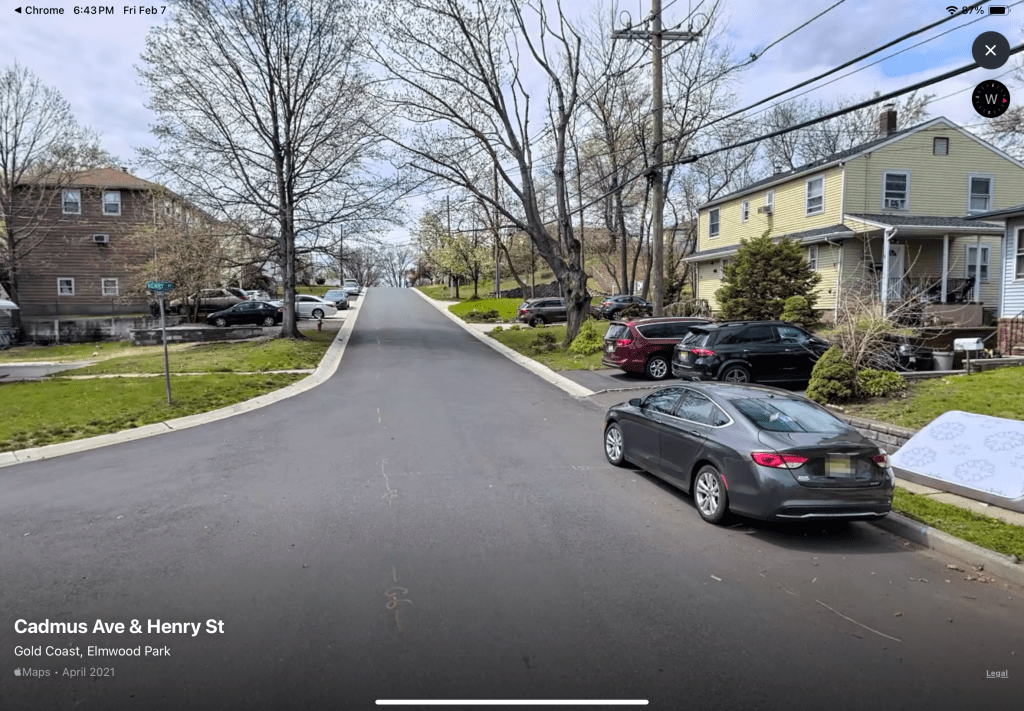
We rode through the Cherry Hill School complex and struck Cadmus Avenue. After riding about 200 yards from our home, we encountered the steep grade of Cherry Hill. Again, when you are a kid, it was the equivalent of Mount Everest, so we both dismounted and Ken walked the bike up the hill. Reaching the summit of the hill, climbed back on the bike and began to roll down the back side of Cherry Hill. This is where the adventure begins.

From Google Maps, beginning of downward slope of Cherry Hill.

On the downward grade, instead of coasting and braking, Ken began to pedal like a mad man. I yelled in his ear, “What are you doing!”

Ken’s reply was a maniacal laugh, and he pedaled harder. I wrapped my arms around his waist as we jetted down the hill. I didn’t close my eyes, because I was desperately looking for modes of escape. The road took a sharp turn to the right and I was terrified we weren’t going to make it. That we were going to be embedded in the living room wall of my friend Billy Stewart’s house, which was right at the curve.

From Google street view. The fist curve on Cherry Hill. My friend’s house is the one with the silver car in the driveway.

Ken pedaled furiously through the curve and fate was kind, we made it without mishap. But the road took an even sharper, 90 degree turn to the left. I knew we weren’t going to make that one. I was yelling for Ken to slow down. He just giggled.

Reaching the intersection, Ken maybe realized I was right. We were going too fast to make that sharp of a turn without disastrous consequences. He made a slight correction to the left, heading straight toward a hedge surrounding a house at the intersection. I thought he was going to try and soften the blow by running into the hedge versus getting most of our skin erased by the pavement. A husband and wife were doing yard work at the house. I envisioned them bandaging our wounds and driving us home with the wrecked bike in the trunk of their car. Somehow, Ken spotted the narrowest of openings in the hedge and we rocketed through it, unscathed. We passed between the startled husband and wife at the speed of light, Ken now aiming the bike to a wider opening in the hedge. I heard a woman’s voice screech “Trespassers!” But we were safely out of the yard, on the sidewalk, speeding away from the angry couple. Ken never stopped laughing throughout the whole yard ordeal.

From Google street view, the 2nd turn. The two family house was not there in 1965. There was a waist high hedge.

The rest of the trip to the deli was uneventful. Wisely, we both decided to take a different route home, about a half mile longer than the wild ride route. Ken and I made it home safely, the perishables hadn’t perished..

The home whose owners we terrorized was along my paper route. Fortunately, they were not customers of mine. Every time I walked past, if they were working in the yard, I would be preoccupied rolling a paper, head down, making no eye contact. Initially, not too long after the incident, they would eye me suspiciously. But no questions were ever asked.

Fly (off the handle) Fishing in America

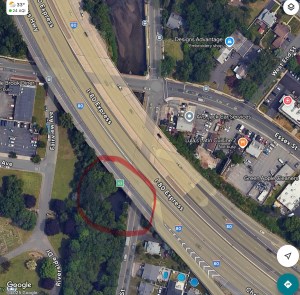
Saddle River flows beneath Route 80 in this Google Maps image. The area circled in red was the spot we fished from many times in 1966 – 1968.

By the summer of 1967, my brothers, my friends, and I fashioned ourselves as seasoned anglers. Pouring over issues of Field & Stream and Outdoor Life, watching the Joe Foss outdoor series, The American Sportsman on TV, we knew which fishing lures were good for catching trout, and which ones were good for catching bass. We caught no bass, but we had the best lures. We purchased some stuff called Buss Bedding and maintained worm farms. Red worms for trout, night crawlers for every other species of freshwater fish. Everything we knew and practiced was for using spin casting rods and reels (produced by Mitchell-Garcia, THE BEST, according to Field & Stream magazine).

    Cliff, one of the kids in our group, puzzled us with his declaration that he wanted to try fly-fishing. We had no experience in this mode of fishing. The equipment was entirely different. Fly-fishing uses a longer, much more flexible rod and a simple reel. Second, it required a certain level of skill to cast and place the bait – something that resembled a fly. It had to land lightly on the water’s surface. You couldn’t use a weight or lead sinker. We looked at Cliff like he had two heads. “What do you know about fly-fishing?” We asked.

     “I watched The Flying Fisherman on TV. I know how to do it.” Cliff said with great confidence, “I’m going to try it the next time we go fishing!”

    “Cliff, we are going to the Saddle River. There are no trout in that river,” we tried to reason with him.

     He squinted at us, much like a wizened old angler would, and said, “That’s because we aren’t using the right bait. Trout like flies.”

     That settled it. Cliff was going to try fly-fishing in a river known as a home for carp, catfish, whatever washed off the Route 80 overpass in a rainstorm, an occasional tire and an abandoned shopping cart or two.

     It was a beautiful late June day for our fishing excursion. Gathered in front of my house were 9 accomplished pre-teen anglers; my brothers and me, the two Garys, brothers Mike and Dean, and the brothers Cliff and Robert. With fishing rods in one hand, a tackle box in the other we lined up like a squad of soldiers and trooped off to our Saddle River fishing site. Cliff was really excited about fly-fishing. Over the course of our two-mile journey, he bragged about the fly lure he bought and talked up the number of trout it was going to catch for him. He carped against our comments about that section of the river being only suitable for carp. For the rest of the hike, we tuned out Cliff’s droning and thought about how many carp we would catch, and that Cliff would get skunked.

   Finally arriving at our destination, we broke out our gear attaching hooks and sinkers, applied our bait, and cast our line into the murky waters of the Saddle River. Typical with most fishing events involving the brothers Cliff and Robert, things were about to go sideways.

   It became readily clear that Cliff had not the foggiest idea of how to fly fish. He started swinging his fishing pole overhead in a frenetic fashion. He looked like a stagecoach driver whipping a team of horses. His fly-bait dangled but a few inches from the tip of his fishing rod. Perplexed, he switched his stance and, using both hands, started swinging his fishing pole as though it were a baseball bat. He now looked like Mickey Mantle taking batting practice. We gave him a wide berth for fear of getting snagged by the fly hook. While he was flailing away, the rest of us reeled in carp and goldfish. As a testament to the quality of the Saddle River, my brother, Ken, reeled in a discarded Wonder Bread bread bag. Inside of the bag was a live goldfish, still counts as a catch!

   Cliff finally wearied of his fly-fishing flailing and plopped down on the ground, breathing heavily, his face covered in sweat. Seeing the rest of the squad having some moderate success catching fish, he quietly removed the fly from his fishing line, attached the standard hook and sinkers, and pulled a worm from his brother’s bait can.

    Robert, meanwhile, had seen some carp jump out of the water in the middle of the river. He had caught nothing yet and attached a sinker heavy enough to enable a cast to where the fish were. He chose a pyramid shaped, 2-ounce sinker for the job. Starting his casting motion, the fishing line slipped from his finger on his backswing. The line shot straight back; the sinker striking his brother, Cliff, right in the mouth. Cliff screamed and doubled over. Robert turned and looked at his brother, dumbfounded.

    Cliff straightened and removed his hand from his face, revealing a small split in his lip. His face was red, his eyes even redder. “Robert! You bastard! I AM GOING TO KICK YOUR ASS!” His snarl turning to a screech. He charged at his brother.

    It was now Robert’s turn to screech. The only thing on his mind was flight, so he took off in the only direction he could. Into the river he ran, fishing pole in hand, the 2-ounce sinker dragging behind him, leaving a small trail in the sand. We guessed he decided drowning the better option to getting his ass kicked. Robert’s plan worked. Cliff wouldn’t venture into the river. Instead, he jumped up and down on the shoreline, howling invectives at Robert.

   For his part, Robert was able to work his way up-river past a point where the shoreline disappeared, and Cliff couldn’t follow him. He screamed back, “I’m going home to tell Mom you swore at me!” Then he climbed out of the river, covered in muck from the waist down.

   Cliff stood silently now, clenching and unclenching his fists. He turned and walked over to his tackle box to pack up his gear. “I have to go now, my mouth hurth.” His injured lips had swollen to the point where he now spoke with a lisp.

   The rest of us had enough excitement for the day, so we packed up our gear, grabbed Robert’s tackle box and trudged off towards home. We caught up with Robert. He hadn’t gotten too far. We spotted him sitting on the step of a pharmacy, crying. He saw us approaching and yelled, “I’m sorry Cliff! It was an accident.”

   Cliff was much subdued now. From his swollen mouth he lisped, “I know it was an acthident. Pleath don’t tell Mom I thwore.” We all walked the rest of the way home in silence. Cliff never attempted to fly fish again, nor did he ever bring it up in conversation.

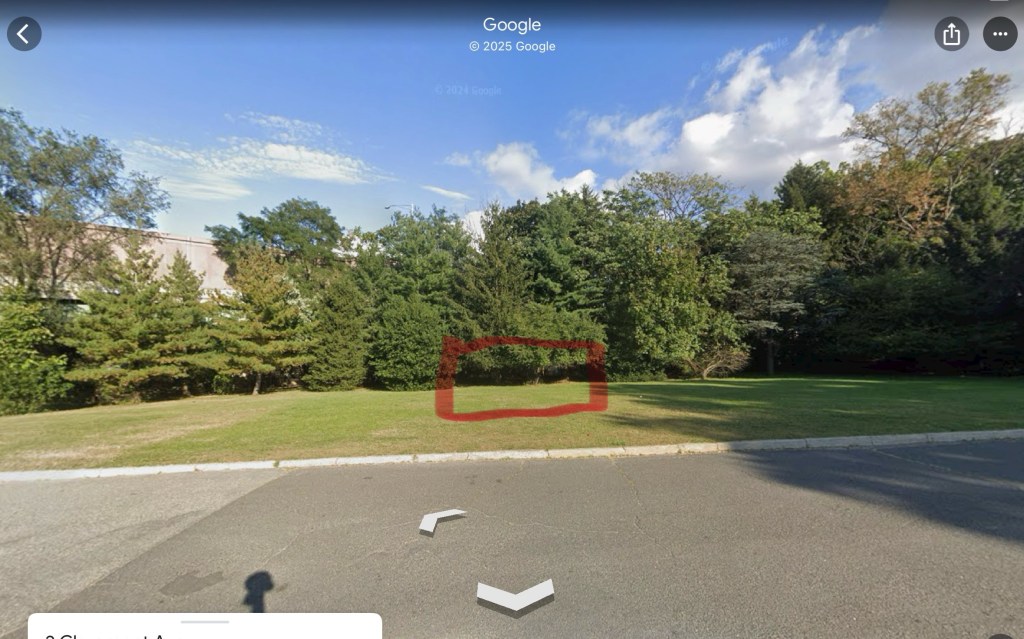
Ground level Google Maps view of tree line along the Saddle River. In the 57 years since my story took place, the trees have grown substantially. The red square was clear of trees when we fished there, that was our approach to the river. There is a fence there now, behind the trees.

A Father’s Sorrowful Search

Civil War artist Samuel Ward captured Lt. Bayard Wilkeson in action.

This historical fiction story was written to the prompt “In peace, sons bury their fathers. In war, fathers bury their sons”, a quote from Herodotus. The fictional characters are Captain Bartlett and Sergeant Boyle. Samuel Wilkeson, Lieutenant Bayard Wilkeson, Major Thomas Osborn and General John Buford were present at the Battle of Gettysburg. With two exceptions, all of the dialogue between the characters is fictional. See my notes at the end of the story.

Gettysburg, PA, July 4, 1863
The rain was falling in sheets as Bartlett and his aide, Sergeant Boyle, reined their horses to a stop in front of the Fairview Cemetery gatehouse.
    “Ahh, this weather’s manky, sir. Truly ‘tis!” Boyle exclaimed.
    Bartlett smiled from inside the hood of his rubber poncho. “Manky. I’ve not heard you say that since Fredericksburg, Sergeant Boyle. This isn’t nearly as bad as that.”
    “For sure it’s not Captain. I’m just a tad surly after three days of racing all over this battlefield, dodgin’ every shot and shell the Johnnies could throw at us.”
     Bartlett nodded his head in agreement. The horrors he had seen over the past three days left him feeling numb. Gettysburg was not his first battle by far, but it was the most savage one he had been part of. Maybe because they fought to repel an invasion of northern soil. “Sergeant let’s get off these nags and take shelter in the gatehouse arch,” he said.
      Under the cover of the arch, they shook the rain from their ponchos like two golden retrievers and tugged off their hoods. From where he stood, Bartlett could see the stretch of the Baltimore Pike toward army headquarters.
     Boyle flipped the poncho over his shoulder and pulled a watch from his vest pocket. “When are you expecting the man from the New York Times, Captain, sir?”
    “Any minute now.”
    “If you don’t mind me askin’, sir, but do ya really think your friend, I mean Mr. Wilkeson’s son, might still be alive?”
     Bartlett inhaled deeply and let out a long sigh. “I don’t know, Sergeant. Major Osborn saw Lt. Wilkeson being carried away from his battery. His right leg was gone.”
    “Your man, Lt. Wilkeson, is a tough nut, sir. I heard his leg was mangled by a round shot that went through his horse. I heard he used his pocketknife to finish what the cannon ball started.”
    Bartlett sighed again and turned his gaze from Boyle to the Baltimore Pike. The heavy rain had lightened to a misty drizzle. Plodding towards them along the Pike was a team of horses hitched to an ambulance. Next to the teamster, Samuel Wilkeson sat bolt upright, shoulders squared, and head held high. His hands rested on his thighs.
     “Here they come,” Bartlett told Boylan. He walked out from the cemetery gatehouse to the middle of the Pike and raised his hand to halt the ambulance.
     “Good morning, James. To what do I owe the honor?”
     He noted Sam Wilkeson’s flat voice before saying, “Sergeant Boylan and I would like to help you look for your son.”
     “I would be honored,” Wilkeson’s voice trembled, “And please, sit with me. I need a friend to talk to.”
     Bartlett nodded, tethered his horse to the ambulance and climbed aboard and squeezed next to Sam. With a snap of the reins, the wagon jerked into motion and rolled towards town. Sergeant Boylan guided his horse to fall in alongside.
     After riding along in silence for a few moments, Sam Wilkeson turned to face Bartlett and said, “Thank you again for offering to help James. But I know where Bayard is. Major Osborn said he was carried to the Alms House after receiving his wound. I suspect he is still there.”
     “I know where that house is, Mr. Wilkeson. I saw it early in the morning of July 1st while scouting with General Buford. So, Bayard has been behind Rebel lines for the past three days.”
     “Yes. I pray he received adequate care from their surgeons.”
      The ambulance rolled slowly along the road through town. Sam Wilkeson spoke again. “James, the survivors of Bayard’s battery told me they were ordered to an exposed area. Rebels were firing on them from three directions. They fought back hard. The Rebs swept the remaining Yankees from the field after Bayard got wounded. He should not have been sent there. Bayard should not…” his voiced trailed off. He let out a long sigh and said no more.
     The ambulance passed through town and came to a halt in the yard of the Alms House. Wounded soldiers were everywhere. Bartlett and Wilkeson climbed off the wagon. Joined by Sergeant Boylan, they walked through the door into a den of pure misery. The cries of men being operated on, the sights and smells, were overwhelming.
     Bartlett stopped a medical attendant who tried to scurry past them. “Excuse me, this man is looking for his son. He was wounded on July 1st.”
     “Name? What’s his name?” The impatient attendant asked.
     Sam Wilkeson tried to hide his anger, but it was clear when he spoke, “Lt. Bayard Wilkeson. Battery G, 4th U.S. Artillery.”
    “Don’t know him.” The attendant pulled free from Bartlett’s grasp and hustled off.
    “Sir, we know where your son is.” The soft voice startled the three men, and they turned to see two young women approaching. “We took care of him after he was brought here.”
    Wilkeson’s shoulders sagged. “Cared. You said cared.”
    “Yes sir. We’re sorry, he passed on the evening of July 1st. We stayed by his side to the end.”
    His voice was heavy with emotion, Wilkeson asked, “Where is he? Can you take me to him?”
    The women led him out of the building to a mound of dirt beneath a tree. Bartlett and Boylan trailed along. Wilkeson stared at the ground where his son rested. Falling to his knees, he placed his hand on the grave and cried out in anguish, “He was only 19 years old! Dear God.” Sam Wilkeson sobbed.
     Boylan looked away and noticed Bartlett wiping tears from his face. Tossing aside regulations, he laid his arm over his commander’s shoulders. “I’m profoundly sorry for the loss of your friend, sir. I truly am. He was a fine man.”
     “Thank you, Sergeant Boylan. We will miss him forever. Like so many in this war. Now he sleeps the sleep that knows no earthly waking.”*
     Boylan turned his gaze back to the scene at the grave. “‘‘Twas it Herodotus, sir? Who said ‘In peace, sons bury their fathers. In war, fathers bury their sons.”
     “It certainly was,” replied Bartlett. Patting the sergeant on his back, he said, “Let’s see what we can do for Mr. Wilkeson.”

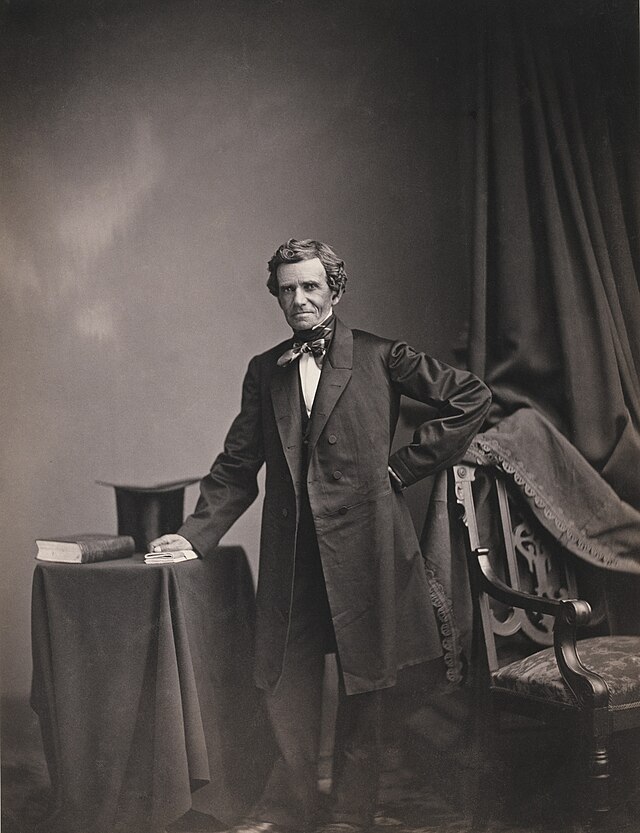
Samuel Wilkerson, Jr.. War correspondent for New York Times and father of Bayard Wilkeson.

Lieutenant Bayard Wilkeson, commander of Battery G, 4th U.S. Artillery.


Notes
1)    The Wilkeson’s were a prominent family from western New York. Samuel Wilkeson’s father was one of the founders of the city of Buffalo and his wife was the sister of suffragist Elizabeth Cady Stanton. After working for Horace Greeley and the New York Herald, Sam Wilkeson joined the New York Times as a war correspondent and was reporting on the battle of Gettysburg when he learned of his son being wounded on the morning of July 1st.
2)    Nineteen-year-old Lieutenant Bayard Wilkeson was a rising star in the Army of the Potomac and led Battery G, 4th U.S. Artillery. On the morning of July 1, 1863, his battery wreaked havoc on the Rebels advancing on the town of Gettysburg. So efficient was his leadership, Rebel artillery commanders ordered their gunners to aim directly at the young Lieutenant, prominently exposed on horseback. An artillery round struck the horse, passing through it and mangled Bayard’s right leg. He used his pocketknife to sever through the couple of tendons still connected to his leg. Carried to the county poor house, he died from shock and loss of blood the evening of July 1st.
3)    The words, “sleeps the sleep that knows no earthly waking” were not spoken by my character, James Bartlett. They appeared in a letter of condolence written to Samuel Wilkeson by Eunice Beecher. Eunice was the wife of noted minister, orator, and abolitionist Henry Ward Beecher. Her sister-in-law was Harriett Beecher Stowe.
 

Bummer Of A Summer

What was to be the 70th summer of my life became the summer of the fight of my life. In June, an MRI revealed a blockage in my bile duct which turned out to be cancerous. In July, I underwent a surgical procedure called the Whipple. I am currently undergoing an aggressive chemo and radiation therapy program that will continue into February of 2025. I feel very confident that I am going to be ok. Also, I feel really, really good! Better than before my surgery. I feel so good, it is difficult to wrap my head around the fact that there is anything seriously wrong with me.

The writing prompt for the Chatham Memoir Group was “Angels In My Life”. For some reason, Jackson Brown’s song, “These Days”, popped into my head and I started scribbling down words to fit the tune. Please keep in mind I don’t consider myself to be a poet, but my effort to fit the prompt and the song follow.

Angels In My Life

Ernie Stricsek©

I was told that I had cancer

Of the cause there was no answer

Those days

I was full of anger, dread, and tears

Then the angels of my life drew near

And I saw I had nothing to fear

My wife is my first angel

Of her love and devotion, she’s so giving

These days

She has made me feel not afraid

To live each day as all is fine

And that I’ll be around for a long, long time

My other angels are so many

Family, friends, and Doc’s give me reasons

All of these days

These days I think and hope

Their love and care will guide me through more seasons

I’ve been given a second chance

The rest of my life will be a different dance

To Be, Or Not To Be…

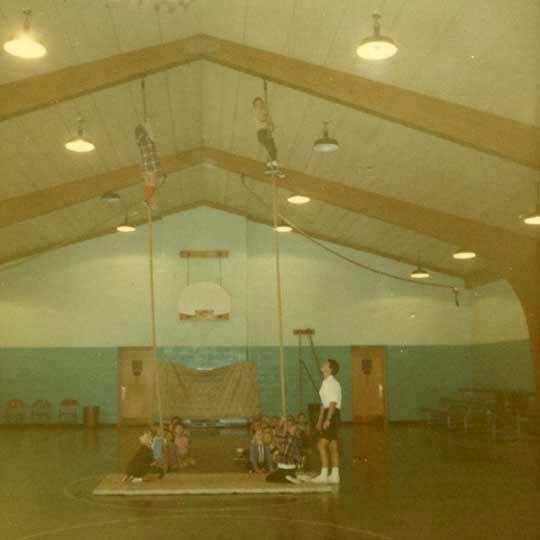
Photo of gym class ropes from Reddit. Like those kids spotting are going to arrest someone’s fall, or those postage stamp thick mats will prevent a bone break!

The prompt for the Chatham Writers Group was from The Bard himself: “To be, or not to be? That is the question.” I don’t know what made me think of climbing ropes in gym class. My memoir follows.

To Be or Not To Be…. A Memoir

Ernie Stricsek©

     “To be, or not to be? That is the question. Whether ‘tis nobler to suffer the slings and arrows” of misfortune. Or feign illness and not go to school tomorrow. It was late fall, 1968, and I lay in bed, struggling with a decision that I must make. For you see, the next day in gym class we are supposed to climb ropes. In another place and time, like 1966 in New Jersey, I was a total failure for this activity. At that point, I had difficulty with synchronizing my arms, legs and feet to propel myself 100 feet up with a coarse rope to the ceiling of the gym. It probably wasn’t 100 feet, maybe more like 30 feet, but to me the rope appeared to reach the sky. I remember stepping up to the rope, grasping in my hands and wrapping around my ankle to get a hold with both feet. My efforts in trying to climb were all motion and no progress. Eventually tiring, I would just swing back and forth. The gym teacher stalked over and shouted instructions. I closed the gap to the ceiling by maybe six inches. Disgusted, he told me to go sit “with the girls”. Those who were as unsuccessful as me. There were two other guys there, but he didn’t mention them.

     The gym teacher apparently felt becoming a master at the climbing arts was essential to success later in life. He waited for the Parent/Teacher Conferences to tell my parents about my failure. I envisioned him sitting in the gym’s corner before calling them in, taking a sip of carrot juice and swirling around in his mouth before swallowing. Then rubbing his hands vigorously before cackling in a ghoulish voice, “Ha! The Stricsek’s. Wait’ll they hear about their son! BWAH HA HA!”. He told my parents I was overweight and out of shape. If I didn’t learn how to climb a rope, my life was over.

     “Ernest’s future is bleak. He’ll be lucky to find employment if he can’t climb a rope. He might as well pick out a good-sized appliance box and look for a place to live alongside the Passaic River. Beneath the Route 46 bridge, so he stays out of the rain. Yes. Cardboard Village, beneath the Route 46 bridge.”

     That stuff about the appliance boxes and living under a bridge I totally made up. But he did talk about my weight and lack of physical ability. I don’t know how he figured I was out of shape. I lugged 60 pounds of newspapers on foot, every afternoon, six days a week. I rode my bike everywhere and walked miles to go fishing on Saddle River. But in the gym teacher’s mind. I was a slug.

     Two years later, I’m in a new place. In a new school. It’s 180 miles from my New Jersey home and I don’t know anyone. In a way, this is a new start for me. Nobody knows of my rope climbing folly. Not yet anyway. As it is, living in the New York City metropolitan area for all my 14 years, I dress differently and speak differently that the kids in this rural community. Someone pointed out that my shoes, which all the “cool” kids in my former school wore, looked like “old man shoes.” They weren’t the dorky penny loafers worn by most of the kids in Middletown. My hair was slicked back (when I still had hair) and not combed forward over the forehead. My shirts had high roll collars. I heard someone call me “Nicky New York”. After the first two months in this new place, the comments slacked off. In gym class, much to my surprise, I developed some football and basketball skills and gained a level of respect. But now the gym class curriculum had advanced to the dreaded ropes. I was in a quandary about what to do. I tossed and turned all night.

     The following morning, I made my decision. Or someone decided for me. My mom said, “I think you’ll feel better as the day goes on.” So, it was off to meet my fate.

     Gym was not until third period, and I sat in my Algebra and English classes staring out the windows. When the bell rang at the end of the session, I retrieved my blue denim bag with sneakers and gym clothes and trudged through the hallways like I was walking “The Green Mile”. As my classmates and I filed into the gymnasium, the gym teacher directed us over to the corner, where four ropes hung from the high ceiling. I had a sinking feeling because it was higher than the one in my 6th grade school. Assisting the gym teacher with “spotting” the climbers was the head football coach. His penetrating blue eyes flashed above a sneering smile.

     I pause in my narrative to ask what does “spotting” even mean? If a 150 lb. kid loses his grip on the rope and plummets to the floor, nobody’s going to try and catch him! The average person is going to yell “LOOKOUT!” I guess that’s what it means – I spotted someone falling and warned everyone on the ground. Back to my story.

     After receiving the briefest of climbing instructions, the activity began. The gym teacher and head football coach shouted different encouragements to the climbers.

     “You can do better than that! C’mon!” shouted the gym teacher.

     “Is that the best you can do? Damn good thing Charlie ain’t behind you with a bayonet! See how fast you climb then!” encouraged the head football coach. It was 1968, he was fond of using Vietnam references.

     Then it was my turn. The football coach handed me the rope, positioned my hands, legs, and feet, and said, “Let’s see how you do!”

     I did it! I began slowly, but realized I could do it and went faster. We were to climb the rope and touch the bar it hung from before coming back down. I was fearful of letting go, but I touched the bar and started down. My descent didn’t go as well as my climb. I came down too fast, and the rope left a foot long burn on my right calf. But I did it!

     I told the coach I had never done that before. He gave me a look of surprise, then took the time to show me how to come down the rope without burning my leg. “You did good,” he said.

     I stopped looking for empty refrigerator boxes that day.