Relaxing On The Rhine

Cologne Frankenwerft on the Rhine River in the 1930’s. The setting for my story.

The prompt for the Sturgis Library Writing Group this past week was “relaxing”. My story is a sequel to the one I wrote some time ago called “Lisa”. The location and time frame is Cologne Germany in the 1930’s.

Relaxing on the Rhine

Guido Mara stepped off his barge and climbed the steps to the wide promenade fronting the Rhine River in Old Town Cologne. After fifteen years as an inspector in the criminal police, or Cripo, he was on his way to tender his resignation. Disgusted with the disturbing rise to prominence of Hitler, his National Socialist Party, and the intrusion of its secret police into day-to-day Cripo activities, Guido decided it was time to move on. He managed to secure several contracts to transport freight on his barge, Lisa, to and from ports along the Rhine between Cologne and Rotterdam.

As he stepped onto the promenade, he spotted two men wearing long, black leather trench coats with gray fedoras pulled low over their eyes, approaching him. 

“Gestapo! Bloody Hell,” he muttered to himself.

“Good morning, Inspector Mara. It seems we managed to catch you just in time. Were you going somewhere special?” asked one of the men. He was rail thin with a skeletal face. The eyes above his smile were icy, penetrating, searching.

“Just on my way to headquarters. How can I help you, gentlemen?” Guido fought to remain calm.

“You were observed last night carrying a couple of large sacks across the promenade to your barge. Onlookers thought it suspicious. May we have a look?” the second man asked in an officious tone. His jowly cheeks and upturned nose made Guido think of one word, “Swine.”

“Of course, you may look,” answered Guido, “We were with some of your colleagues searching for vagrants. I discovered a boxcar with several sacks of potatoes trying to avoid detection, so I brought two of them to my boat for questioning. I determined they were indeed potatoes as well as fit for consumption.”

“Jews. You were searching for fugitive Jews. Inspector Mara, not vagrants,” said the swine, “I find your humor disrespectful.” Contempt hung from every word like an icicle.

“I meant no disrespect, sir. Let me take you aboard.”

The skeletal man held up his hand, “NO. You will remain here. We will call you down if we have any questions.”

As the Gestapo agents went to search Guido’s barge, he lit a cigarette and scanned the shops along the promenade. He spotted one of the fishmongers staringat him. Guido waved to the man and called out, “Good Morning, Herr, Schiller! Were you keeping an eye on my boat last night? Thank you!”

In response, the man shouted back, “Bah!” and walked back into his fish shop, shaking his head. Guido chuckled, then pitched his cigarette into the river. The Gestapo officers were calling him to come on board his barge.

They made Guido open the lockers on the deck where all the life jackets and tarpaulins were stored. 

“We see no potatoes,” the skeletal Nazi said.

“Because they are the galley pantry, sir,” replied Guido, “I’ll show you.”

The agents inspected the galley pantry and made Guido open the lockers in his and the crew member’s quarters. After searching the engine room and examining the bilge with Guido’s flashlight, they removed their hats and wiped sweaty brows. 

“What exactly are you gentlemen looking for?” Guido asked.

The skeletal man said, “It appears the information we were given was inaccurate.” He looked at his watch, smiled at Guido, and said, “We’ll leave you now. You will be late for work.”

The other officer said, “It must be nice living on a boat. I think the gentle lapping of the river would make it very relaxing for you.”

Guido ushered them off the barge and began securing its lockers and crew cabins. Entering the galley, he opened the pantry doors and removed the potatoes and some canned goods, exposing the teak panels of the pantry’s back. Giving a gentle push on one of the panels, it sprung open slightly. Removing it completely, he poked his head into a small compartment hidden behind the pantry. 

He smiled at the two children huddled in the compartment’s corner.  “Hello again, Rachel and Paul. Everything is fine; you kids did well. I am going out again. The same rules as before. If you hear people moving about, don’t make a sound until I open the panel.” Their heads bobbed in agreement.

Rachel Edelman asked, “Will you be looking for our Poppa, Herr Mara? The police took him last night. You’re a policeman.”

“I’ll do my best to find him, little Rachel. But he was taken by different police. I’m going to close things up again.”

When everything on the barge was secure, Guido climbed the stairs back to the promenade. He turned to give one more look to the Lisa. “It’ll be some time before I’ll truly be able to relax again.”

Ernie Stricsek

The Sturgis Writers Group

August 29, 2023

Small Mercies

Fog shrouded Edisto River, the setting for my story. Photo from The Friends of The Edisto River website.

The prompt for the Tuesday meeting of The Sturgis Library Writing group was “Small Mercies”. About two years ago I started a story about a husband and wife team of law enforcement officers in the Huntsville, Alabama area who get involved in the search for a young girl believed to be abducted by human traffickers. I didn’t finish the story, which is a story in itself. While we were vacationing in South Carolina this past winter, we drove past a turquoise and pink painted motel near the Edisto River and it thought it would make a great story setting. My tale follows.

Small Mercies

An early morning fog blanketed the Edisto River and its inlets.  Fingers of mist stretched into the creeks that fed the river and into the pine trees that lined its shore.  The black waters of the river lapped gently against the sides of an irregular row of four small fishing boats anchored about 25 yards from the shoreline.  There were two occupants in each boat, their fishing poles extending out over the water.  However, none of the people fishing paid attention to the red and white plastic bobbers floating on the river’s surface, they couldn’t care less about the large and small mouth bass the Edisto was famous for.  What they hoped to catch was suspected to be in the Edisto Motor Lodge, enveloped in the mist about 50 yards from their boat.

In the last boat in the line, Limestone County Detective Sergeant Lucinda, or Lucy, Amberson and her husband FBI Special Agent Derek Amberson huddled in the morning dampness.  They had been on the trail of human traffickers who were suspects in the abduction of 7-year-old Niecy Lawrence who had disappeared on her way home from school.  The tips and leads they’ve received had led them on a journey from Decatur, Alabama to this damp skiff on the Edisto River trying to peer through the fog to observe the flea bag motel in no-where-land, South Carolina.  The Ambersons and the FBI agents in the other boats were all awaiting the command to rush the building, arrest the traffickers and rescue Niecy.  Other agents and police officers would approach the motor lodge from the trees and high grass lining Route 17.  Hopefully without any gun play. 

“I don’t like this, Lucy.  We can’t see that shit box hotel through the fog.  And why aren’t there any agents posted to watch the fishing camp downriver?”  Derek’s rich bass voice had an edge to it.

“I feel the same Derek.  But that county sheriff was dead certain our suspects are in the motel.”

“Right, but he was too quick to answer, like he was…”

Before Derek could finish expressing his concerns about the county sheriff, the command to rush the motor lodge barked over their radios.  The boats fired up their engines and sped to the shore, an agent poised in the front of each boat to leap once land was touched. The boats to the right of the Ambersons startled a siege of Blue Herons which flew from their rookery with a great deal of noise.  They flew low and close to the water, aiming directly for Derek’s head.  Ducking and turning to avoid the onslaught, he spotted a small skiff dart out into the river from a narrow inlet and turn downriver into the fog.  There appeared to be four large forms hunched around an object in the middle of the skiff.  Derek shouted to Lucy to turn and follow the boat before it was swallowed up in the mist.  He then shouted into his radio to alert the other agents of the suspicious boat.  No other boats were supposed to be on the river while the raid was underway.  Lucy sped their boat into the mist, the other boats trailing at a distance behind them now.

It was no small mercy that the fog thinned as the Edisto River neared the seacoast.  The suspicious skiff burst from its gray cloak and directly into a semi-circle of Coast Guard small response boats.  The skiff’s engine was cut and its occupants, four hard looking men, raised their hands.  Between them was a lump covered with empty rice sacks.  The Amberson’s boat spit out of the mist behind the skiff and came to a stop on its starboard side.  With his pistol, Derek motioned to one of the skells to lift the sacks away from lump.  As the last sack was lifted a young boy of about 10 years old sprang up, sputtering and crying.  Lucy nudged closer to the skiff.  Derek extended his arms to the boy and pulled him to the safety of their boat.

“What’s your name son?  How old are you? Where are you from?” Asked Derek.

“My name is Anthony Taylor, sir.  I am 9 ½ years old and I live in Savannah.”

The Ambersons soon discovered Master Taylor had been abducted only a week prior to his rescue.  The four men arrested were indeed part of human trafficking ring based in the Balkans.  

“It’s a small mercy that Blue Heron almost took your head off Derek,” said Lucy, “or you would never have seen that skiff slip out into the river.”

Before the end of the day, the Amberson’s would receive a tip that a girl meeting the description of Niecy Lawrence had been seen in Georgetown, South Carolina.  

Ernie Stricsek

The Sturgis Library Writing Group

June 27, 2023

Choices

The writing prompt for last Tuesday’s Sturgis Library Writing Group was the photo displayed above. The source of the photo is Anders Saling who is spending the summer on Cape Cod as the team photographer for the Harwich Mariners of the fabulous Cape Cod Baseball League. I encourage everyone who reads this story to visit Anders’ website “Salingmedia.com” to see more of his terrific sports photos and portraits. Thank you Anders for allowing me to post your photo on my blog.

When I saw this photo, for some reason I was immediately drawn to the experiences of former Major League Ballplayer George “Doc” Medich. Twice during his career he leapt into the stands to administer CPR to fans who had suffered heart attacks during the ballgame. At the time, in addition to his pitching duties, “Doc” was a student at the University of Pittsburgh School of Medicine. My story that follows is completely fictional.

Choices

Aaron Henry, first baseman for the Mashpee Mollusks of the Cape Cod Baseball league, had finished his warmup throws and began a few exercises to stretch his leg muscles. He paused a moment during his squats to reflect on the argument he had with his dad the previous night.  As much as Aaron loved baseball, a game he began playing when he was five years old, he had begun to feel it was not going to be his life’s goal.  His experiences over the two summers he spent as an EMT with the volunteer fire department in his hometown had convinced him his true calling was to be a doctor, a surgeon. His academic prowess, along with his baseball skills made him a highly sought after scholar/athlete. His choice to attend a small liberal arts college disappointed the recruiters from all the major universities and Ivy League schools, but he was drawn to the school’s neuroscience program.  He argued with his dad about leaving the Mashpee team mid-season to attend a seminar on the use of stem cells in battling Parkinson’s Disease.  His father was adamantly against it.  “You are the most sought-after college baseball player in America,” his father declared, “I don’t know where this Doctor stuff is coming from.  With signing bonuses, in your first minor league season alone you’ll make 5 times what any Doctor makes.”

“It isn’t about the money,” he told his dad, “There are no guarantees of a long, lucrative career in any sport.  Jim Bouton once said, ‘you spend a great piece of your life gripping a baseball, only to discover it was the other way around, all the time’. I don’t want that to be my life.”  

“Jim who? Sounds like a loser to me and you sound like a fool!”  The phone call ended.  In his crouch, Aaron stared at the grass, seeking an answer.  His thoughts were disrupted by the shouts of his teammates calling him to the dugout for the coach’s pep talk.

When the National Anthem ended, Aaron pushed the argument from his mind and gave his full concentration to the game.  Going into the bottom of the 9th inning, Mashpee held a slim one run lead over Chatham.  With two outs and runners on 2nd & 3rd  bases, the Chatham batter fouled a pitch high into the air along the first base side of the field.  Seemingly an easy, game ending out, Aaron drifted to his left, tracking the ball’s trajectory.  He glanced down for a moment to check his distance from dugout when he spotted a woman in the stands clutch her chest and fall to her side.  Her husband, startled at first, realized what was happening and began to cry out for help.  Aaron’s attention was no longer on the ball as it bounced near his foot.  Shouting to the Mashpee team trainer to bring the first aid kit, Aaron vaulted the fence and was next to the stricken woman in two leaps. 

Kneeling and leaning close to the woman’s face, he observed she was not breathing and immediately began to perform CPR.  After a few chest compressions, the woman choked, moaned and began to breath on her own. He was able to get her to take an aspirin.  The EMT’s from the Chatham Rescue Service arrived and rushed the woman to the hospital.

The game eventually resumed.  With the missed foul ball, the Chatham player was still at bat and lined the next pitch out to the fence, driving in both runners and, thus, winning the game.  But the celebration became surreal as the players and coaches from both teams rushed to the field and surrounded Aaron, giving him hugs and shaking his hand.  They were soon joined by a crowd of fans.  The outcome of the game was never remembered, what lingered in everyone’s memory was on that June day, Aaron Henry saved someone’s life.  On that day a decision was reached.

In the second round of the Major League Baseball draft, Aaron Henry was selected by the Pittsburgh Pirates.  He shrewdly invested his $750,000 signing bonus, and after two minor league seasons, began classes at the University of Pittsburgh Medical School.  

Post Script: if you didn’t catch on, the name of the character in my story is in reverse order of one of my favorite baseball players, the Hall of Fame member Henry “Hank” Aaron. Also, if you haven’t read it, I recommend “Ball Four” by Jim Bouton. It has the distinction of being listed in the New York Public Library’s Books of the Century, the only sports related book on the list. It is also identified by Time Magazine as one of the 100 greatest non-fiction books published.

Ernie Stricsek

The Sturgis Library Writing Group

June 20, 2023

Last Gas Station In America

“Gas”. Edward Hopper painting, 1940

The prompt for the Chatham Writers Group for Monday was the Edward Hopper painting titled “Gas”. My fiction story follows.

End of the Line

The whitewashed building and red gas pumps of Mal’s Derby Line Mobil station stood in sharp contrast to the deep green pine trees that rose behind it.  The last rays of the setting sun lent a golden hue to the dry grass that bracketed the Derby Line Road.  The black top road melded into the darkness of the dense pines so much that it appeared to end just past the station.  In fact, the road continued East for 100 yards before making a sharp left turn and crossed into Canada.  

It had been over an hour since the last car had stopped to fill its tank at the station so Mal Devine decided to close for the day.  He folded and stowed away the cheeky sandwich board sign that warned drivers “Last gas station in America”, locked the gas pumps and was preparing to move the cans of Mobiloil into the service bay when his peripheral vision caught movement inside the sales office near the cash register.  Startled, he blinked several times to make sure his eyes weren’t playing tricks.  No, there was movement in the office!  Shadows near the register for sure.  His mechanic had left right after the last customer stop, there shouldn’t be anyone else but him at the station!

Pretending to have not seen anything, Mal planned to slip into the office after securing the oil display cart.  However, the moment he entered the service bay, a voice behind him said, “Don’t do anything to make me hurt you Mr. Devine, but I need all your cash and I need it now!”

Mal’s brow furrowed; he recognized the voice.  He put up his hands.  “I won’t do anything rash. I am going to turn around, if it’s okay.”

“Real slow, I don’t want to hurt you, but I will if I have to.  Please, just give me your cash, Mr. Devine. And I’ll be on my way.”

Doing as he was told; he came face to face with the robber, who’s partially raised arm brandished a tire iron.

“Teddy Dobbs, what’s wrong? Why are you doing this?”  

Teddy stepped towards Mal, grabbed him by his necktie and snarled, “I don’t have time to talk.  Last time, give me your cash or I’ll lay into you with this iron!”

“Okay,” gasped Mal, “but I can’t get the money if you hurt me.  And you’re choking me.”

Teddy loosened his grip somewhat, “You were always kind to me.  But I gotta get out of Derby Line and fast.  I did something bad, really bad. I don’t have time for chit chat!”

“Alright. I already closed the register for the day, the money is in the safe.  But, Teddy, it’s not much.”

Teddy followed Mal into his office.  Surprisingly, it was neatly arranged.  Not something you would expect t see in a gas station.  There were shelves on one wall of the office with various trophies and photos of little league baseball teams.  Teddy coughed to cover a gasp when he spotted a photo of him standing between his two coaches.  One coach was his dad. The other was Mr. Devine.

Mal hunched over to work the combination to the safe, but Teddy stopped him.  “Get in your chair and tell me the combination.  I don’t want to chance you havin’ a gun in there.”

“Okay, whatever you want, but there is no gun in the safe.  Can I ask you what you did that was so bad?”

“My Dad stole all my money.  I had saved up $1200.  He gambled and drank it away at the casino in Stanstead.”

 “Did you hurt your father, Teddy?”

“What? No! He’s my dad!  I’m really mad at him, but he hasn’t been the same since my mom died.  He’s lost one job after another because of his drinking.  I have to work instead.  I worked 3 jobs, two shifts and on weekends.  I take care of the bills and food and whatnot.  But I also saved for myself because I gotta get out of here.  This is no life for me here Mr. Devine.”

“How did your dad get your money?”

“He forged my name on a withdrawal slip.”

“How’d you know he lost it gambling?”

“My dad told me he lost it, claimed he was cheated by Mayor Trent!  Of all people.  I went to see if I could get the money back.  I tried to reason with the Mayor, and I didn’t mention cheating.  He got in my face, called my dad a drunk and said we were all low-lifes.  Then he jammed his finger in my chest.  I saw red, Mr. Devine.  I hit Mayor Trent hard, and a lot.”

Teddy opened the safe and pulled out a brown bank envelope.  It contained $40 in small bills and change.  “I’ll take what’s in your wallet too.” 

“No…”, was all Mal was able to say, then his world turned dark.  

Somebody was calling to Mal, from far away, a vaguely familiar voice. He thought it was coming from the forest.  Then he heard the melodic sound of his wife’s voice calling him.  He smiled.  The pungent smell of ammonia made him gasp and his eyes flew open.  His head ached and his jaw felt like wet sand.  “Oh, Mal! Thank God!” His wife cried out from somewhere behind him.  

“Welcome back Mal,” a smiling Doc Blanchard hovered over his face, waving a smelling salts pack.

The stern visage of a Vermont State Trooper leaned in next to the Doc and in a soft voice asked, “Can you tell us what happened Mr. Devine?  Do you know who hit and robbed you?”

He tried to speak, needle points of pain in his jaw made him wince.  “No. Wearing mask,” he mumbled.  

The State Trooper sighed.  His wife sobbed, “Oh Mal.”

Ernie Stricsek

The Chatham Writers Group

June 12, 2023

The Edit

The prompt for the Sturgis Library Writing Group this week was simply “The Edit”. I wrote a story using my reporter character from the fictional Pittsburgh newspaper called “The Manchester Press & Journal”. There is an element of truth to this story, I will explain at the end.

The Edit

Two of my earliest assignments as a cub reporter for the Manchester Press & Journal were related to industrial accidents and the importance of a safe working environment.  Because of this, my boss asked me to write a piece on safety for the health section of the Friday paper.  “Try to relate safety at home being as important as safety in the workplace.  Keep it under 500 words, Rookie.”  This would be easy, I knew someone, a neighbor of my parents, who had been injured while performing a home improvement project.  I phoned him to ask if if he could relate the details of his accident and he agreed, “if it helps someone else to be safe at home, I’m all for it,” he said.  To protect his identity, I would refer to him as “Buddy” in my article.

Buddy’s Story

Buddy was restoring a 200 plus year old home that he and his wife had purchased.  The chimney above the roof was in rough shape with cracked bricks and large chunks of mortar missing from the joints, so he decided to remove the old bricks and construct a new chimney above the roof line.   

To make the task of getting the old bricks to the ground and new bricks to the roof easier, Buddy designed a system of ropes, pulleys and a medium sized barrel to lower and raise the materials.  To support his system, he nailed 2×6 boards to the roof of the house and a sturdy oak tree branch.  Raising the barrel to the roof using his cool (he thought) pulley system, he secured it in place by tying the rope lift around the trunk of the oak tree. 

Buddy climbed a ladder to the peak of his roof and began chiseling away at the old bricks, tossing them in the barrel after removal.  When the barrel was nearly full, he climbed down to the ground and untied the rope to lower the load.  At this point, the project became very interesting.

The moment the rope was untied, the barrel plummeted to the ground, Buddy’s wrist became tangled in the rope.  Weighing less than the barrel of bricks, Buddy quickly found himself rocketing skyward.  The descending barrel struck his right shoulder, dislocating it.  Reaching the pulleys, his entangled left hand got pinched in the wheels.  The barrel meanwhile had crashed into the ground, breaking apart on impact, spilling its load of bricks.

Buddy was now heavier than the remains of the barrel and began a rapid descent to the ground, his pinched left-hand bleeding.  About halfway to the ground, he encountered whatever remained of the barrel on its way up.  This resulted in a bruised shin.  Buddy hit the ground hard, breaking an ankle.  Dazed, he loosened his wounded hand from the rope entanglement.  Absent the counterweight of Buddy’s body, the few sections of shattered barrel fell to the ground once more, hitting him the head, knocking him out.  

There is a happy ending to this story, Buddy fully recovered.  He came to realize that do-it-yourself work might better be left to the experts.  His biggest takeaway from his experience was the need to be as careful and mindful of the safest methods in performing household tasks as you are at your places of work.  He urges everyone to be safe, all the time, you owe it to yourself and your family. 

Pleased with my effort, I brought the single sheet of paper to my boss.  

Gently waving the paper like a fan, he asked, “How many words Rookie?”

“425, boss.”

“I’ll do my review and send it on up the line.  It should be in this Friday’s paper.”  

I stood there grinning and nodding.

“Don’t you have something else to do?” I guess I was dismissed, but nothing diminished the excitement of my story appearing in Friday’s paper.

“Hey Rookie!  I see your name under a story in the Health Section.”  It was Sly from the mail room.  He plopped a crisp copy of Friday’s paper on my desk.  “Yes siree! In print.  Heh. Heh.”  He slithered off to torment someone else.

I eagerly began flipping the pages of the Health Section.  Where was my story?  I went through more slowly a second time.  There, butted up against the Hair Club for Men, Chiropractor and Electrolysis ads were two sentences:   

Be as careful and mindful of the safest methods in performing household tasks as you are at your places of work.  Be safe, all the time, you owe it to yourself and your family.  Followed by my name.

Those damn editors.

Note: The story about Buddy’s misfortune is one I had read a long time ago (40 years or more?) in a humor section somewhere – perhaps Reader’s Digest, I don’t know. Because of my involvement in safety teams at the place I worked at, I was asked to write a story about the importance of safety whether at work or during projects at home. It would appear in the company newsletter. So I wrote Buddy’s story as it appears above. Before the story was published, a representative from Human Resources poked her head into my office to say my story had been “editorialized”, but didn’t offer anymore information. When I received the newsletter, my story consisted of just two sentences and my name. Those damn editors….

Ernie Stricsek

The Sturgis Library Writing Group

June 6, 2023

Descent Into Madness

Captain John Alden, Jr. being denounced as a witch by young Mercy Lewis during his hearing at the Salem Witch Trials, May 31, 1692.

The prompt for the Chatham Writers Group this past Monday was the image displayed above, titled “The Denouncement of Captain John Alden”. My initial thought was the Pilgrim John Alden, but upon researching the print, I discovered it involved his son, Captain John Alden, Jr. As I dug deeper, I learned things I didn’t have prior knowledge of. For instance, the younger Alden was accused and convicted of witchcraft in the notorious Salem Witchcraft Trials of 1692. Alden’s association with the Village of Salem (now Danvers, MA), was his stopping there briefly on his return from Quebec after conducted hostage release negotiations with the French and Abanaki tribesmen. There was speculation that Alden played both sides of the equation, on one side profiting from selling gunpowder, weapons and ammunition to the French and Native Americans, and on the other profiting from hostage negotiations. One of the young girls claiming to be possessed by evil sprits, Mercy Lewis, was orphaned after French and Abanaki warriors massacred her family in York, Maine. She had heard the rumors of Alden’s dealing with the French, and it is thought that was why she accused him. My research of the Salem Witch Trials proved to be fascinating and I learned more than I ever knew. The University of Virginia has a large cache of original documents relating to these trials and they are available in digital format. In my following story, the actual comments made by the parties involved appear in italics. This story is historical fiction.

The warrant for Captain John Alden, Jr. to appear before magistrates in the Salem Witchcraft Trials. Transcription below. From the University of Virginia Archives of the Salem Witchcraft Trials.

The transcribed version of the warrant pictured above reads as follows:

(Warrant for the Apprehension of John Alden & Officer’s Return)

[May 31, 1692]

To the Constable of Salem 

Essex Ss Whereas Complaint hath been made unto us John Hathorne & Jonathan Corwin Esq’rs by severall persons of Salem Village that Cap’t John Alden of Boston Marrin’r # [that he] is guilty of witchcraft in cruelly tortureing & afflicting several of their Children & others these are therefore in their Maj’ties King William & Queen Maryes name to Authorize & Comand you forthwith to Apprehend the body of the said John Alden and Imediately bring him before us to Answer what shall be objected ag’t him in that behalfe and this shall be yo’r sufficient warrant Given under our hands the 31st day of May 1692 And in the fourth year of the Reigne of our Sovereigne Lord and Lady William & Mary now King and Queen over England &c

Per us * John Hathorne
* Jonathan. Corwin { Assis’ts 

Persons Complaining viz’t  
Mary Walcott 
Mercy Lewis 
Abigail Williams
Ann putnam
Elizabeth Booth

Mary Warren

(Reverse) In obediance to the within written warant I have Apprehended the Body of Cap’t John Alden accordeing to tener of this warant
(In right margin) John Alden

My story follows:

Descent Into Madness

Captain John Alden, Jr. entered the parlor of his Boston home, an opened scroll in one hand, the other hand rubbing the back of his neck. His wife, Elizabeth, asked, “Who was at the door John?  And what is the nature of the scroll you are reading?”

Looking perplexed, he answered, “I have been accused of witchcraft.  Two constables have been sent to escort me to Salem, where I am to be examined and questioned by magistrates in three days hence!”  

The letter Elizabeth was reading fell from her hand and fluttered to the floor.  “Witchcraft? But that is preposterous!”, she exclaimed.

John had been at the Fort of Quebec in New France since February, negotiating a prisoner exchange with French authorities and members of the Wabanaki tribe.  He first learned of the witchcraft accusations and arrests when he passed through Salem on his return to Boston a few days ago.  He thought it all hysteria and madness, but he complied with the summons and prepared to accompany the constables.  He felt he had nothing to worry about, almost all of his business was conducted in Boston, so he knew no one in Salem.  Additionally, one of the magistrates who would be examining his statement, Bartholomew Gedney, was a friend and business associates.  They also had been shipmates at one time.

The descent into madness for John Alden began on the day established for his examination, May 31st, 1692.  As a test of the veracity of the girls claiming to be victims of witchcraft, he was allowed to join the court proceedings unescorted by constables and be situated amongst the members of the public viewing the trial.  He was allowed to wear his normal clothing as well as his sword.  Alden was appalled by what he saw.  The girls behaved in all manners of bizarre behavior.  Those accused of witchcraft had no legal representation, no witnesses to cast doubt on the accusers’ stories.  When the magistrates asked one of the possessed girls named Mercy Lewis to identify the person in the gallery who caused her suffering, she pointed to another man, several times.  Alden’s relief was brief however when he observed an unknown man lean close and whisper something to the girl while nodding in his direction.  Mercy blurted out, “It is Alden that caused me harm, yes Alden.”  

The magistrates demanded everyone in the makeshift courtroom go outside where, in better light, a more positive identification could be made.  The supposedly bewitched girls circled Alden, accusing him of pinching and biting them, causing great pain.  Mercy Lewis pointed at him and began to yell, “there stands Alden, a bold fellow with his hat on before the judges, he sells powder and shot to the Indians and French, and lies with the Indian squaws, and has Indian papooses.”  

“What does this have to do with witchcraft,” he wondered.  The girls also claimed he was able to bewitch them with his sword.  Before returning to the courtroom to continue proceedings, Alden had his sword taken away and his hands tied.  Once inside, he was made to stand on a chair and keeps his hands open in plain view so as not to pinch the girls.  He was forced to look them in the eye which caused them to begin their hysterical mannerisms, and then to perform a touch test.  When he touched the women, their bizarre behavior ceased, and they returned to normal.  

Alden’s humiliation was further deepened when his friend, Judge Gedney, denounced him and said the bewitched girls had changed his opinion of him, he no longer felt he was trustworthy.  

“These wenches, playing their juggling tricks, falling down, crying and staring dumbly in your faces have completely beguiled you.  Why would I come to this village to afflict people I have never seen before?”, Alden challenged.

“Confess Alden,” demanded Gedney, “to give glory to God.”

“I hope I should give glory to God,” Alden fired back, “and I hope to never gratify the devil!”

He began to question why the girls would would go so far to harm innocent people, but the magistrates cut him off.  He was found guilty of witchcraft.  Because the jails in Salem were full of the accused and convicted witches, Alden was sent to a prison in Boston to await his fate.  

The executions of the convicted witches began that July, further adding to Alden’s gloom.  On a night in mid-September, he was jolted awake by the sound of footsteps approach his cell.  The door was unlocked and opened; guards ordered him out.  As they marched him to the gates of the prison, Alden thought, “Is this it?  Is my life to end in my 66th year?”

He was ushered through the gates and was astonished when the guards went back into the prison, slamming the the gates behind him. Alden stood alone on the street.  Men appeared out of the shadows, leading a riderless horse.  He knew these men!  They were his friends!  

“Climb on this horse and ride fast and far!  As far you can go Captain Alden!”, they urged.

He first rode to his home in Boston to gather up some things.  His clattering about woke his family.  With his voice shaking in terror, he told his wife, “I am flying from the Devil!  And the Devil is following me!”  He fled off into the night.

Some accounts claim he escaped to New York City, some have him hiding out at his family’s home in Duxbury.  In April of 1693, Captain John Alden returned to Boston and appeared in court to answer the warrant for his escape, and his pending witchcraft sentence.  The hangings had stopped, the hysteria disappeared.  None came forward to accuse or denounce.  He was acquitted of all charges.

Notes: The details of exactly how Alden escaped from prison are not recorded anywhere, the only references are he was “friends assisted in his escape”, so the description of his escape in my story is completely fictional. In my research before writing this story, it is clear the citizens of Salem Village, largely a farming community, were contemptuous of the “merchant class” of Salem Town. Additionally, there was much animosity among the residents of the Village, they were fond of suing each other over a variety of issues. It also appears the different religions in the village did not get along. A number of these factors contributed to the a number of people accused of witchcraft on the trials. If someone didn’t like you, or disagreed with you, then they would seek allies to their cause and accuse you of being a witch. Very fascinating, very horrific.

Ernie Stricsek

The Chatham Writers Group

June 4, 2023

The Painted Desert

The members of the Sturgis Library Writers Group were tasked to write a story, poem or memoir to a photo of the Painted Desert in the Petrified Forest National Park. My story follows.

The Panted Desert in The Petrified Forest National Park. The prompt and setting for my tale. Photo taken by me in May, 2019

The Painted Desert

Even the early blush of the rising sun brought the vivid colors of the Painted Desert to life.  But it wasn’t the lightening of the sky that jolted Frankie Pollard awake.  It was the sudden sharp pain in his ribs.  Blinking the sleep from his eyes he focused on a collared lizard, staring back at him from less than a foot away.

“Was that you that bit me on the ribs?” queried Frankie.

“It was me kicking you, Frankie!” The angry voice hissing behind him also frightened the lizard.  It disappeared in a slot between two rocks.  Frankie winced and wished he could join the lizard in its hiding place.  The voice behind him continued its harangue, “What am I gonna do with you Frankie? You were supposed to be on watch!  I let you sleep first and now I catch you sleeping.  Anybody could have snuck up on us!”

Frankie stood and turned to look at the most beautiful woman he had ever laid eyes on.  Even with her auburn hair all wild from sleeping in the car, she was lovely.  The emerald eyes he always melted into were a shade darker because of her anger, but it only made the flecks of gold surrounding her irises even more prominent. “Aww Trish, I had just nodded off as the sun was coming up, I was keeping watch.”

“Yeah, watching the backs of your eye lids.”

Patricia, or Trish, Stoddard was really worried about Frankie.  She was attracted to him by his charm, his carefree attitude, and, ok, his resemblance to Errol Flynn.  But he was proving to be too carefree and not a very deep thinker.  They had left Flagstaff with a satchel full of cash from a savings and loan, heading for a new life in Chicago, when Frankie pulled off Route 66 and stopped in front of the Painted Forest Inn.  “What are you doing?”, she demanded.

“I’m tired, all the excitement you know, this place is supposed to be nice.”

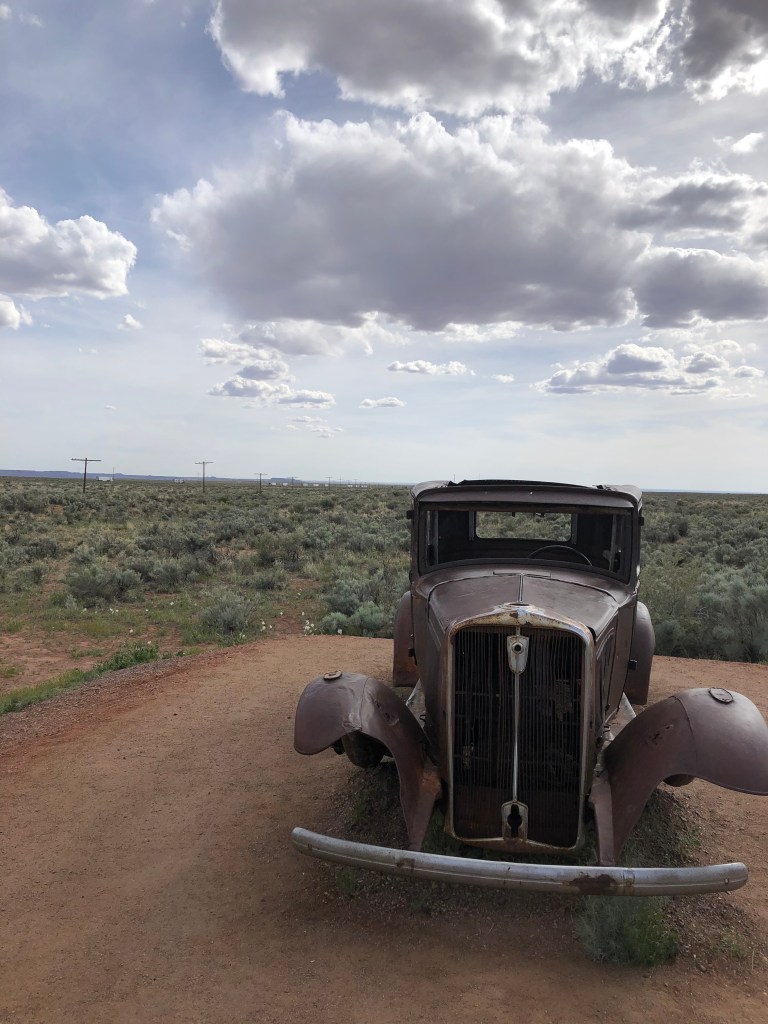
“Frankie!  We can’t stay anywhere near Flagstaff; don’t you think the cops may be looking for us?  Especially the car!  I told you to Jack a black Ford or Pontiac.  But a blue Studebaker?  Think, Frankie! Think!”

“But I like the color blue.”

“Go! Here comes the valet!”  With a spray of gravel and a cloud of dust, Frankie zoomed out of the lot.  “I’m worried now Frankie, really worried.”  

They didn’t get much further when the Studebaker sputtered to a halt.  “Yup, out of gas.”, declared Frankie.  

Trish helped him push the car to a spot not easily seen from the highway.  Disgusted to the point of being near speechless, all Trish said was, “You’ll have to walk back and get gas from the station at the Inn.  I’ll take first watch, you take the second.  We need to get on the road as early as possible.”

Seeing Frankie asleep at dawn the next morning instead keeping a lookout for intruders, mostly cops, added to Trish’s fear that they may not make it to Chicago.  But his cheerful disposition and eyes filled with love, after being kicked awake, warmed her heart.  He turned and waved an arm at the pastels of the desert.  “Look at this view Trish!  This is beautiful!  Why don’t we just build a place here.  Nobody will bother us.  It’ll be just you and me, and this lizard.”  The collared reptile had re-emerged and was watching them from his rock perch.

“We can’t Frankie, even if we wanted to, it’s a National Park..”

Trish’s words were cut off by the demands being shouted from the rocky outcrops surrounding them.  “Put up your hands!  Don’t move!  We have you covered!”  Their hands flew up.  Tears began to course down Trish’s cheeks.  

Men in police uniforms and suits, all pointing pistols at them, slowly emerged from behind the rocks and walked towards them.  One of the uniforms was leering at Trish.  “Well, we’ll.  I believe I’m gonna have to pat you down for a weapon. Heh, heh.”

“Don’t you lay a hand on her!”, Frankie snarled.  Before Trish could stop him, he laid a fist squarely on the jaw of the cop.  Two pistol shots and a scream “NO!” resounded across the desert.  The collared lizard scurried back into its hideout.

1932 Studebaker near the Painted Desert Inn. The car has a bit part in my story. Photo taken by me in May, 2019.
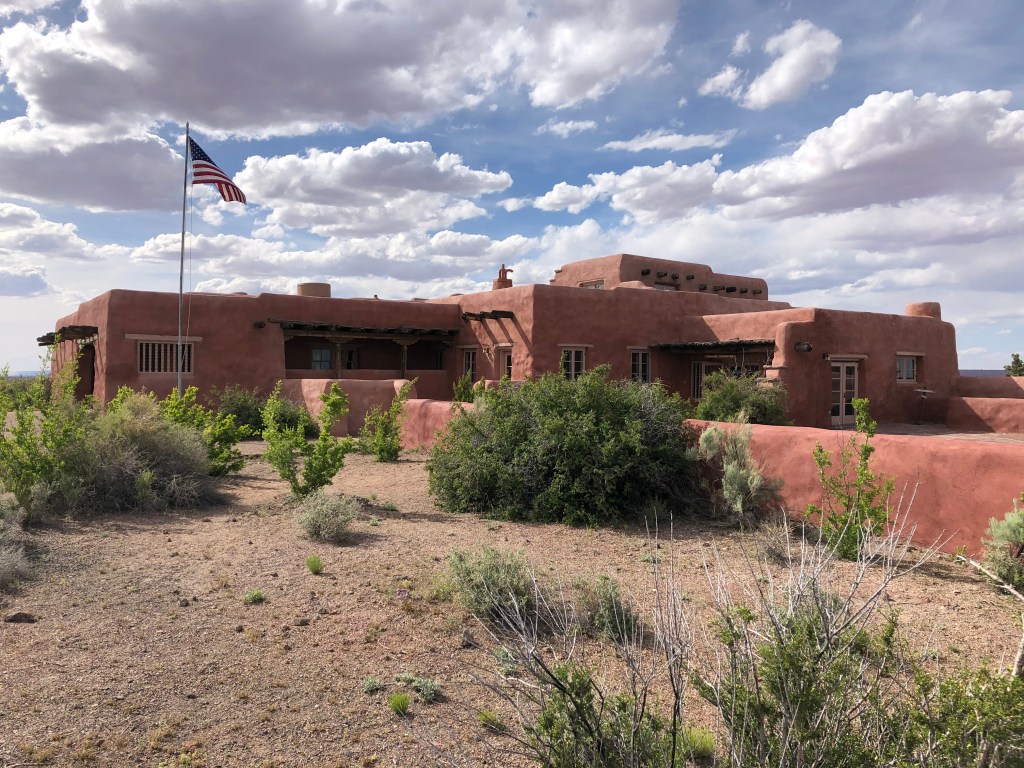
The Painted Desert Inn. My characters beat a hasty retreat from here in my story. Photo taken by me in May, 2019

Ernie Stricsek

Sturgis Library Writing Group

May 30, 2023

Super Adventure Saturdays

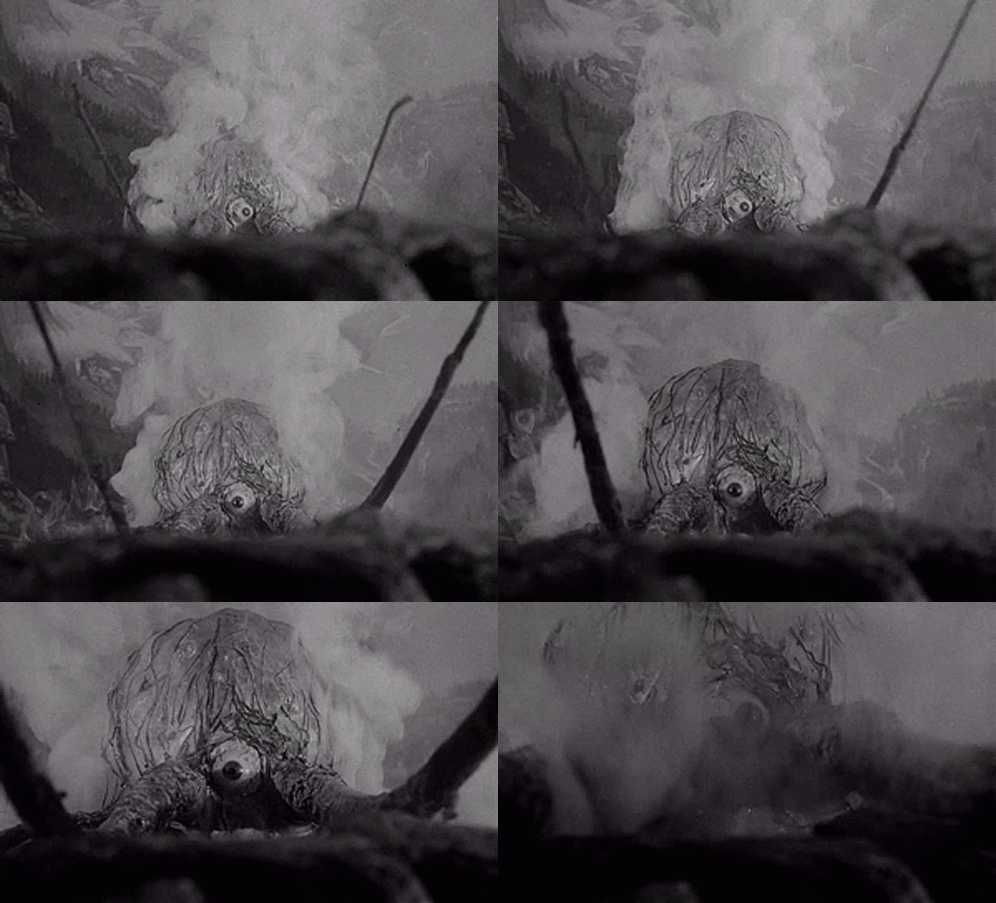
The Crawling Eye. One of the many mishaps of the dawn of the nuclear age…..

There was not a specific prompt for the Chatham Memoir Writing Group for last Friday, which means we can write about anything. My friend, and creative writing group colleague, John Chamberlain and I were talking about old movies, which genres we enjoyed and the fact that certain independent TV networks broadcast many movies of the 1930’s, 40’s and 50’s on a nightly and weekly basis. I recalled when I was a kid how my friends and I would get together on Saturdays and play act the action movies we had seen. The more I thought about our conversation the more I liked the idea of writing about the fun we had. My memoir follows.

Super Adventure Theater/Super Adventure Saturday

When I was a kid, one of the advantages of living in close proximity to New York City was the fact that we could get seven TV channels.  In addition to the big three networks, there were three independent broadcasters and a public TV station.  One of the indie stations, Channel 9, would broadcast a Saturday morning program called Super Adventure Theater.  Hosted by a guy named Claude Kirchner, who for some reason dressed up as a circus ringmaster, he would introduce classic, and not so classic movies from the 1930’s, 40’s and 50’s.  There was a type of rotation of genres – westerns, sci-fi, horror, comedy, war, adventure, crime, no romance films – hence the name Super Adventure.  

Claude Kirchner, host of many kids TV shows and Super Adventure Theater. Photo from WOR-TV, Channel 9, New York City

For us kids, a good Super Adventure movie led a super adventure Saturday of play.  We would analyze the channel guides on Friday to see what was going to be broadcast on Saturday morning then establish the scenarios we would re-enact.  “OK guys, it’s King Kong!  Dress the part and meet at the Cherry Hill woods at 10:30.”  Adjacent to the Cherry Hill playground was a large pie shaped wooded lot that would serve as the setting for many of our re-enactments, especially jungle or wilderness type settings.  Although we enjoyed the Laurel & Hardy, Abbott & Costello and Olson & Johnson comedies, you just couldn’t re-enact a comedy sketch.  It was more fun trying to outwit a giant gorilla or bank robbers.  

For some reason the adventure movies of the ‘40’s and ‘50’s seemed to feature quicksand.  It had an influence on my grandmother because she always cautioned my brothers and I to be on the lookout for quicksand if we played somewhere other than in the backyard of our house.  Some of the trails through the Cherry Hill woods had sandy patches – not quicksand, mind you – but would suit the purpose in our imagination.  With the advent of the nuclear age, there were a plethora of movies released in the 1950’s that employed the gimmick of a nuclear accident being the catalyst for the creation of giant ants, giant crabs, crawling eyes, a 50 foot woman, melting glaciers that released carnivorous dinosaurs.  With the exception of the 50 foot woman, we encountered all of these things in the Cherry Hill woods.  

Horror movies were also fun to re-enact and it was fairly easy to recruit someone to play Wolfman or Dracula.  One of my friends wanted to be the Invisible Man – “pretend you don’t see me as I try to throttle you” – but that didn’t work.  It was hard to find someone to be Frankenstein though.  He lurched along slowly with extended arms, kids wanted to be something that ran or flew like a bat.  We tried to talk one of our friends into playing Frankenstein, we pointed out with his square head and peculiar haircut, he resembled the monster.  He took exception, got upset and told his mother.  No more Frankenstein re-enacting.

There was always that one kid who was so fixated on a single character that he always wanted to be that character.  That one kid was my friend Chris, who lived in the house behind my grandparents.  He loved Tarzan and always wanted to be Tarzan, no matter what the scenario.  It taxed our imaginations to fit Tarzan into unfamiliar situations; Tarzan and cowboys, Tarzan thwarting Al Capone, Tarzan fighting a T-Rex with a sling-shot and Bowie knife.  Chris would actually swing on a rope hanging from a tree branch and scream that Tarzan yell.  This never worked well and at times we would end our re-enacting in disgust and go play kickball or baseball.

This nonsense came to an end in rather dramatic fashion for Chris.  We were actually playing a scenario suitable for the Tarzan character, a jungle setting involving archeologists who discovered some ancient, bejeweled statues.  Chris, as Tarzan, was to swing in and rescue an archeologist, played by a friend named Kathy, from quicksand.  Kathy was on her knees in the middle of one of those sandy patches, pretending to be sinking.  Chris began his rope swing, emitting his Tarzan call.  The call became a scream when the branch his rope was attached to broke.  He landed on his back, still gripping the rope, a cloud of dust from the fake quicksand rising over his prostrate form.  Astonished, we stood with mouths agape.  The wind was knocked from him and he was gasping “Help”.  Regaining his breath he stood up slowly, a little shaky on his feet.  He muttered, “I quit, I’m going home.”

Although he continued to be part of our Saturday Super Adventures, he never played Tarzan again.  Instead he he became Robin Hood.  All the time, Robin Hood.  Robin Hood and cowboys, Robin Hood and gangsters in Chicago, Robin Hood and Wolfman, dinosaurs, martians, giant crawling eyes.  Robin Hood.  Robbin’ us of our fun on a Super Adventure Saturday.

Ernie Stricsek

Chatham Memoir Writers Group

May 26, 2023


First Real World Job

The prompt for the Chatham Writers Group last Monday was to write about a summer job. My story follows.

My First Real World Job

I started working my first job the summer after I turned nine, delivering the Bergen Record.  For the next five years, neither rain, nor snow, nor sun prevented me from completing my rounds, six days a week.  A stint at McDonald’s followed and that proved to be a fun job because just about all of the people working there were friends of mine from high school.  The only thing I didn’t like about working there were the days the Sergeant of the Lower Swatara Police Department would show up for his free dinner.  When I was first introduced to him, he shook my hand, looked me straight in the eye and said, “Boy, when you see my cruiser pull into the parking lot, there better be a Filet O’ Fish, an order of fries and a chocolate shake sittin’ on this desk (the restaurant manager’s) when I walk in.  Yeah, you do that and me ‘n you will get along just fine.” He was a real piece of shit.  Ironically, he would dress up as Santa Clause each year and greet kids at the Christmas Tree Farm, the farm that I frequented in the dead of night seeking trees for special clients, but I’ve already told that story.  My next job, and one that I would work at for the next three years, was staffing the booth of the Harrisburg International Airport Parking Lot.  I sat in air-conditioned luxury collecting parking fees, all cash, no charge cards yet.  On occasion I would have to let an inebriated businessperson know their briefcase was still on the roof of their car and sometimes I would have to call the airport PD when some scofflaw would race past the booth without paying.

My first real world job was the one that I worked the summer between my senior year of high school and freshman year of college, assembling 40-foot truck trailers for the Fruehauf Trailer Corporation.  I had been somewhat insulated from the harsh realities of the working world in my previous jobs, but the dog-eat-dog environment at Fruehauf made me feel like the proverbial deer in the headlights.  My job interview went well, the people who talked to me seemed pretty nice.  I was hired on the spot, most likely because I was breathing, and I had assured everyone that I was not going to quit in August to go to college. I was instructed to buy a pair of steel toe work boots and a hammer.   Reporting to work the following Monday, I shuffled into a small auditorium-like room with about 50 other people and took a seat in a folding chair.  The moment everyone was settled, a bowling ball with arms, legs, and a crew cut head barreled into the room.  After introducing himself as Mr. Geib (I went to school with his brother) he began to berate the new hires.  Anyone with hair longer than his was addressed as “Hippie”, recent high school grads were called “fresh meat”.  He especially doled out his malevolence on those he perceived as Hippies, accusing them of having their brains turned to mush by constant marijuana consumption and they better pin up their ponytails or suffer the consequences of them getting scalped by some piece of moving machinery.  He predicted by the end of the first week, of the 50 people in the room, only 15 would remain.  He was right.  I need to mention Mr. Geib was the HR manager.  Curiously there were no employee grievances. Everyone was so pleasant at Fruehauf.  A co-worker had strongly urged me to take my hammer home at the end of my shift.  I didn’t have a toolbox, if I left it laying out in the open, “Someone will rip it off, there’s a lot of assholes working here.”  As I approached the gates that exited to the parking lot, one of those “assholes” I was warned about told the security guard I was trying to leave the premises with “company property”.  I was supposed to have a note from my supervisor stating the hammer was indeed mine, a policy I was unaware of, and one I was now violating, as was stated on the deviant behavior form the security guard issued to me, “With a copy going to your shift foreman. You will be dealt with tomorrow.”  My hammer was clearly not one supplied to me by the company, I believe Fruehauf issued Stanley hammers to employees once they were past their 90 day probation period.  My hammer was an inexpensive TruTemper acquired from the Middletown Merchandise Mart, referred to as “The Big M” by us locals.  I was not dealt with severely, my supervisor apologized for not making me aware of the policy and gave me a tool pass the next day.

I was assigned to the refrigerator trailer assembly department as part of a two-person team fastening panels in the nose of the trailer.  There was almost no air movement in the nose and by the end of the second week I had sweated away 15 pounds.  I was supposed to report to my college football team in mid-August weighing between 220 – 225 pounds, but I weighed in at 198 on the first day of training camp.  198 pounds, I need to go back and work in the nose of a trailer for a few months.  But back to the work environment.  It was hot and loud, profane, medium profane and super profane.  Some people were very eloquent in their profanity.  In the employee caste system, the color of one’s hard hat revealed where they fell in the hierarchy.  White hard hats were the managers, from department level to executive level, shift supervisors wore brown hard hats, welders wore green, painters wore blue, maintenance staff orange, and the worker bees yellow.  All supervisors and managers had to wear white shirts and a dark necktie.  The manager of my department fell into the eloquently profane conversation group and would walk along the production line swearing at the teams toiling inside the trailers.  “Lazy bastards, lazy hippie bastards (it was 1972), lazy F’ing hippie bastards, dope fiends, and stupid asses” we’re his trademark berate lines.  His florid complexion and gin blossom nose stood out in contrast to his brilliantly white shirt.  When he finished verbally kicking all the yellow hats and went back to his office, our shift supervisor would come by and apologize for his boss’s behavior and tell us to pay him no mind, he was either drunk or “bad hungover”.  

I got pretty good at my job and earned the respect of my co-workers.  After missing one day of work because of the major flooding caused by Hurricane Agnes, they were glad to see me return and hoped my family didn’t experience any storm damage.  One hot, humid day in mid-July, my boss called me over and asked, “What the ‘f’ are you doing here?”  I thought I had done something wrong.  He clarified by telling me I didn’t belong there and that I better make enough money so I could go to college and not work in such a “shit-hole”.  My co-workers had begun to echo his comments.  Two weeks after my boss had queried me, I gave him my notice.  I would be leaving for college in mid-August to report for football training camp.

He smiled a wry grin and said, “You bastard.” High praise from my supervisor.

Hammer Post Script

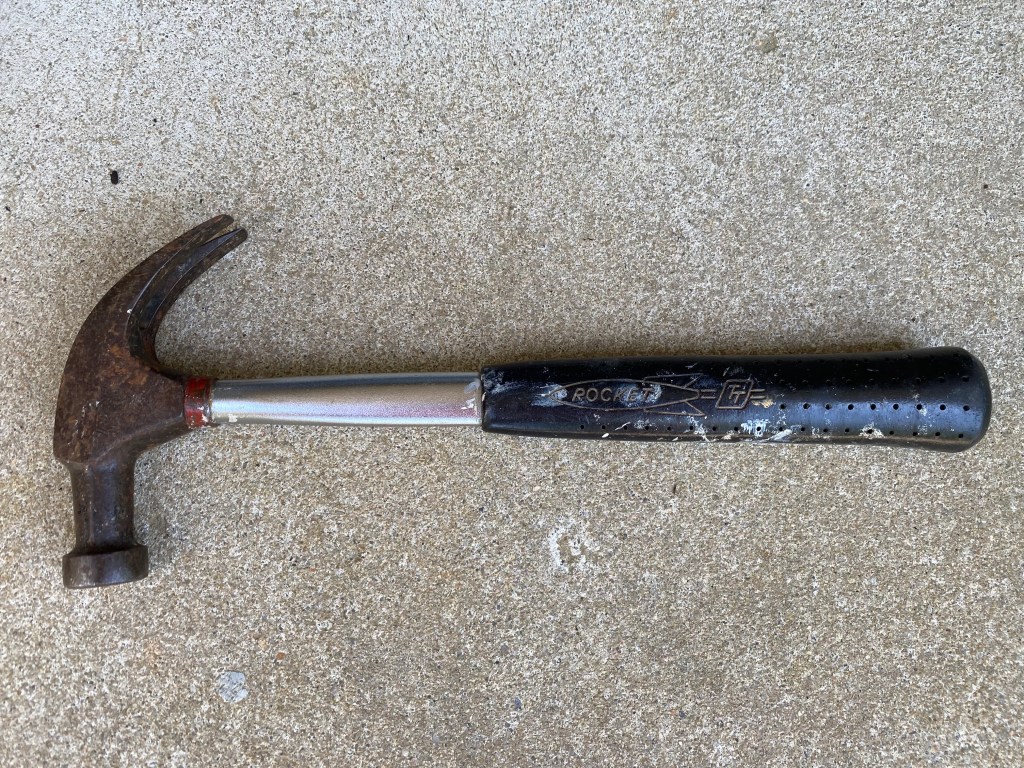
My hammer drew a lot of attention on my first day at Fruehauf Trailer. In addition to being accused of stealing it, my team leader heaped a load of scorn on it. Just before we walked into the trailer to start attaching wall panels, he said, “Let me see your hammer.” I handed it over to him. He examined it like a jewelry appraiser and began to laugh, “Hah! What a piece of shit hammer! This won’t last two hours in here, and I ain’t gonna loan you one neither!” He proceeded to wave it at the other members in the work crew, who took turns expressing their opinions on the apparent low quality of the work tool. Well, they were right in a manner of speaking. The Big M, TruTemper hammer didn’t last 2 hours, it would survive many projects for the next 51 years and is still in use as of this writing, as evidenced below.


Ernie Stricsek

The Chatham Writers Group

May 22, 2023

Adventures in Yard Work

Weeding in Western Pennsylvania

Adventures In The Yard

I scramble over the crest of the hill, trailing a spool of electrical wire behind me and drop to the ground next to my wife.  I cut the wire and attach the loose ends to the terminals on a small box.  

“Clear?” asks my wife.

I raise my head to peer over the crest of the hill, “Clear!”

“Fire in hole!”, shouts my wife and twists a handle on the small box. 

There’s a muffled pop and we wait a few seconds for any dust to settle.  We stand and walk over the crest of the hill to survey what destruction we have wrought.  It’s heartbreaking.  There are a few cracks in the ground extending from the hole where the stick of dynamite had been placed.  Rising above the sparse patch of grass is the dandelion we had hoped to eliminate.  Swaying back and forth in the gentle breeze, it taunts us, like a symbolic middle finger.  “Hah! Is that the best you’ve got?”, it seems to say.  My wife and I look at each other, steely determination etched on our faces, “More dynamite!”, we both shout.

Okay, so maybe I am exaggerating a bit here, but the hard clay soil made doing any yard work at our western Pennsylvania home a daunting task.  We didn’t have to resort to dynamite to remove dandelions, in Pittsburghese “Dandy Lions”, or other weeds.  But one couldn’t just yank them out of the ground, you would end up with just a handful of weed tops. Even after a rainfall, the weed roots would remain steadfastly imbedded in the ground, essentially needing to be dug out.

Speaking about digging, the clay soil was near impervious to the sharp bladed spade.  Within a year of moving to our house, we began a series of landscape projects involving moving some existing trees and shrubs and planting new ones.  Compared to getting rid of the weeds, it was surprisingly easy to dig up an existing item, planting it was another story.  Once a new planting site was determined, the soil would have to be loosened by chopping at it with the blade of the shovel, then scooping up and dumping the loose clay.  I wore the point off of one shovel digging in this manner, turning it into a flat bladed spade.  I broke two other shovels. To make the job of digging easier we would loosen the soil with the sledgehammer end of a maul and a pointed pry bar, then scoop out the clay.  We eventually invested in a rototiller.  Before replanting anything, we would amend the soil with peat moss to encourage root growth.

Digging in this soil would uncover some interesting artifacts from the region’s past history.  We would find coal, ranging in size from small chips to large chunks.  When we closed on our house, we were urged purchase a peculiar item called “mine subsidence insurance”.  From the Bureau of Mines, we discovered our home rested about 350 feet above the abandoned shafts of the Penn Mining Company which had closed in 1923.  Coal mining had been so extensive in the region, there were abandoned mines everywhere.  On occasion, the old shafts would collapse, shifting the soil above it.  Roads would be closed and buildings condemned due to severe subsidence. We would constantly be on the lookout for big cracks in our yard or, even more ominously, in our foundation.  Between the clay and the coal, I believe we could have had a strip mining and pottery conglomerate.  

An interesting topographical feature of the region surrounding Pittsburgh is it is almost impossible to find any land that is naturally flat.  The nearby community of Level Green was anything but level.  Most of the flat areas of land were man-made creations, and these efforts sometimes had a deleterious impact.  For instance, our neighbors had decided they wanted an in-ground pool.  All of the homes at our end of the street had about a 20-degree slope so quite a bit of fill and leveling was needed to make the pool area flat.  When the project was completed, the new slope of their yard caused rainwater to flow down into our yard and give us a pool as well.  It also caused the roots of two trees and several shrubs to rot.  We were unable to plant anything in a 6’ x 15’ section of the berm we had created.  

It was tough work maintaining and caring for this hardscrabble yard, but we eventually had it looking quite nice.  After my wife had detailed the efforts in maintaining our yard to a co-worker, her colleague said, “Wow!  How many acres of land to you have?”  To which my wife answered, “Oh, about a quarter of an acre.”  Size wise, it was the smallest yard we ever had.  But work wise per square inch, it was the biggest yard we ever owned.

Ernie Stricsek

The Chatham Memoir Group

May 19, 2023