Red’s Cafe

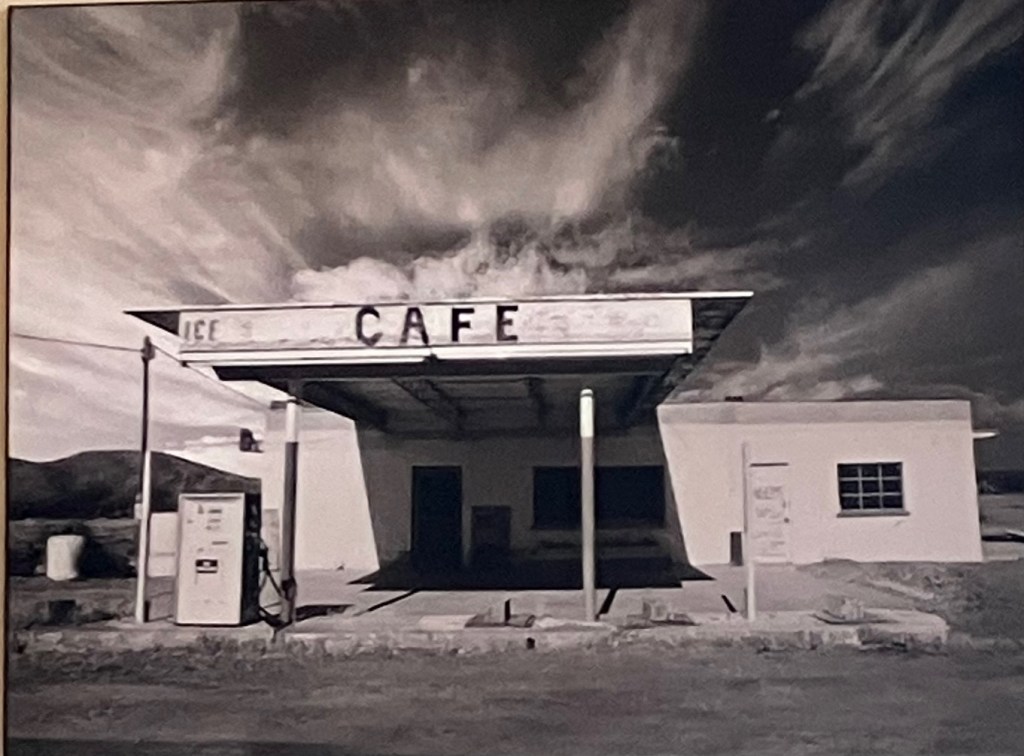
The photo above was used as the prompt for the Chatham Writers Group. It reminded me of the trip Barb and I took through the southwest and the sites we saw along Route 285 between Carlsbad and Santa Fe, then along sections of old Route 66 to Flagstaff. With that in mind, I wrote this piece of speculative fiction.

Red’s Cafe
On most days that it wasn’t raining or too cold, Pete and Lenny would shuffle out to the area called “the courtyard” and lay claim to two faded green plastic garden chairs to watch the sun set. As dusk fell, the art deco lights atop the building behind them would first hum then burst into brilliant white block letters noting “DOTTIE’S SENIOR LIVING”. Except for the letter “I” in senior. That had burned out a long time ago. Pete would chide Dottie’s manager 3 or 4 times a week. “Damn, it Reggie! Tell Dottie to fix that I. That’s why the men outnumber the women three to one in this place. People read that as Señor Living and think that it’s just old fart men living here.” 

They settled into their chairs, each gripping a plastic cup, 2/3 full of Coke. They waited until a group of residents accompanied by a few nurse’s aides trudged past them to smoke in the parking lot of the Evangelical church, generally referred to as St. Nicotine’s, next to Dottie’s, because Dottie didn’t allow smoking on her property.

When the coast was clear, Pete pulled a pint of Myer’s Rum from the inside pocket of jacket and said, “Here Lenny. Let me top off your Coke.” They tapped their cups, said “cheers” and sipped until the sun settled out of sight.

Lenny stood, placed his hand on Pete’s shoulder and said, “I’ll grab us a couple more Coke’s. There’s something I need to tell you, and you’re gonna need a stronger drink.”

Pete’s eyebrows raised, “What’s this about, Lenny?”

“Be right back,” was all he said.

When he returned, Pete was leaning forward in his seat. Lines of concern added to the creases in his brow.

“I’m going to tell you a story. It’s true. I hope you don’t think I’m nuts. The only other person who’s heard this was my wife, rest her soul. It really happened.”

Inwardly, Pete was relieved. For a moment he thought Lenny was going to tell him he was dying. “Go ahead, my friend. Now I’m intrigued,” was all he said.

“Okay. But no laughing! Remember that TV show, Route 66? Those two guys driving from Chicago to LA in a Vette?”

“Yes.”

“After I graduated from college, I did that. Started the summer driving Route 66 before getting a real job.”

“In a Vette? You dog Lenny! You never told me.” Pete looked wistful.

“No, sadly. In my dad’s 1960 Chevy Bel Air. Not a cool car, but a cool trip.”

“Yes! You lucky dog. I would have driven it in an Edsel.”

“Yeah. Well, what I am going to tell you next, Pete, is I don’t know if this was truly luck. Or something even bigger.”

“Okay.”

“I was going to stay in Holbrook, Arizona. A place called the Luna Moth Motel. I even made a reservation.”

“The Luna Moth? You’re joking right? This I gotta hear!” Pete took a sip of his drink and leaned forward, grinning.

“It’s not what you think. I’m driving on Route 66; the country is so flat. Three miles out of Holbrook. I see the lights and buildings at the edge of town. Good thing, ‘cause I was tired from driving all day and was pinching myself to stay awake.”

“Been there,” Pete said.

“Now the strange stuff begins, Pete. There’s a Cities Service station on the right side of the road. It looks abandoned. Only one pump where there used to be four. Signs faded and peeled. It had been called ‘Red’s Café and Auto Service. The only clear word was Café.”

“Go on,” said Pete.

“I’m about to cruise past and this old guy steps out from behind the only pump and waves at me like crazy. Motioning and yelling for me to pull in. He looked upset, so I brake hard and cut into the gas station’s driveway.”

“How old was the guy, Lenny? We’re old!” laughed Pete.

Lenny smiled and nodded, “Yeah, Pete. About how old we are now. His Cities Service uniform had faded to almost turquoise in color. Except for his name tag, it’s still bright green and in bright white cursive letters in the name ‘Red’.”

Lenny paused for a few moments, as though trying to remember. Softly, Pete asked, “What was up with Red?”

“Well, he asked me to help find a set of keys he dropped in the sage brush behind the station. He said his dog was locked in the office, and he needed to get him out. I agreed to help, but all the time we were looking, I didn’t hear a dog barking.”

“Were you worried it was a trick? That he was going to rob you. Or worse?”

“Yeah, a little. Anyway, 20 minutes later we still haven’t found the keys, and we’re back in front of the station. He stops and points towards the town and he says ‘look’. ‘At what?’ I ask. Suddenly there’s a bright flash, flames shoot out sideways and skyward. Three seconds later we hear the loud boom.”

“Fireworks?” asks Pete.

“No!” exclaims Lenny. “The old guy says, ‘Well, looks like the Luna Moth Motel just blew up. I guess they never did figure out where the gas leak was. Weren’t you supposed to be staying there? If I were you, I’d try the Wig Wam Motel, nicer place too.’”

“What happened next?”

“I turned to look at him and he’s gone. I never heard him walk away.”

“What do you mean, gone.”

“He disappeared. I called his name. No reply.”

“Lenny, if I heard you right, he pointed to the Luna Moth before it blew up.”

Lenny exhaled a big breath of air. Speaking slowly, he whispered, “Yes. I never told him I was staying there. I eventually get to the Wig Wam and I ask about Red’s Café. The clerk says, ‘Ahh, Red Olson. Really nice guy. He died a couple of years ago. Too bad nobody took over his business.’ Then he asks me if I’m ok. Tells me I look like I’ve seen a ghost.”

“Holy crap, Lenny! You did!”

“For sure, Pete. I did. A ghost that saved my life.”

A Day In The Life

Prompt photo selected randomly from an internet site displaying “interesting photos”.

The prompt for the Monday Chatham Writers Group was to write something, in any genre, relating to the photo above. My story follows.

Father Pappas gazed out the window of his office, deep in thought about how to end his sermon for the Sunday services. Engrossed in his sermon, he didn’t hear the gentle knocking on the door, only stirring when he heard his secretary ask, “Father? There’s a visitor with an urgent message. May we come in?”


   Spinning his chair around to face the office door, his deep baritone voice replied, “Mrs. Cosmos! Yes! Please come in.”


    Mrs. Cosmos opened the door and ushered in a boy with a post card sized envelope gripped in his right hand.


  “Father, this is Elias Artino. He has a message for you. He claims it’s urgent.”


   The boy was nervous. His eyes darted around the office.


   Father Pappas smiled, “Ahh. Master Artino. It’s good to see you. You have an urgent message for me? Is everything alright at home?”


   As presbyter of the Parish of St. Demetrios in Karpenisi, he felt he was not only the Father of the church, but the father of each parishioner’s family. His level of concern for the people of his community ran deep, they felt it as well.


   “M..m..my family is well, Father Pappas,” Elias stammered, “It’s note from Mrs. Tsolis.” He thrust his tiny hand out and placed the note on the Father’s desk.


   “Thank you, Elias. Which Mrs. Tsolis? The one at the bottom of Ydros Way? Or at the top?”


   “Top. May I go now?”


   “Of course. Tell your family I send my best wishes.” Father Pappas chuckled as Elias scampered away.


   Opening the envelope, he removed the card. His brow furrowed.


   “Is Mrs. Tsolis okay?” asked Mrs. Cosmos.


   Father Pappas shrugged and said, “I don’t know. The note is asking me to come to her home as soon as possible. It’s urgent, so I better be on my way.”


   He rose from his chair, put his cassock on and placed the kalimavkion on his head and looked in a mirror to make sure it was straight.


  “Mrs. Tsolis at the top of Ydros Way,” he sighed, “My cardio workout for the day, Mrs. Cosmos.”


   Reaching Ydros Way, Father Pappas paused for a moment and stared at the steep, cobblestoned road. “OOOH boy,” he exhaled. Seeing a line of mopeds outside of a bakery, he said, “I could use one of those.” He stepped into the bakery and bought a few pieces of Baklava to bring to Mrs. Tsolis.


   He stopped twice to catch his breath while climbing Ydros Way and tried to envision the reasons for Mrs. Tsolis’ sense of urgency. It was 18 months since her husband had passed away. Father Pappas had visited times and had also spoken to her at church. She seemed to do well. However, her son, Achilles, was her Achilles heel. Displaying a rebellious streak when he turned 14, it accelerated and led to several run-ins with the Karpenisi police, culminating with his arrest for breaking into a neighbor’s home to steal some jewelry. Because he was too young for jail, the court placed him under house arrest and required community service. At 18, Achilles left home to work on a fishing boat on the island of Mykonos but fell in with a bad crowd and was now one of several men suspected of robbing a bank in Lamia. The news shattered his mother. Perhaps she needed comfort and support. Father Pappas looked up Ydros Way once more. “Almost there,” he sighed.


   Reaching the house, Mrs. Tsolis yanked the door open before he knocked. “Come in Father. Hurry. Please.” She shoved him into the foyer and looked both ways on Ydros Way before shutting the door.


   Father Pappas asked, “Mrs. Tsolis! What’s wrong?”


  “I’m what’s wrong.” Said Achilles Tsolis as he stepped from the kitchen. A snub nose revolver was in his right hand, pointed at Father Tsolis.


  “That’s unnecessary, Achilles. I won’t harm you.”


  “I know, Father. But I hope you understand,” said Achilles, before adding, “I did something terrible.”


   “I understand you are a suspect in a crime in Lamia. Is that what this is about?” asked Father Pappas.


   “I was involved in a robbery, Father. But I have done something even worse.”
   “What could be worse than robbing a bank?”


   “I didn’t split the money with my accomplices. Now the police and three terrible dudes are looking for me.”


   “Do you wish to turn yourself in? Is that why I am here?” asked Father Pappas.
   “NO! Absolutely not!!” exclaimed Achilles. “You’re here because I want you to give me your clothes. That’s my ticket out of here.”


    Momentarily confused, Father Pappas exclaimed, “What!?”


   “Your clothes. Now!”Achilles pointed the gun at Father Pappas.


    Father Pappas asked a sobbing Mrs. Tsolis to get him a blanket.


   When she left, he undressed and handed his vestments to Achilles, who took them and went back into the kitchen. Mrs. Tsolis returned with a blanket.


   Achilles stepped from the kitchen, dressed as an Orthodox Priest. The gun in his right hand, a canvas sack in his left. He said, “I’m sorry”, opened the front door, scanned Ydros Way, and left, closing the door behind him.


   Sounds like firecrackers made both Father Pappas and Mrs. Tsolis jump. Police whistles screeched. Voices shouted, “He’s down!”


   Mrs. Tsolis buried her face in her hands and began to wail.

First Meeting

Paratroopers of the 101st Airborne Division Liberating Sainte-Marie-Du-Mont, June 6, 1944. Photo at Memorial De Caen/NARA

A couple of years ago, I began writing D-Day related historical fiction pieces to prompts for the Chatham Writers Group. This particular story was written three years ago, months before the D-Day anniversary to a prompt about strange meeting places. My original draft was longer than the 1,000 word limit. I resurrected the story, made several changes, and I am posting for the 80th Anniversary of the Invasion of the European Continent.

 June 5, 1944, outskirts of St. Marie-Du-Mont, France    

     In the corner of their dining room, Gerard Bouchard sat huddled around a small wireless radio with his brother, Rene, and father, Charles, listening to jazz being broadcast by the BBC in London. Shutters drawn, blackout curtains drawn and clipped together with clothespins, the only light in the room came from the radio dial. The musical program ended, and the Bouchards leaned in closer to the radio. 

     A distinct voice floated over the airwaves now. A French-speaking host announced, “London calling with Frenchmen speaking to our countrymen, London calling with some messages for our friends”. From this point on, they would broadcast all messages in French.

  After a brief pause, the voice recited a line from a poem by Paul Verlaine “Wound my heart with a monotonous languor”, then repeated it.  

     The Bouchards sat bolt upright, emitted a collective gasp and looked at each other’s faces with wide, anxious eyes. They leaned back over the radio as a series of other abstract messages poured from the wireless. “Molasses tomorrow will bring forth cognac,” announced the voice.

    “My God!” exclaimed Gerard’s father.  

     The next radio message declared that “the dice are on the carpet”.  

     Charles sobbed, stood, and motioned for his sons to stand. Hugging and kissing them both, through his tears, he said, “France is about to be liberated. We have a long night ahead of us. Be quick, we have work to do.”

     Messages still were being transmitted when Gerard turned off the radio and hid it away. They didn’t need to hear anything else. The ‘dice were on the carpet’ was their signal, which meant the Allied invasion of France would begin before dawn. The Bouchard’s role in this drama would be to disrupt communications by blowing up a line of telephone poles that linked the German army rear support depots to the defensive lines on the beaches at Normandy. Gerard and Rene followed their father to the root cellar. Charles pried the lid from a barrel and pulled out a canvas bag loaded with plastic explosives. He reached into the barrel twice more, handing a bag with fuses and wire to Gerard and one with the detonator to Rene. They slung the bags over their shoulders and set off for their targets.

     Avoiding German patrols along the roads, the Bouchards followed obscure paths, leading them through orchards to a dense hedgerow. Pausing for a moment, Charles Bouchard looked back in the direction they came to make sure no one was following. The hedgerow ran roughly 100 yards where it stopped at the edge of a forest where they were to meet someone who would guide them to the targeted section of trains tracks.

    “We are not being followed,” Charles whispered to his sons, and led them off towards the tree line. After they moved about 50 yards, a light flashed on and off once from the woods at the end of the hedgerow. Gerard pulled a flashlight from his coat pocket and clicked it on and off twice. A single flash of light answered him from the woods. Charles said, “That’s our guide. Let’s go.”

     When they reached the trees, Gerard was surprised to discover that their guide was a woman.

     “My name is Margaux. Follow me. No talking,” was all she said.

     In the darkness, it was impossible for Gerard to make out her features. Gerard didn’t recognize her voice, but she sounded young. About his age.

     Margaux led them to a second team of Resistance fighters tasked with blowing up the rail bridge over the Merderet River, close to the telephone poles the Bouchards were to destroy. They carried weapons. There were German soldiers guarding the bridge. For the first time, Gerard noticed Margaux had a machine gun slung over her back. She turned to look at him. The clearing next to the railroad tracks was not as dark, and he immediately noticed how beautiful she was. Ringlets of dark hair curled from beneath her beret. He couldn’t tell if it was black or brown in this light. But there was no mistaking how blue her eyes were.

     She smiled at him briefly, but then her features drew hard, her eyes flashed and she snapped, “Close your mouth before a bug flies into it. We’ve got work to do.”

    Gerard’s face felt red hot, and he hoped it was dark enough to hide his embarrassment. 

     The two teams reviewed the plan one more time. The bridge and telephone pole explosions had to occur at the same time. The Bouchards would set their charges first, allowing the other group time to approach and set their bridge charges. When the bridge team was ready, Margaux would jog back along the tracks and signal with a torch. Seeing her signal, Gerard would turn to his brother and father and signal his torch. After detonating the charges, the Resistance fighters would disappear into the darkness and make their way back to their homes. The groups separated. 

    It did not take long for the Bouchards to have their explosives in place. Gerard ran alongside the rail line towards the bridge. Ducking behind a utility box, he awaited the signal from Margaux. “Where was she? He thought, “This is dragging on for too long!””

     Shouts, German voices, from the bridge made his heart skip a beat. Gun shots now, more German voices yelling “Halt”! He could see tracer bullets searching through the trees. There were gun flashes from the woods. Someone was approaching fast along the rail line. He had no weapon to use if it were a German. It was Margaux! She signaled with her torch. Gerard turned and sent his signal. A stream of German machine gun fire spit down the tracks. He heard Margaux cry out in pain, saw her tumble down the rail embankment. At the same moment, the explosive charges detonated behind him and in front of toppling the telephone poles and collapsing the bridge into the river. In the light from the explosions, he saw Margaux lurch off into the woods. He stood to run after her, but there were Germans on this side of the river! They were walking in his direction with weapons at the ready. Upon spotting Gerard, they shouted, “Stop!” and started shooting without aim.  

     The burping of Margaux’s sub-machine gun from the woods to his left made the German soldiers scramble for cover.  He sprinted towards where he had seen her muzzle flashes.  

     He stumbled over a branch and heard her call out “Here”! Discovering Margaux behind a fallen tree with a wound on her side, he bent to help her up. Throwing her over his shoulders, he lumbered off deeper into the woods. They could not outrun their pursuers. Margaux begged him to put her down. German soldiers tracking them from both sides of the river fired indiscriminately into the trees, the rounds striking very close to them.  

     Bursting from the woods, Gerard discovered the Merderet River flowing right in front of them. With little thought, he plunged into the water and began swimming along with the current, his arm around Margaux. Soldiers following on the other side of the river saw them and raised their weapons to fire. The sound of plane engines, hundreds of them, halted the German soldiers in their tracks. They now stood gaping up at the sky. Soon searchlights broke through the darkness, parachutes blossomed in the glare. The Germans sprinted back to the smoldering bridge.

     Gerard floated onto a shoal. Catching his breath, he carried Margaux out of the river and set her down on its bank to examine her wound. From the darkness came whispered voices. Margaux let out a cry of pain.  

     A voice shouted from the darkness, “Throw down your weapons! Put up your hands!”

    The voice from the woods was speaking English! Gerard called out, “I am French, I have a wounded friend”.  

    Three men, faces blackened with burnt cork, cautiously stepped from the woods. Gerard noticed their uniforms. Their left shoulder had a black patch with a white eagle stitched on it, and their right shoulder had an American flag.

    Gerard cried out, “Americans! Your Americans!”

    Seeing the wounded Margaux, one of the Americans yelled “Medic”!

#####

L’Estaminet Hotel, Sainte Marie Du Mont, June 1994  

     From the kitchen entrance, Annette saw the host seat a couple at a table in her section. Both were strikingly attractive. The woman had black curly hair threaded with silver and her eyes were a deep blue. Gray streaks were also present in the man’s brown hair. His brown eyes sparkled above his broad smile. Annette thought they were about 60 years old.

     After seating the couple, the host walked over to Annette and said, “A special couple for you, Annette, and a special evening. They’ve been celebrating their anniversary here long before I came to the L’Estaminet.”

    Arriving at their table, she said, “Hello, my name is Annette, and I will be your server tonight. I understand you are celebrating a special event this evening?”

    The woman answered, “Yes! My name’s Margaux and this is my husband, Gerard. It’s our 50th wedding anniversary.” Annette realized they were older than they looked. “Oh, my! How delightful! Congratulations! Can I ask how you the two of you met? I am always curious how people who have been together a long time met each other.”  

    With a twinkle in his eye and a wry smile on his face, Gerard looked at Margaux and replied, “Well, Annette, we met while swimming. It changed our lives forever. We had a blast.”

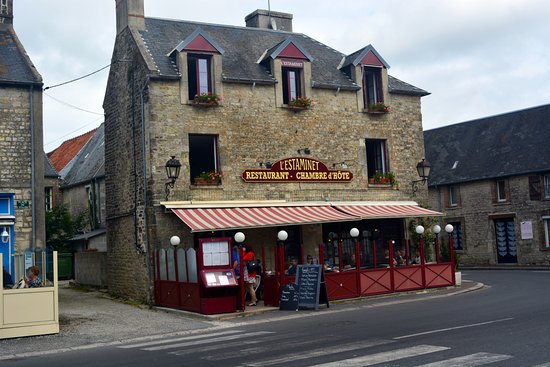
L’Estaminet Hotel, Sainte-Marie-Du-Mont. The site of my character’s anniversary.
French Resistance members received coded messages relating to the impending invasion along the Normandy Coast. The last two messages in this string are the ones that alerted the French that the invasion would begin in 24 hours.

The First Draft

I was listening to the Outer Cape radio station, WOMR, last week when ‘Uncle John’s Band’ by the Grateful Dead began playing. The opening lines of a poem popped into my head. After listening to the song a half dozen more times, I strung together this poetic take of what writing a first draft is like.

The First Draft

Ernie Stricsek ©

Well, the first words are the hardest words

When creating your first draft

You stare at a hummingbird

Versus working at your craft

Will they draw the reader in

Will my words be profound

Or will I sound crazy daft

At the end of my first draft

“A dark and stormy night”

Wait, why did I write that

How did such purple prose

Make it into the first draft

Words, words, words, words

I’m sounding like a hack

It’s only my first go round

So cut me some slack

A Thesaurus is in my hand

My face looks rather bland

“I’ve used first draft to many times”

My voice cracks and whines

Oh, this word fits good here

And these words look great there

Hot damn, I’m on a roll

Like a river, words flow

Happy New Year

Pittsburgh, the scene of my story. This photo from a Carnegie Library collection shows the “Point” where the three rivers flow, and Three Rivers Stadium.

The prompt for the Monday Chatham Writers Group was to open your story with a sentence using each letter from the greeting “Happy New Year”, in order and with no other word between them. My letters are in bold and italics. I called for help from my reporter for the fictional Manchester Press & Journal, headquartered in Pittsburgh’s Manchester neighborhood. I finally gave my young reporter a name, Andy Wink. My story follows.

Happy New Year

Hey Andy! Percy Pathemore Yancy’s Next Essay, ‘Would Yinz Eat A Raccoon?’, is going to be published in the City Paper this week. I’d like for you to interview that old buzzard and see just what the hell he means.”

 “Why me Chief?” I asked my editor.

 “Because you’re in my line of sight.”

 “So, if I was in the break room having a cup of coffee, I wouldn’t be getting this assignment?”

“Of course not! I would’ve waited for you to come back into my line of sight. That’s another thing. You spend a lot of time in that break room, drinking coffee and moonin’ over the view of Three Rivers Stadium, n’at.”

Normally, I would accept any assignment willingly. “Chief, I’d rather have pins stuck in my eyes than interview Mr. Yancy.”

My boss took the unlit cigar from his mouth. “You don’t mean that. You’d rather be blind than talk to a guy who seems to have taken a liking to eating raccoons? Come on, kid.”

“Mr. Yancy was my English teacher the entire time I was at Schenley High. English I, English II, English Comp and English Lit. It was four years of hell. Prisoners breaking rocks at Devil’s Island have an easier time.”

“But you must have done ok. You wouldn’t have gotten into Syracuse University journalism school if you were a hack.”

The boss had me there. “Alright, I’ll call him and see if he will let me interview him. That’s if he deems my writing skills worthy enough to grant an interview.”

“That’s the sport! Go get him, kid! Now where the hell’s my matches?” My boss stalked off.

I took a deep breath, grabbed the phone book and leafed to the Y’s section. Mr. Yancy still lived on Walnut Street in Pittsburgh’s Shady Side neighborhood. He used to walk the two blocks from his Victorian style home to Schenley High. I took another deep breath before calling. Mr. Yancy used to smoke a pipe in the teacher’s lounge. He would enter the classroom in his rumpled tan corduroy jacket, suede patches on its elbows, and pipe stem sticking out of the breast pocket. No amount of dry cleaning would ever remove the odor of his favorite brand of tobacco from his jacket. It was so engrained in its every fiber.

Pittsburgh’s historic Schenley High School. The cost for asbestos remediation forced the school’s closure in 2008.
Walnut Street in Pittsburgh’s Shady Side neighborhood, not too far from Schenley High School. Uncredited photo from Wikipedia.

One more gulp and I dialed his number. He picked up on the second ring. After identifying myself, my trepidation vanished.

“Mr. Wink! It’s a pleasure. I was pleased when I read yinz was hired by the Manchester Press & Journal.”

 Did he just say yinz?  

 He was even more delighted when I told him the purpose of my call.

 “An interview? Conducted by my prize student? Of course! Of course!”

 After establishing a day and time, Mr. Yancy said, “See yinz next week.”

 Yinz again! I definitely heard that! Yinz! In his classroom, Mr. Yancy showed no mercy to students who spoke “Pittsburghese”. His verbal floggings were severe enough to bring many to tears. He even paddled several students for referring to Agatha Christie’s Miss Marple for being, in their opinion, just a “nebby” neighbor, and not a real sleuth. Use of the slang “nebby” was a sin!

I was non-plussed by Mr. Yancy’s choice of words, but his appearance when he opened the door to his Walnut Street home floored me. I wasn’t expecting to see the tobacco infused sport coat. But I was thinking something along the lines of corduroy pants with the wales worn to a shiny luster, topped by a cardigan with suede elbow patches. The transformation of my English teacher was astonishing. A Pendleton flannel shirt and Carharrt overalls adorned his lanky frame. 

Seated in the study, he lit his pipe and motioned for me to begin the interview. Mr. Yancy told me a college friend had invited him and his wife to a “Wild Game Cookoff”. They had scoffed at the idea initially. Maybe nibble on some pheasant, or venison, down an IPA or two and call it a day. None of the food was identified until after it was consumed. The Yancy’s ate snake, mongoose, beaver, and ostrich, all prepared with seasonings and sauces like most beef, chicken, and pork dishes. It was the raccoon with sweet potatoes that overwhelmed Mr. Yancy. It was one of the best meals he had ever eaten. He had an epiphany. Yancy became engrossed in the cooking of wild game, especially raccoon. He created stews, soups, fried and filets, but his recipe for maple bourbon glazed raccoon pushed him over the top. His book of recipes shot to number one, and he was in such demand for cooking shows, he shed the smelly sport coat and retired to concentrate full time on his wild game creations. 

He peppered his conversation with classic Pittsburghese. Yinz instead of you, gumbands vs. rubber bands, it’s Jumbo, not baloney, alunimin foil. Dropping infinitives was a gut punch for me; “Young Man, this story needs told”, “I can’t think of anything more that needs done, than this.”

 Mr. Yancy saw my jaw dropping to the ground and paused for a moment.

“Are yinz surprised with my transformation, young Andy? Don’t be. I was too stuffy, too harsh.”

He apologized for being so tough on me. I was the best student he had ever had the pleasure of teaching. He wanted to see me achieve good things.

When the interview ended, Mr. Yancy wished me a Merry Christmas and a Happy New Year. We promised to meet again soon. I returned to the Press & Journal and presented a 1,500-word piece to my boss, which he knocked down to 1,000. 

“Maple Bourbon Glazed Raccoon. Damn, that sounds good, kid. Sounds good, but I’ll stick to a pastrami Reuben from Primanti’s. Go get me one.”

Bourbon Maple Glazed Raccoon. Photo from recipes section Realtree website.
Primanti Brothers pastrami sandwich. Photo from Primanti Brothers webpage. My favorite Primanti’s sandwich!

Ernie Stricsek, Chatham Writers Group, January 8, 2024

Two Flash Fiction Pieces

I wrote a flash fiction piece to the following prompt:

It’s the middle of the night.
There’s a band of heavy cloud.
You’re in the countryside.
There’s a cold feel to the place.

I titled it “ Smuggler’s Blues”. After I read it, someone asked, “What next?”, which became the title of the second flash fiction piece. I had fun writing these.

Photo from a New Zealand magazine called Buzz. I thought this was how Rutledge’s plane may have looked.

Smuggler’s Blues

When his plane’s engine began to sputter, Rutledge kept his cool and, with the aid of a brightly lit full moon, discovered a broad meadow to land in. He cut the engine just before touching down. The plane bounced twice and rolled forward a short distance before pitching nose down in an irrigation ditch. Releasing his seat belt and shoulder harness, Rutledge pushed open the door and dropped to the ground. He took a quick inventory of his surroundings. He knew the Canadian border was a scant 3 miles north. To his left, about 300 yards away, a large barn and farmhouse stood in silhouette on a slight rise. About 100 yards to his right was a thicket of woods he had noticed just before landing. A band of thick clouds passed before the moon, pitching the landscape into blackness. As the adrenaline rush of his crash landing dissipated, Rutledge became aware of how cold it was. When his vision became accustomed to the dark, he looked at the farmhouse again and speculated how helpful its occupants would be at 2:00 AM. Before approaching the house, two things needed to be done. “How long will it take me to hide 100 kilos of cocaine and $400,000 in that thicket of woods?” Rutledge wondered.  From the distant farmhouse, a dog began to bark.

What Next

As the sound of the barking dog reached his ears, Rutledge glanced at the farmhouse and thought, “What next?” From where his plane was nose up in the irrigation ditch, the thicket of trees was 100 yards away. Rutledge estimated he had about fifteen minutes to stash the coke and cash in the woods before anyone in the house checked to see why their dog was barking.

Markoff sat in the safe room of his farmhouse, staring at the display screen of his shortwave radio. At 1:50 AM, the static ceased, and a symphony playing the first few lines of the “Hungarian Rhapsody” filled his headphones. When the music stopped, a child’s voice, speaking Czech, recited a series of random numbers. He jotted them down in a notebook. After a brief pause, the child repeated the numbers. Verifying the sets of numbers matched, he tapped out a reply, removed his headphones, and switched off the radio. Exiting the safe room, Markoff was nearly bowled over by the greeting from his 90-pound Samoyed.

 “Tucker! Glad to see you too, my friend,” he rubbed the dog’s favorite spots behind his ears, “Okay, boy. Okay. We’ll go out, hold on, it’s freezing out there.” 

Tucker shot out into the yard the second the kitchen door was opened. Markoff pulled on his parka, walked out onto the porch, and stopped. Tucker stood rigid, tilting his head slightly, looking out into the meadow. The clouds blanketing the moon made it difficult to see what attracted the dog’s attention. He barked once, then grew restless and barked again. 

Markoff went back into the house and grabbed a pair of powerful night-vision binoculars. He returned to stand next to Tucker, rubbing behind his ears again. “Hold on, boy, let’s see what’s got you so worked up. I wager it’s your moose buddies.” 

Switching on the binoculars, he lifted them to his eyes and scanned the meadow. What the hell! Something was out there, but it was at the limit of the night-vision range. He clipped a leash to Tucker’s collar. “We need to get closer, boy.” When Markoff estimated they had crept forward about 100 yards, he stopped and peered through the binoculars again. He was stunned by what he saw. A small plane was nose down in an irrigation ditch, its cargo door hanging open. It didn’t appear anyone was around. Lowering the binoculars, he looked back towards his house, then toward the thicket of woods just beyond the plane. Something was moving. Lifting the binoculars to his eyes, Markoff saw a man bent forward with a heavy rucksack slung over his shoulders. He was moving as fast as his load would allow, bearing directly for the trees. The night-vision image was clear enough to see the man’s puffs of breath condensing in the frigid air. 

Markoff lowered his binoculars and absentmindedly rubbed behind Tucker’s ears. “What’s next, my friend? What’s next?” Tucker answered by head-butting his thigh.

The real life Tucker, the pup in my story. Tucker belongs to our friend, Jill, who provided the photograph.

Note: My second story begins with the character, Markoff, listening to a “numbers station” on a short wave radio. Numbers stations have been monitored for decades because they are believed to be used for communicating messages to spies and foreign agents. If you Google “The Conet Project” there is a wealth of information of how these stations are tracked and what methods are used to communicate. I find it fascinating. An example follows.

An Uninvited Guest

The prompt for The Chatham Writers Group was “your worst fear shows up on your doorstep”. My story is about a writer confronting his worst fear.

An Uninvited Guest

The study smelled like mahogany and leather. A Banker’s lamp on a large desk cast a soothing glow through its green shade. Light danced along the reddish-brown walls from a crackling fireplace. Angstrom was ensconced in an easy chair more tired, worn, and wrinkled than he was. His positions in the chair would range from slumped to sitting upright to leaning forward with elbows on his thighs. Deep in thought, he gazed at the fire, taking occasional sips of an amber liquid from a Glencairn perched on a side table.

So engrossed he initially didn’t hear the ring of his doorbell. Only the loud banging of the large brass pineapple door knocker finally roused him. Angstrom looked at his watch. “What the hell, who comes calling at ten p.m.?”  He looked over his shoulder, squinting in the direction of his front door. He couldn’t see the door; it was two rooms away, but he thought by looking hard in its direction, the wretch who was creating a racket at such a late hour would leave. 

“Angstrom! Open the door! I know you’re in there. I see the flickering light of a fire! Open up!”  The brass knocker beat a tattoo on the front door.

Angstrom exhaled, long, disgusted. He pushed himself up from the comfort of the leather chair and stomped to the front door. “Do you know what time it is? Leave me alone!”

“I need to tell you something, something serious. Let me in, I won’t be long.”

Angstrom let out another long exhale, unlocked and opened the door. He guided his visitor to the study and motioned for him to sit in another well-worn leather chair near the fireplace.  

Settling back into his chair, he asked, “So what is this thing of great importance to tell me at 10 o’clock in the evening?”

“Oh, you know all too well why I am here. The same reason I visited you before.”

“You’re mistaken; you have no business here.”

“I know you stare at that fire for hours….”  The visitor stopped for a moment and looked at the Glencairn. He tried to speak again, “You stare, um… uh. Excuse me, what’s that in your glass?”  

“Just some 12-year-old Red Breast.”

The visitor licked his lips. A long moment passed. Angstrom sat motionless, eyebrows raised, “what were you going to say about my staring?”

“Good God, Man! You are indeed a scoundrel! You sit there nursing a grand 12-year-old Irish whiskey and offer me none? Where are your manners? You scoundrel!”

Angstrom procured another Glencairn and poured his visitor two fingers of the Red Breast.  

“Why are you here? Go see Cameron. You can hector him.”

“Hah! I’ll never visit Cameron! The pages he writes aren’t fit to line the bottom of a birdcage! He puts words on paper without thought. ‘This is a good word. I’ll fit it here. Same with this exclamation point. Bah, writer’s block is one thing he’ll never suffer from! But you, on the other hand…”

Angstrom didn’t let his visitor finish his sentence. “Nah, your game is not going to work this time.”

“Oh, I believe it will!”

“No, this is how it starts. You show up at my doorstep. I let you in, and the next thing you know, we are talking as though we are two 19th-century Gilded Age twits. Then I start writing like a stuffy old bird. I don’t talk this way.”

A sinister smile began to form on the visitor’s face, “But Angstrom, you weren’t writing anything. You were staring at your fire.”

“I was doing some research in my mind. And there’s the second seed of doubt you plant. I begin to overthink my story and get bogged down in the details. I begin to worry if my readers will spot incorrect dates, locations, things that are out of place for the time.”

The visitor was now grinning like a Cheshire Cat.

“Finish your drink and leave. You need to go so I can begin to write about our encounter.”

The grin disappeared, replaced by a look of defeat.  

“Yeah, the blockade is cleared. When you finish that whiskey, you will return where you came from.”

Angstrom was struck by his resemblance to the visitor, who was now deflating like a balloon. He never finished his whiskey; writer’s block drifted up the chimney with the fire smoke. 

Angstrom’s eyes flew open. The dream of his encounter with writer’s block energized him. He quietly slipped out of bed to avoid disturbing his wife and went to the study. Flipping open his MacBook, he typed an 800-word story about overcoming writer’s block and fired it off to his editor. He reached for his notebook and furiously began to plot his next novel.

Relaxing On The Rhine

Cologne Frankenwerft on the Rhine River in the 1930’s. The setting for my story.

The prompt for the Sturgis Library Writing Group this past week was “relaxing”. My story is a sequel to the one I wrote some time ago called “Lisa”. The location and time frame is Cologne Germany in the 1930’s.

Relaxing on the Rhine

Guido Mara stepped off his barge and climbed the steps to the wide promenade fronting the Rhine River in Old Town Cologne. After fifteen years as an inspector in the criminal police, or Cripo, he was on his way to tender his resignation. Disgusted with the disturbing rise to prominence of Hitler, his National Socialist Party, and the intrusion of its secret police into day-to-day Cripo activities, Guido decided it was time to move on. He managed to secure several contracts to transport freight on his barge, Lisa, to and from ports along the Rhine between Cologne and Rotterdam.

As he stepped onto the promenade, he spotted two men wearing long, black leather trench coats with gray fedoras pulled low over their eyes, approaching him. 

“Gestapo! Bloody Hell,” he muttered to himself.

“Good morning, Inspector Mara. It seems we managed to catch you just in time. Were you going somewhere special?” asked one of the men. He was rail thin with a skeletal face. The eyes above his smile were icy, penetrating, searching.

“Just on my way to headquarters. How can I help you, gentlemen?” Guido fought to remain calm.

“You were observed last night carrying a couple of large sacks across the promenade to your barge. Onlookers thought it suspicious. May we have a look?” the second man asked in an officious tone. His jowly cheeks and upturned nose made Guido think of one word, “Swine.”

“Of course, you may look,” answered Guido, “We were with some of your colleagues searching for vagrants. I discovered a boxcar with several sacks of potatoes trying to avoid detection, so I brought two of them to my boat for questioning. I determined they were indeed potatoes as well as fit for consumption.”

“Jews. You were searching for fugitive Jews. Inspector Mara, not vagrants,” said the swine, “I find your humor disrespectful.” Contempt hung from every word like an icicle.

“I meant no disrespect, sir. Let me take you aboard.”

The skeletal man held up his hand, “NO. You will remain here. We will call you down if we have any questions.”

As the Gestapo agents went to search Guido’s barge, he lit a cigarette and scanned the shops along the promenade. He spotted one of the fishmongers staringat him. Guido waved to the man and called out, “Good Morning, Herr, Schiller! Were you keeping an eye on my boat last night? Thank you!”

In response, the man shouted back, “Bah!” and walked back into his fish shop, shaking his head. Guido chuckled, then pitched his cigarette into the river. The Gestapo officers were calling him to come on board his barge.

They made Guido open the lockers on the deck where all the life jackets and tarpaulins were stored. 

“We see no potatoes,” the skeletal Nazi said.

“Because they are the galley pantry, sir,” replied Guido, “I’ll show you.”

The agents inspected the galley pantry and made Guido open the lockers in his and the crew member’s quarters. After searching the engine room and examining the bilge with Guido’s flashlight, they removed their hats and wiped sweaty brows. 

“What exactly are you gentlemen looking for?” Guido asked.

The skeletal man said, “It appears the information we were given was inaccurate.” He looked at his watch, smiled at Guido, and said, “We’ll leave you now. You will be late for work.”

The other officer said, “It must be nice living on a boat. I think the gentle lapping of the river would make it very relaxing for you.”

Guido ushered them off the barge and began securing its lockers and crew cabins. Entering the galley, he opened the pantry doors and removed the potatoes and some canned goods, exposing the teak panels of the pantry’s back. Giving a gentle push on one of the panels, it sprung open slightly. Removing it completely, he poked his head into a small compartment hidden behind the pantry. 

He smiled at the two children huddled in the compartment’s corner.  “Hello again, Rachel and Paul. Everything is fine; you kids did well. I am going out again. The same rules as before. If you hear people moving about, don’t make a sound until I open the panel.” Their heads bobbed in agreement.

Rachel Edelman asked, “Will you be looking for our Poppa, Herr Mara? The police took him last night. You’re a policeman.”

“I’ll do my best to find him, little Rachel. But he was taken by different police. I’m going to close things up again.”

When everything on the barge was secure, Guido climbed the stairs back to the promenade. He turned to give one more look to the Lisa. “It’ll be some time before I’ll truly be able to relax again.”

Ernie Stricsek

The Sturgis Writers Group

August 29, 2023

Choices

The writing prompt for last Tuesday’s Sturgis Library Writing Group was the photo displayed above. The source of the photo is Anders Saling who is spending the summer on Cape Cod as the team photographer for the Harwich Mariners of the fabulous Cape Cod Baseball League. I encourage everyone who reads this story to visit Anders’ website “Salingmedia.com” to see more of his terrific sports photos and portraits. Thank you Anders for allowing me to post your photo on my blog.

When I saw this photo, for some reason I was immediately drawn to the experiences of former Major League Ballplayer George “Doc” Medich. Twice during his career he leapt into the stands to administer CPR to fans who had suffered heart attacks during the ballgame. At the time, in addition to his pitching duties, “Doc” was a student at the University of Pittsburgh School of Medicine. My story that follows is completely fictional.

Choices

Aaron Henry, first baseman for the Mashpee Mollusks of the Cape Cod Baseball league, had finished his warmup throws and began a few exercises to stretch his leg muscles. He paused a moment during his squats to reflect on the argument he had with his dad the previous night.  As much as Aaron loved baseball, a game he began playing when he was five years old, he had begun to feel it was not going to be his life’s goal.  His experiences over the two summers he spent as an EMT with the volunteer fire department in his hometown had convinced him his true calling was to be a doctor, a surgeon. His academic prowess, along with his baseball skills made him a highly sought after scholar/athlete. His choice to attend a small liberal arts college disappointed the recruiters from all the major universities and Ivy League schools, but he was drawn to the school’s neuroscience program.  He argued with his dad about leaving the Mashpee team mid-season to attend a seminar on the use of stem cells in battling Parkinson’s Disease.  His father was adamantly against it.  “You are the most sought-after college baseball player in America,” his father declared, “I don’t know where this Doctor stuff is coming from.  With signing bonuses, in your first minor league season alone you’ll make 5 times what any Doctor makes.”

“It isn’t about the money,” he told his dad, “There are no guarantees of a long, lucrative career in any sport.  Jim Bouton once said, ‘you spend a great piece of your life gripping a baseball, only to discover it was the other way around, all the time’. I don’t want that to be my life.”  

“Jim who? Sounds like a loser to me and you sound like a fool!”  The phone call ended.  In his crouch, Aaron stared at the grass, seeking an answer.  His thoughts were disrupted by the shouts of his teammates calling him to the dugout for the coach’s pep talk.

When the National Anthem ended, Aaron pushed the argument from his mind and gave his full concentration to the game.  Going into the bottom of the 9th inning, Mashpee held a slim one run lead over Chatham.  With two outs and runners on 2nd & 3rd  bases, the Chatham batter fouled a pitch high into the air along the first base side of the field.  Seemingly an easy, game ending out, Aaron drifted to his left, tracking the ball’s trajectory.  He glanced down for a moment to check his distance from dugout when he spotted a woman in the stands clutch her chest and fall to her side.  Her husband, startled at first, realized what was happening and began to cry out for help.  Aaron’s attention was no longer on the ball as it bounced near his foot.  Shouting to the Mashpee team trainer to bring the first aid kit, Aaron vaulted the fence and was next to the stricken woman in two leaps. 

Kneeling and leaning close to the woman’s face, he observed she was not breathing and immediately began to perform CPR.  After a few chest compressions, the woman choked, moaned and began to breath on her own. He was able to get her to take an aspirin.  The EMT’s from the Chatham Rescue Service arrived and rushed the woman to the hospital.

The game eventually resumed.  With the missed foul ball, the Chatham player was still at bat and lined the next pitch out to the fence, driving in both runners and, thus, winning the game.  But the celebration became surreal as the players and coaches from both teams rushed to the field and surrounded Aaron, giving him hugs and shaking his hand.  They were soon joined by a crowd of fans.  The outcome of the game was never remembered, what lingered in everyone’s memory was on that June day, Aaron Henry saved someone’s life.  On that day a decision was reached.

In the second round of the Major League Baseball draft, Aaron Henry was selected by the Pittsburgh Pirates.  He shrewdly invested his $750,000 signing bonus, and after two minor league seasons, began classes at the University of Pittsburgh Medical School.  

Post Script: if you didn’t catch on, the name of the character in my story is in reverse order of one of my favorite baseball players, the Hall of Fame member Henry “Hank” Aaron. Also, if you haven’t read it, I recommend “Ball Four” by Jim Bouton. It has the distinction of being listed in the New York Public Library’s Books of the Century, the only sports related book on the list. It is also identified by Time Magazine as one of the 100 greatest non-fiction books published.

Ernie Stricsek

The Sturgis Library Writing Group

June 20, 2023

Last Gas Station In America

“Gas”. Edward Hopper painting, 1940

The prompt for the Chatham Writers Group for Monday was the Edward Hopper painting titled “Gas”. My fiction story follows.

End of the Line

The whitewashed building and red gas pumps of Mal’s Derby Line Mobil station stood in sharp contrast to the deep green pine trees that rose behind it.  The last rays of the setting sun lent a golden hue to the dry grass that bracketed the Derby Line Road.  The black top road melded into the darkness of the dense pines so much that it appeared to end just past the station.  In fact, the road continued East for 100 yards before making a sharp left turn and crossed into Canada.  

It had been over an hour since the last car had stopped to fill its tank at the station so Mal Devine decided to close for the day.  He folded and stowed away the cheeky sandwich board sign that warned drivers “Last gas station in America”, locked the gas pumps and was preparing to move the cans of Mobiloil into the service bay when his peripheral vision caught movement inside the sales office near the cash register.  Startled, he blinked several times to make sure his eyes weren’t playing tricks.  No, there was movement in the office!  Shadows near the register for sure.  His mechanic had left right after the last customer stop, there shouldn’t be anyone else but him at the station!

Pretending to have not seen anything, Mal planned to slip into the office after securing the oil display cart.  However, the moment he entered the service bay, a voice behind him said, “Don’t do anything to make me hurt you Mr. Devine, but I need all your cash and I need it now!”

Mal’s brow furrowed; he recognized the voice.  He put up his hands.  “I won’t do anything rash. I am going to turn around, if it’s okay.”

“Real slow, I don’t want to hurt you, but I will if I have to.  Please, just give me your cash, Mr. Devine. And I’ll be on my way.”

Doing as he was told; he came face to face with the robber, who’s partially raised arm brandished a tire iron.

“Teddy Dobbs, what’s wrong? Why are you doing this?”  

Teddy stepped towards Mal, grabbed him by his necktie and snarled, “I don’t have time to talk.  Last time, give me your cash or I’ll lay into you with this iron!”

“Okay,” gasped Mal, “but I can’t get the money if you hurt me.  And you’re choking me.”

Teddy loosened his grip somewhat, “You were always kind to me.  But I gotta get out of Derby Line and fast.  I did something bad, really bad. I don’t have time for chit chat!”

“Alright. I already closed the register for the day, the money is in the safe.  But, Teddy, it’s not much.”

Teddy followed Mal into his office.  Surprisingly, it was neatly arranged.  Not something you would expect t see in a gas station.  There were shelves on one wall of the office with various trophies and photos of little league baseball teams.  Teddy coughed to cover a gasp when he spotted a photo of him standing between his two coaches.  One coach was his dad. The other was Mr. Devine.

Mal hunched over to work the combination to the safe, but Teddy stopped him.  “Get in your chair and tell me the combination.  I don’t want to chance you havin’ a gun in there.”

“Okay, whatever you want, but there is no gun in the safe.  Can I ask you what you did that was so bad?”

“My Dad stole all my money.  I had saved up $1200.  He gambled and drank it away at the casino in Stanstead.”

 “Did you hurt your father, Teddy?”

“What? No! He’s my dad!  I’m really mad at him, but he hasn’t been the same since my mom died.  He’s lost one job after another because of his drinking.  I have to work instead.  I worked 3 jobs, two shifts and on weekends.  I take care of the bills and food and whatnot.  But I also saved for myself because I gotta get out of here.  This is no life for me here Mr. Devine.”

“How did your dad get your money?”

“He forged my name on a withdrawal slip.”

“How’d you know he lost it gambling?”

“My dad told me he lost it, claimed he was cheated by Mayor Trent!  Of all people.  I went to see if I could get the money back.  I tried to reason with the Mayor, and I didn’t mention cheating.  He got in my face, called my dad a drunk and said we were all low-lifes.  Then he jammed his finger in my chest.  I saw red, Mr. Devine.  I hit Mayor Trent hard, and a lot.”

Teddy opened the safe and pulled out a brown bank envelope.  It contained $40 in small bills and change.  “I’ll take what’s in your wallet too.” 

“No…”, was all Mal was able to say, then his world turned dark.  

Somebody was calling to Mal, from far away, a vaguely familiar voice. He thought it was coming from the forest.  Then he heard the melodic sound of his wife’s voice calling him.  He smiled.  The pungent smell of ammonia made him gasp and his eyes flew open.  His head ached and his jaw felt like wet sand.  “Oh, Mal! Thank God!” His wife cried out from somewhere behind him.  

“Welcome back Mal,” a smiling Doc Blanchard hovered over his face, waving a smelling salts pack.

The stern visage of a Vermont State Trooper leaned in next to the Doc and in a soft voice asked, “Can you tell us what happened Mr. Devine?  Do you know who hit and robbed you?”

He tried to speak, needle points of pain in his jaw made him wince.  “No. Wearing mask,” he mumbled.  

The State Trooper sighed.  His wife sobbed, “Oh Mal.”

Ernie Stricsek

The Chatham Writers Group

June 12, 2023