The Edit

The prompt for the Sturgis Library Writing Group this week was simply “The Edit”. I wrote a story using my reporter character from the fictional Pittsburgh newspaper called “The Manchester Press & Journal”. There is an element of truth to this story, I will explain at the end.

The Edit

Two of my earliest assignments as a cub reporter for the Manchester Press & Journal were related to industrial accidents and the importance of a safe working environment.  Because of this, my boss asked me to write a piece on safety for the health section of the Friday paper.  “Try to relate safety at home being as important as safety in the workplace.  Keep it under 500 words, Rookie.”  This would be easy, I knew someone, a neighbor of my parents, who had been injured while performing a home improvement project.  I phoned him to ask if if he could relate the details of his accident and he agreed, “if it helps someone else to be safe at home, I’m all for it,” he said.  To protect his identity, I would refer to him as “Buddy” in my article.

Buddy’s Story

Buddy was restoring a 200 plus year old home that he and his wife had purchased.  The chimney above the roof was in rough shape with cracked bricks and large chunks of mortar missing from the joints, so he decided to remove the old bricks and construct a new chimney above the roof line.   

To make the task of getting the old bricks to the ground and new bricks to the roof easier, Buddy designed a system of ropes, pulleys and a medium sized barrel to lower and raise the materials.  To support his system, he nailed 2×6 boards to the roof of the house and a sturdy oak tree branch.  Raising the barrel to the roof using his cool (he thought) pulley system, he secured it in place by tying the rope lift around the trunk of the oak tree. 

Buddy climbed a ladder to the peak of his roof and began chiseling away at the old bricks, tossing them in the barrel after removal.  When the barrel was nearly full, he climbed down to the ground and untied the rope to lower the load.  At this point, the project became very interesting.

The moment the rope was untied, the barrel plummeted to the ground, Buddy’s wrist became tangled in the rope.  Weighing less than the barrel of bricks, Buddy quickly found himself rocketing skyward.  The descending barrel struck his right shoulder, dislocating it.  Reaching the pulleys, his entangled left hand got pinched in the wheels.  The barrel meanwhile had crashed into the ground, breaking apart on impact, spilling its load of bricks.

Buddy was now heavier than the remains of the barrel and began a rapid descent to the ground, his pinched left-hand bleeding.  About halfway to the ground, he encountered whatever remained of the barrel on its way up.  This resulted in a bruised shin.  Buddy hit the ground hard, breaking an ankle.  Dazed, he loosened his wounded hand from the rope entanglement.  Absent the counterweight of Buddy’s body, the few sections of shattered barrel fell to the ground once more, hitting him the head, knocking him out.  

There is a happy ending to this story, Buddy fully recovered.  He came to realize that do-it-yourself work might better be left to the experts.  His biggest takeaway from his experience was the need to be as careful and mindful of the safest methods in performing household tasks as you are at your places of work.  He urges everyone to be safe, all the time, you owe it to yourself and your family. 

Pleased with my effort, I brought the single sheet of paper to my boss.  

Gently waving the paper like a fan, he asked, “How many words Rookie?”

“425, boss.”

“I’ll do my review and send it on up the line.  It should be in this Friday’s paper.”  

I stood there grinning and nodding.

“Don’t you have something else to do?” I guess I was dismissed, but nothing diminished the excitement of my story appearing in Friday’s paper.

“Hey Rookie!  I see your name under a story in the Health Section.”  It was Sly from the mail room.  He plopped a crisp copy of Friday’s paper on my desk.  “Yes siree! In print.  Heh. Heh.”  He slithered off to torment someone else.

I eagerly began flipping the pages of the Health Section.  Where was my story?  I went through more slowly a second time.  There, butted up against the Hair Club for Men, Chiropractor and Electrolysis ads were two sentences:   

Be as careful and mindful of the safest methods in performing household tasks as you are at your places of work.  Be safe, all the time, you owe it to yourself and your family.  Followed by my name.

Those damn editors.

Note: The story about Buddy’s misfortune is one I had read a long time ago (40 years or more?) in a humor section somewhere – perhaps Reader’s Digest, I don’t know. Because of my involvement in safety teams at the place I worked at, I was asked to write a story about the importance of safety whether at work or during projects at home. It would appear in the company newsletter. So I wrote Buddy’s story as it appears above. Before the story was published, a representative from Human Resources poked her head into my office to say my story had been “editorialized”, but didn’t offer anymore information. When I received the newsletter, my story consisted of just two sentences and my name. Those damn editors….

Ernie Stricsek

The Sturgis Library Writing Group

June 6, 2023

Descent Into Madness

Captain John Alden, Jr. being denounced as a witch by young Mercy Lewis during his hearing at the Salem Witch Trials, May 31, 1692.

The prompt for the Chatham Writers Group this past Monday was the image displayed above, titled “The Denouncement of Captain John Alden”. My initial thought was the Pilgrim John Alden, but upon researching the print, I discovered it involved his son, Captain John Alden, Jr. As I dug deeper, I learned things I didn’t have prior knowledge of. For instance, the younger Alden was accused and convicted of witchcraft in the notorious Salem Witchcraft Trials of 1692. Alden’s association with the Village of Salem (now Danvers, MA), was his stopping there briefly on his return from Quebec after conducted hostage release negotiations with the French and Abanaki tribesmen. There was speculation that Alden played both sides of the equation, on one side profiting from selling gunpowder, weapons and ammunition to the French and Native Americans, and on the other profiting from hostage negotiations. One of the young girls claiming to be possessed by evil sprits, Mercy Lewis, was orphaned after French and Abanaki warriors massacred her family in York, Maine. She had heard the rumors of Alden’s dealing with the French, and it is thought that was why she accused him. My research of the Salem Witch Trials proved to be fascinating and I learned more than I ever knew. The University of Virginia has a large cache of original documents relating to these trials and they are available in digital format. In my following story, the actual comments made by the parties involved appear in italics. This story is historical fiction.

The warrant for Captain John Alden, Jr. to appear before magistrates in the Salem Witchcraft Trials. Transcription below. From the University of Virginia Archives of the Salem Witchcraft Trials.

The transcribed version of the warrant pictured above reads as follows:

(Warrant for the Apprehension of John Alden & Officer’s Return)

[May 31, 1692]

To the Constable of Salem 

Essex Ss Whereas Complaint hath been made unto us John Hathorne & Jonathan Corwin Esq’rs by severall persons of Salem Village that Cap’t John Alden of Boston Marrin’r # [that he] is guilty of witchcraft in cruelly tortureing & afflicting several of their Children & others these are therefore in their Maj’ties King William & Queen Maryes name to Authorize & Comand you forthwith to Apprehend the body of the said John Alden and Imediately bring him before us to Answer what shall be objected ag’t him in that behalfe and this shall be yo’r sufficient warrant Given under our hands the 31st day of May 1692 And in the fourth year of the Reigne of our Sovereigne Lord and Lady William & Mary now King and Queen over England &c

Per us * John Hathorne
* Jonathan. Corwin { Assis’ts 

Persons Complaining viz’t  
Mary Walcott 
Mercy Lewis 
Abigail Williams
Ann putnam
Elizabeth Booth

Mary Warren

(Reverse) In obediance to the within written warant I have Apprehended the Body of Cap’t John Alden accordeing to tener of this warant
(In right margin) John Alden

My story follows:

Descent Into Madness

Captain John Alden, Jr. entered the parlor of his Boston home, an opened scroll in one hand, the other hand rubbing the back of his neck. His wife, Elizabeth, asked, “Who was at the door John?  And what is the nature of the scroll you are reading?”

Looking perplexed, he answered, “I have been accused of witchcraft.  Two constables have been sent to escort me to Salem, where I am to be examined and questioned by magistrates in three days hence!”  

The letter Elizabeth was reading fell from her hand and fluttered to the floor.  “Witchcraft? But that is preposterous!”, she exclaimed.

John had been at the Fort of Quebec in New France since February, negotiating a prisoner exchange with French authorities and members of the Wabanaki tribe.  He first learned of the witchcraft accusations and arrests when he passed through Salem on his return to Boston a few days ago.  He thought it all hysteria and madness, but he complied with the summons and prepared to accompany the constables.  He felt he had nothing to worry about, almost all of his business was conducted in Boston, so he knew no one in Salem.  Additionally, one of the magistrates who would be examining his statement, Bartholomew Gedney, was a friend and business associates.  They also had been shipmates at one time.

The descent into madness for John Alden began on the day established for his examination, May 31st, 1692.  As a test of the veracity of the girls claiming to be victims of witchcraft, he was allowed to join the court proceedings unescorted by constables and be situated amongst the members of the public viewing the trial.  He was allowed to wear his normal clothing as well as his sword.  Alden was appalled by what he saw.  The girls behaved in all manners of bizarre behavior.  Those accused of witchcraft had no legal representation, no witnesses to cast doubt on the accusers’ stories.  When the magistrates asked one of the possessed girls named Mercy Lewis to identify the person in the gallery who caused her suffering, she pointed to another man, several times.  Alden’s relief was brief however when he observed an unknown man lean close and whisper something to the girl while nodding in his direction.  Mercy blurted out, “It is Alden that caused me harm, yes Alden.”  

The magistrates demanded everyone in the makeshift courtroom go outside where, in better light, a more positive identification could be made.  The supposedly bewitched girls circled Alden, accusing him of pinching and biting them, causing great pain.  Mercy Lewis pointed at him and began to yell, “there stands Alden, a bold fellow with his hat on before the judges, he sells powder and shot to the Indians and French, and lies with the Indian squaws, and has Indian papooses.”  

“What does this have to do with witchcraft,” he wondered.  The girls also claimed he was able to bewitch them with his sword.  Before returning to the courtroom to continue proceedings, Alden had his sword taken away and his hands tied.  Once inside, he was made to stand on a chair and keeps his hands open in plain view so as not to pinch the girls.  He was forced to look them in the eye which caused them to begin their hysterical mannerisms, and then to perform a touch test.  When he touched the women, their bizarre behavior ceased, and they returned to normal.  

Alden’s humiliation was further deepened when his friend, Judge Gedney, denounced him and said the bewitched girls had changed his opinion of him, he no longer felt he was trustworthy.  

“These wenches, playing their juggling tricks, falling down, crying and staring dumbly in your faces have completely beguiled you.  Why would I come to this village to afflict people I have never seen before?”, Alden challenged.

“Confess Alden,” demanded Gedney, “to give glory to God.”

“I hope I should give glory to God,” Alden fired back, “and I hope to never gratify the devil!”

He began to question why the girls would would go so far to harm innocent people, but the magistrates cut him off.  He was found guilty of witchcraft.  Because the jails in Salem were full of the accused and convicted witches, Alden was sent to a prison in Boston to await his fate.  

The executions of the convicted witches began that July, further adding to Alden’s gloom.  On a night in mid-September, he was jolted awake by the sound of footsteps approach his cell.  The door was unlocked and opened; guards ordered him out.  As they marched him to the gates of the prison, Alden thought, “Is this it?  Is my life to end in my 66th year?”

He was ushered through the gates and was astonished when the guards went back into the prison, slamming the the gates behind him. Alden stood alone on the street.  Men appeared out of the shadows, leading a riderless horse.  He knew these men!  They were his friends!  

“Climb on this horse and ride fast and far!  As far you can go Captain Alden!”, they urged.

He first rode to his home in Boston to gather up some things.  His clattering about woke his family.  With his voice shaking in terror, he told his wife, “I am flying from the Devil!  And the Devil is following me!”  He fled off into the night.

Some accounts claim he escaped to New York City, some have him hiding out at his family’s home in Duxbury.  In April of 1693, Captain John Alden returned to Boston and appeared in court to answer the warrant for his escape, and his pending witchcraft sentence.  The hangings had stopped, the hysteria disappeared.  None came forward to accuse or denounce.  He was acquitted of all charges.

Notes: The details of exactly how Alden escaped from prison are not recorded anywhere, the only references are he was “friends assisted in his escape”, so the description of his escape in my story is completely fictional. In my research before writing this story, it is clear the citizens of Salem Village, largely a farming community, were contemptuous of the “merchant class” of Salem Town. Additionally, there was much animosity among the residents of the Village, they were fond of suing each other over a variety of issues. It also appears the different religions in the village did not get along. A number of these factors contributed to the a number of people accused of witchcraft on the trials. If someone didn’t like you, or disagreed with you, then they would seek allies to their cause and accuse you of being a witch. Very fascinating, very horrific.

Ernie Stricsek

The Chatham Writers Group

June 4, 2023

The Painted Desert

The members of the Sturgis Library Writers Group were tasked to write a story, poem or memoir to a photo of the Painted Desert in the Petrified Forest National Park. My story follows.

The Panted Desert in The Petrified Forest National Park. The prompt and setting for my tale. Photo taken by me in May, 2019

The Painted Desert

Even the early blush of the rising sun brought the vivid colors of the Painted Desert to life.  But it wasn’t the lightening of the sky that jolted Frankie Pollard awake.  It was the sudden sharp pain in his ribs.  Blinking the sleep from his eyes he focused on a collared lizard, staring back at him from less than a foot away.

“Was that you that bit me on the ribs?” queried Frankie.

“It was me kicking you, Frankie!” The angry voice hissing behind him also frightened the lizard.  It disappeared in a slot between two rocks.  Frankie winced and wished he could join the lizard in its hiding place.  The voice behind him continued its harangue, “What am I gonna do with you Frankie? You were supposed to be on watch!  I let you sleep first and now I catch you sleeping.  Anybody could have snuck up on us!”

Frankie stood and turned to look at the most beautiful woman he had ever laid eyes on.  Even with her auburn hair all wild from sleeping in the car, she was lovely.  The emerald eyes he always melted into were a shade darker because of her anger, but it only made the flecks of gold surrounding her irises even more prominent. “Aww Trish, I had just nodded off as the sun was coming up, I was keeping watch.”

“Yeah, watching the backs of your eye lids.”

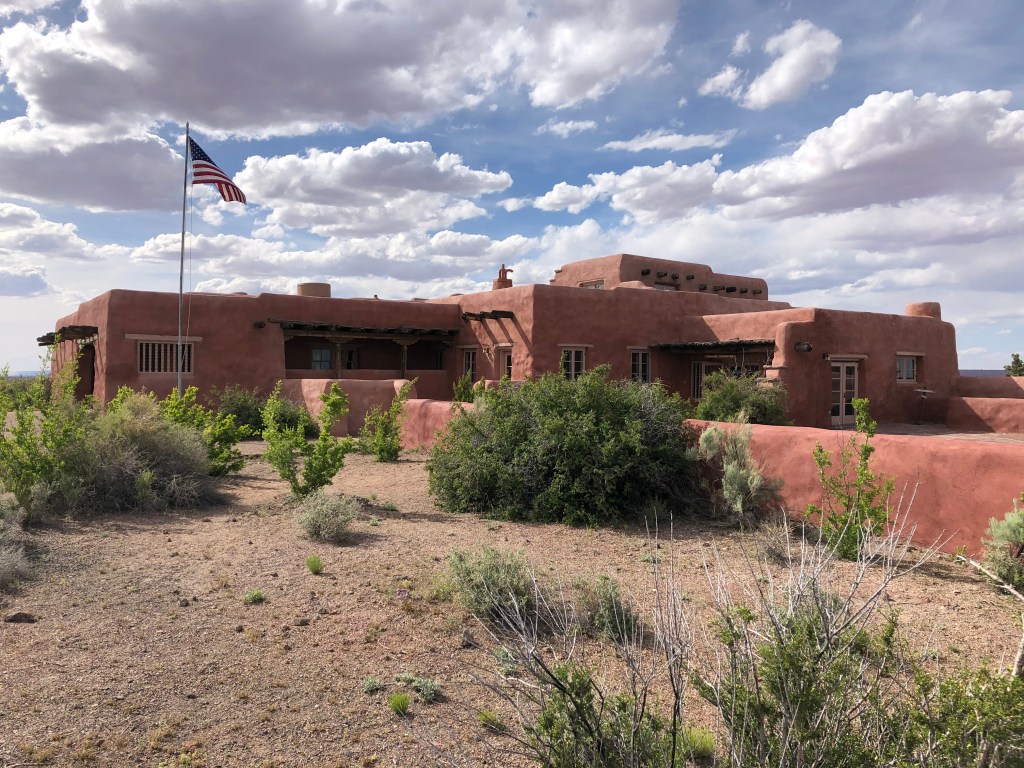
Patricia, or Trish, Stoddard was really worried about Frankie.  She was attracted to him by his charm, his carefree attitude, and, ok, his resemblance to Errol Flynn.  But he was proving to be too carefree and not a very deep thinker.  They had left Flagstaff with a satchel full of cash from a savings and loan, heading for a new life in Chicago, when Frankie pulled off Route 66 and stopped in front of the Painted Forest Inn.  “What are you doing?”, she demanded.

“I’m tired, all the excitement you know, this place is supposed to be nice.”

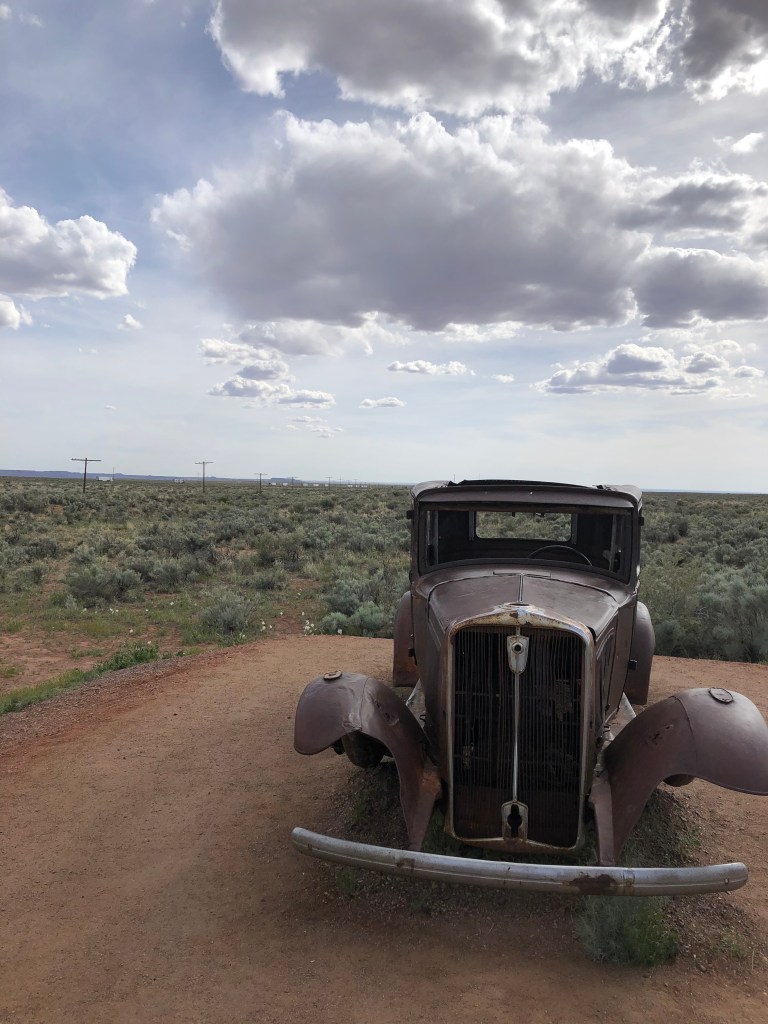
“Frankie!  We can’t stay anywhere near Flagstaff; don’t you think the cops may be looking for us?  Especially the car!  I told you to Jack a black Ford or Pontiac.  But a blue Studebaker?  Think, Frankie! Think!”

“But I like the color blue.”

“Go! Here comes the valet!”  With a spray of gravel and a cloud of dust, Frankie zoomed out of the lot.  “I’m worried now Frankie, really worried.”  

They didn’t get much further when the Studebaker sputtered to a halt.  “Yup, out of gas.”, declared Frankie.  

Trish helped him push the car to a spot not easily seen from the highway.  Disgusted to the point of being near speechless, all Trish said was, “You’ll have to walk back and get gas from the station at the Inn.  I’ll take first watch, you take the second.  We need to get on the road as early as possible.”

Seeing Frankie asleep at dawn the next morning instead keeping a lookout for intruders, mostly cops, added to Trish’s fear that they may not make it to Chicago.  But his cheerful disposition and eyes filled with love, after being kicked awake, warmed her heart.  He turned and waved an arm at the pastels of the desert.  “Look at this view Trish!  This is beautiful!  Why don’t we just build a place here.  Nobody will bother us.  It’ll be just you and me, and this lizard.”  The collared reptile had re-emerged and was watching them from his rock perch.

“We can’t Frankie, even if we wanted to, it’s a National Park..”

Trish’s words were cut off by the demands being shouted from the rocky outcrops surrounding them.  “Put up your hands!  Don’t move!  We have you covered!”  Their hands flew up.  Tears began to course down Trish’s cheeks.  

Men in police uniforms and suits, all pointing pistols at them, slowly emerged from behind the rocks and walked towards them.  One of the uniforms was leering at Trish.  “Well, we’ll.  I believe I’m gonna have to pat you down for a weapon. Heh, heh.”

“Don’t you lay a hand on her!”, Frankie snarled.  Before Trish could stop him, he laid a fist squarely on the jaw of the cop.  Two pistol shots and a scream “NO!” resounded across the desert.  The collared lizard scurried back into its hideout.

1932 Studebaker near the Painted Desert Inn. The car has a bit part in my story. Photo taken by me in May, 2019.
The Painted Desert Inn. My characters beat a hasty retreat from here in my story. Photo taken by me in May, 2019

Ernie Stricsek

Sturgis Library Writing Group

May 30, 2023

A Cabin In The Dunes

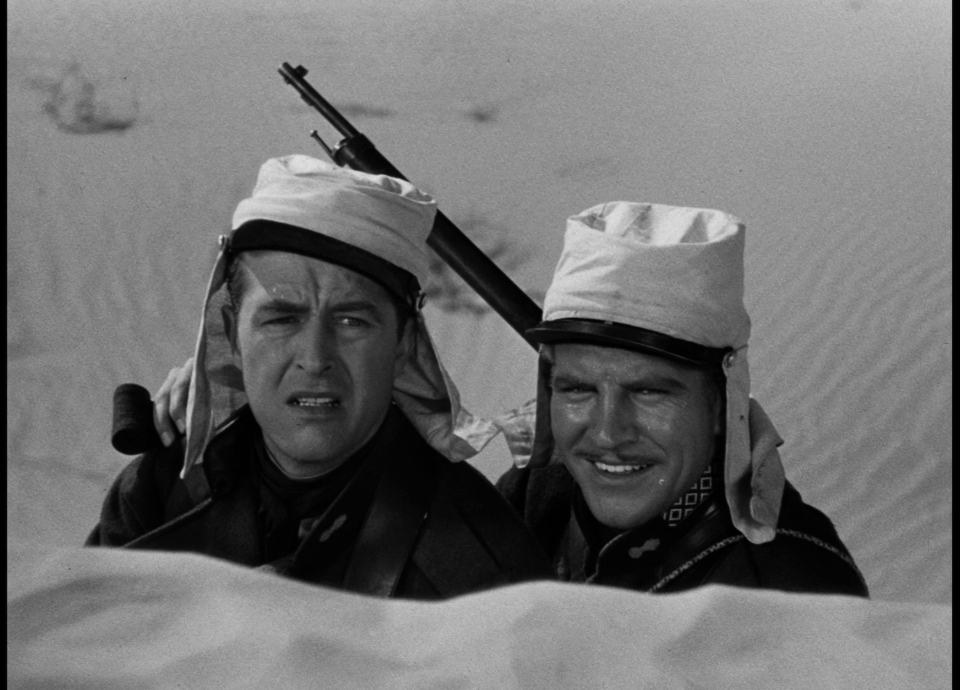
A scene from the movie “Beau Geste”, the Algerian desert is the setting for my story.

The prompt for the Sturgis Library Writing Group was “A Cabin In The Dunes”. I set my story in the Algerian desert before the start of World War I. My characters are in the French Foreign Legion.

The Cabin In The Dunes

Sergeant Dagineaux lowered his binoculars, wiped the perspiration from his brow and passed them to the man lying on the ground next to him.  

“Between those two sand dunes, Corporal Reynaud, at about one o’clock, tell me what you see.”

Reynaud peered in the direction Dagineaux had pointed to.  He pulled his head back, blinked several times, and peered through the binoculars again.  He passed them back, a puzzled look on his face.

“I see a bloody cabin, Sergeant!  It’s not a mirage, our eyes aren’t playing tricks on us.  What’s a bloody log cabin doing in the Algerian desert?”

“Well Corporal, we need to find out now, don’t we?”  

Dagineaux and Reynaud stood, unslung their rifles and cautiously approached the cabin.  As each step brought them closer, the strange building became clearer in the shimmering reflections of the sun off the sand.  It was indeed a log cabin.  Nestled as it was between the two dunes, they hadn’t seen the well and small garden flanking the cabin with the binoculars. Vegetables were growing in the garden.  Standing exposed, there was no place to hide in the desert, but they didn’t sense danger.  It was surreal, Dagineaux felt compelled to knock on the cabin door.  He and Reynaud were startled to hear a voice croak, “Come in.”  The Sergeant slowly opened the door, its hinges squeaked in protest.  An ancient looking man was seated at the head of a table.  A broad toothy grin appeared in his bearded face.  “Ahh! My relief has arrived!  Sit gentlemen, sit!  We have much to discuss, and very little time to do it in.”

Completely baffled, Dagineaux asked, “You were expecting us?”

Pointing to a thick book on the table in front of him, the old man replied, “Yes, of course, the manifest states Sergeant Claude Dagineaux and Corporal Victor Reynaud, of the French Foreign Legion, will arrive to assume my duties on the ninth of May, 1905.  That is today gentlemen.”

“But we must return to our fort in Adrar, sir.  A member, or members, of our patrol drugged the Corporal and I, then deserted. Taking six camels and all of our supplies.  We have to report this to our commander.”

“None of that is necessary now, Sergeant.  A higher power has deemed you’re needed here.  It’s all in the manifest.”

“Umm, what is it we are expected to do?” asked Reynaud.  He thought he would humor this man, who was obviously daft.

The old man stood, every joint in his body cracking with the effort.  He motioned for them to follow him to a desk in the corner of the cabin.  An even larger book sat on it.  Books of similar size were arrayed on shelves lining the wall.  Each book had what appeared to be a range of years stenciled on the spine, 1875 – 1900, and so forth, back to the 1700’s.  He opened the book on the desk to a marked page.  “From time to time, you will have visitors, seeking to go through that door,” he pointed to a padlocked door on the wall opposite the desk.  “You must ask them their name.  If it doesn’t appear in this logbook, they can’t go through that door.  Send them on their way, no matter how much they protest.”

Dagineaux and Reynaud looked at the names listed in the columns on the open page.  “Parks, Robert”, was the last name in the column.  “That’s me,” said the old man, “When I am done here, you will unlock that door and let me pass to the other side.”

“And where does that door lead?” asked Dagineaux.

Before the old man could answer, the door to the cabin swung open.  Another legionnaire stumbled in.  

“Gastineau! You bastard!” howled Reynaud, “You left us to die in the desert!”

The old man put his hand on Reynaud’s shoulder to calm him.  Gastineau had a bewildered look on his face.   “I’m sorry.  Something went terribly wrong, Berber tribesman ambushed us…,” looking at the locked door he continued, “I assume I pass through there?” He took a step towards it.

“No! You’re not in the register.  Run along now, go back the way you came.” ordered the old man.

Gastineau sobbed, dropped his head and shuffled back out the front door, closing it behind him.  “It’s as simple as that,” said the old man.  He pulled a key from his pocket and handed it to Dagineaux.  “Unlock that door please, it’s time for me to go.”  The Sergeant complied.  When the door was open, a bright, golden light bathed the room.  There was a stairway on the other side of the door.  The old man stepped into the light.  He was no longer old!  He appeared as young and robust as the two legionnaires.  “It’s the stairway to Heaven, my friends, guard it well.”  He paused for a moment and smiled, “Stairway to Heaven, I envision someone writing a song about it someday.  Goodbye my friends.”  And with that he dissolved into a cloud of golden dust, the door slammed closed.

Dagineaux reattached the padlock and turned to look at Reynaud, “Bloody h….”

“Don’t swear Sergeant!  You sure don’t want to scotch this sweet assignment.”

Ernie Stricsek

The Sturgis Library Writers Group

May 9, 2023

The Picket Line

Yankee and Rebel pickets meet on the Rappahannock River at Fredericksburg, Virginia. The setting of my story.

Two summers ago I joined a fiction writing group that was designed to provide guidance and insight for writers intending on creating a novel. Over that summer I wrote six chapters of what I hope to become a historical novel set during the American Civil War. Besides needing to get back to that effort, I have written three stand alone stories using the same characters. The prompt for the Tuesday Sturgis Library Writers Group was “I Heard That…”. I went back to my historical novel characters and wrote a fourth stand alone story, which could be incorporated into the novel. I italicized and emboldened the prompt in the following story.

The Picket Line

Fredericksburg, Virginia, December 12, 1862

The waning Gibbous Moon illuminated the rutted path to the Rappahannock River crossing.  The temperature had dropped as the sun set making the path icy in spots.  Fearing his horse may slip, the rider dismounted, tied its reins to a sapling and walked the rest of the way to the river.

A voice with an Irish brogue called out of the shadows of the trail, “Halt! Who goes there!”  

“Captain James Bartlett, Corp of Engineers, and aide to General Burnside.”

The guard called for Bartlett to approach.  After exchanging salutes, Bartlett noted the brass numbers and letters on the guards’ cap, “69th New York Volunteers, cheers to the Irish Brigade!”

“Thank you, sir.  How can I be of service?”

“Can you direct me to the sergeant of the guard?”

“Follow the path to the river sir, Sergeant Quincannon’s ‘is name.”  Bartlett thanked the guard and continued towards the river.  Soon he could hear the river gurgling over the stones at the crossing.  The guards at the crossing had lit a small fire.  There were blankets tied to the tree trunks and branches to conceal its flickering flames.  Quincannon, sitting near the fire and sipping from a tin cup, stood and saluted Bartlett, then offered him a cup of tea.  Inquiring about the Captain’s visit, Bartlett answered, “I heard that men on the picket lines engage in commerce with our Rebel opponents across the river.”

Quincannon stammered, “That’s against regulations sir.”

Bartlett chuckled and said, “Don’t worry Sergeant, I know it happens.  I need to get a message to a friend on the other side. How do I arrange for that transaction?”

Quincannon hesitated a moment, leaned out from the cover of the blankets and called into the dark, “Corliss, you over there?”

A voice called back, “Howdy Quinn, what can I do fer ya’ll?”

“There’s an officer of engineers here says he needs to get a note to someone, can you help?”

“And what’s this officer of engineers have to offer us to be his messenger?”

Quincannon gave Bartlett a questioning look.  “Coffee and some brandy.”

Quincannon called back, “He’s got coffee and brandy Corliss.”

“I’ll be damned!  Send him over Quinn.”  Corliss told the other Rebels with him to not shoot.

Bartlett splashed across the cold, shallow river and walked into a circle of rather seedy looking Rebel soldiers.  Corliss stepped forward and gave a lazy salute.  Bartlett saluted back and handed over the brandy and coffee.  The circle of Rebels gasped.  Reaching into his coat pocket, Bartlett withdrew a letter and asked Corliss if he could get it to a cavalry officer named Captain Redmond Downes.  

“T’aint no cavalry here Captain”, said Corliss.

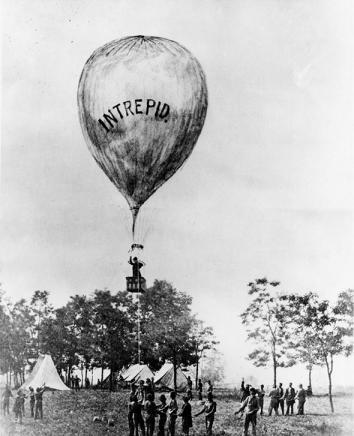
“I know there is, I saw them from the observation balloon today,” replied Bartlett.

Corliss was astounded.  “You were in that thang? I saw it today!  What’s it like to be so high up?”

“Scary as hell when it’s windy.  But you can see for miles. Please get this letter to Captain Downes,it is about a mutual friend of ours.  A young woman named Lizz.. Miss Elizabeth Haw.”

Balloons filled with hydrogen gas were used by the Union Army for aerial observation in the Virginia Theater of War until May of 1863. It was cumbersome transporting the balloons and gas generating equipage.

Corliss’ eyes narrowed, then his mouth twisted in a wry grin.  “Mutual friend, eh?  Soon to be closer to one than t’other I’m guessin’.”

“Please see that he gets it Mr. Corliss. I’d also like for him to know that I am still alive.”  

Corliss became serious again, “I am sorry Captain, I was just joshin’ with ya’all.  I’ll do my best.”

A Rebel burst through the brush startling everyone.  “Officers approaching”, he blurted out breathlessly.

Corliss turned to Bartlett, “You have to scoot sir.  I’m gonna to count to 10 and then we will fire off a volley.  Tell Quinn we’ll be shootin’ high, we’d be much obliged if ya’ll return the favor.”

Bartlett slipped, tripped and scrambled his way back to the Yankee side of the river, counting to 10 as well.  Reaching for Quincannon’s outstretched hand he told him what was about to unfold.  Sure enough, a volley rang out from the Rebel side of the river, the bullets humming through the branches high above their heads.  The Yankees aimed high and fired off a volley into the heavens over the Rebs.  A few insults were hurled back and forth.

Catching his breath, Bartlett thanked Sergeant Quincannon for his help.  Reaching into his sack, he handed the Sergeant a flask of brandy.

“Be’Jesus, you’re a saint sir.  You surely are!” Sergeant Quincannon exclaimed.

Bartlett shook the Sergeant’s hand and walked up the moonlit trail to his tethered horse.

Ernie Stricsek

Sturgis Library Writers Group, Barnstable MA

April 25, 2023

Sisters

A dark cafe, the setting for my story.

The prompt for the Chatham Writers Group this week was to write a piece that includes the following words: envy, beauty, hatred, insecurity, icon, compromise, reconciliation. My brief tale follows, I emboldened the words we needed to include. Also, I am working on trying to improve my skills writing dialogue, so this story is largely a dialogue between two people in a coffee shop, an actress and an entertainment reporter.

Sisters

The couple sat in a corner booth in the coffeehouse, away from the lights over the counter and entryway.  The air was rich with the fragrance of hazelnut coffee and cinnamon rolls.  The other patrons thought the woman looked familiar, but all they could really see was her back as she leaned forward to talk to her companion.  Then she would lean back and disappear into the shadow of the booth wall.  The man she was with would take a sip of his coffee, then lean towards her, a bemused expression on his face.  They were not really a couple, he was asking questions, then jotting things down in a little notebook.

“So, tell me, why were you and your sister not on speaking terms?”

“I never said we were not on speaking terms. We exchanged birthday wishes, holiday greetings, things of that sort.  We spoke.”

“Superficially though.”

“I suppose…”

“Were you envious of each other?  I don’t understand why that would be the case.  You are both confident and accomplished actors, of equal beauty.” 

“Perhaps, there was some envy…”

“But why?  You’ve each been awarded two Oscars, been nominated two other times….”

“Three Oscars.”

“I’m sorry, what?”

“My sister has three Oscars, she co-wrote a screenplay and won an Oscar for that.”

“Uh, oh, I’m sorry, I had forgotten…”

“Two Tony awards, and Emmy, Golden Globe..”

“So, are you envious of her achievements then?  I mean, you have been recognized as a leading actress for several years now.  Your sister has never had a leading role.  She has primarily been cast in character actor roles, or as a supporting actress.”

“She is SO DAMN GOOD in those character actor roles.  She is a greater scene stealer than Alan Hale ever was.  He was her favorite actor!  She got such a kick out of watching him steal scenes from Errol Flynn in all those old westerns and swashbucklers.”

“You acted together in one movie.  Did her presence, her being in the same scenes make you feel insecure?”

“I suppose.  Her comedic timing is precise, she is as skilled as a neurosurgeon in those comedy roles.”

“But that was a wonderful movie, you both displayed great comedic timing, you played off each other so well.  The roles of two women who were the play-by-play and color announcers of a minor league baseball team became iconic roles. It led to a TV series and a Broadway musical.  What was the problem?”

“She stole my scenes!  I was trying to use a dry wit to describe the incentives in the game program magazine. What the fans would win if a player hit a home run in a specific inning, like a meat tray from a local deli.  Then it would be her turn to describe incentives there were if the players on the home team accomplished a certain goal… like ‘Any Royalton Yankee who pitches a no-hitter, will win a free, rebuilt fuel pump from Tarducci’s Junk Yard’. But she did it with such great flourish.  She got all the laughs!  I hated her for it.”

“Why? That seemed insignificant.  And you were both nominated for Oscars.  You were both great.”

“That was her screenplay Oscar.  Do your research.”

“Ummm… I, …”

“Never mind.  I felt she wrote the best jokes for herself.”

“So that led to the falling apart.”

“I suppose.”

“What happened next?”

“A major studio expressed an interest in reviving the characters.  The two women had become so popular, they made it to the major leagues, broadcasting Pittsburgh Pirate games.  The city and team were all in for it.”

“Then what happened?”

“Our publicists and agents met and attempt to get us together for the roles.  I was reluctant, I promised to never star in another role alongside my sister.”

“Go on.”

“A compromise was reached.  My sister wrote the entire script this time and mailed it to me.  I was blown away.  The story line kind of paralleled our lives.  The two characters had gone through a falling out over a minor slight.  They reconciled and teamed up again, even better than they were in the minor leagues.  My character had become cynical and tough with the male ball players and coach.  I have some really good lines!”

“Wow.  That is fabulous news.”

“Ahh, here comes my sister now, I’ll let her fill you in on the plot details and when filming begins.”

Ernie Stricsek

The Chatham Writers Group

April 24, 2023

Good Bye

The prompt for the Monday Chatham Writers Group was to start your story with the words “Good Bye”. My fictional piece follows.

Good Bye

“‘Good bye.’ Those were the last words she said, just good bye.” 

“Wow, with great finality it sounds.”

“I suppose.” Detective Jerry Mullins shrugged and glanced at his wristwatch.   He reflected on the past two hours.  He had entered the hospital cafeteria, his detective shield clipped to the pocket of his sports jacket.  A woman in uniform waved to him.  Next to her on the table was a cap with the familiar black and gold checkerboard pattern above the bill.  Pittsburgh PD.  He walked over to her table and introduced himself.  She had a firm handshake and said her name was Fran Parker, a Sergeant in the Oakland Precinct.  The Sergeant’s name sounded familiar to Mullins, but he couldn’t recall from where.

He noticed there were two coffee cups on the table in front of her.  She pushed one in his direction and asked him if he was working a case.  When he answered affirmatively, Sergeant Parker asked if he could tell her about it.  He looked around to make sure there wasn’t anyone who could overhear them.  The cafeteria was nearly empty save for a group of hospital staff huddled at one table too engrossed in their conversation to pay attention to anyone else.  Nonetheless, Mullins leaned in a bit closer and laid out the details of the case to Sergeant Parker.  It was a white collar crime case and it involved a childhood friend.

He told Sergeant Parker his friend had introduced him to Laura, his new girlfriend.  “She was stunning.  Now mind you, Curt’s a super guy, however he makes Steve Buscemi look handsome.   The new girlfriend seemed to really like Curt.”

“I sense a but here, Detective.”

“Oh, yeah,” said Mullins, “a couple of days ago we received a bulletin from the Cleveland PD to be on the lookout for a con artist who’s MO was to establish relationships with men in order to obtain their financial info and empty their bank accounts.  The photo that accompanied the bulletin was Curt’s new girlfriend.  Different color hair and wearing glasses, but it was definitely Laura, which apparently was one of the five names she used.”

“So did you tell Curt?” asked Sergeant Parker.

“Yes.  And, Oh God, did he fall apart.  The timing was great because he was ready to give Laura 25 grand.  Tonight as a matter of fact.  Curt told me where Laura was staying and my partner and I went to arrest her.”

“That was tonight?.  How’d it go?”

“Laura, or whatever her real is, was a great actress.  She feigned innocence, then she hugged herself as she was crying real alligator tears.  Suddenly looking up and laughing maniacally, she pointed at me, a glint of metal, then, “‘Good Bye’. Those were the last words she said, just Good Bye’.”

“Wow, with great finality it sounds.”

“Yeah, I suppose.”

 “So what’re you doing here at the hospital?” asked Sergeant Parker.

“Waiting for word on a gunshot wound victim.” Mullins took a sip from his coffee cup.  He  thought, “When did I get a refill?”  Looking at Sergeant Parker, he asked, “So, what are you doing here?”  Before she could answer, it dawned on Mullins where he had heard her name before.  “I know who you are…” his voice trailed off.

“I’m always here detective, but you have to leave now, you’re going to be alright.”

“Wait, Sergeant Parker, what did you say?”

“Glad to see you’re awake!  I said you’re going to be alright Detective Mullins.  You’re going to have a bad headache, but your going to be alright.  Who’s Sergeant Parker?”

“Who are you?” Mullins groggily asked.

“I’m Doctor Sinclair, the one who removed the small caliber bullet from your skull.  Instinctively, you put your hand up for protection.  It absorbed most of the impact otherwise we wouldn’t be talking.  Now who’s Sergeant Parker.”

“She died in the line of duty last year, but I saw her in the cafeteria.”

Doctor Sinclair nodded, “Get some rest Detective Mullins. You’re going to be alright.”

This story is loosely based on an actual incident that occurred to a friend of a friend. An attractive woman tried to bilk this guy out of thousands of dollars. Although the guy truly would make Steve Buscemi appear like Brad Pitt, he was no dope and figured out what the deal was. The woman who tried to grift him did not have an APB out on her – at the time, who knows now – and this happened over 40 years ago. Nobody was shot, there was no police involvement, the dialogue was made up. I fell back to the familiar haunts of Pittsburgh to set the background for my story.

Ernie Stricsek

The Chatham Writers Group

March 20, 2023

The Old Bethel Church

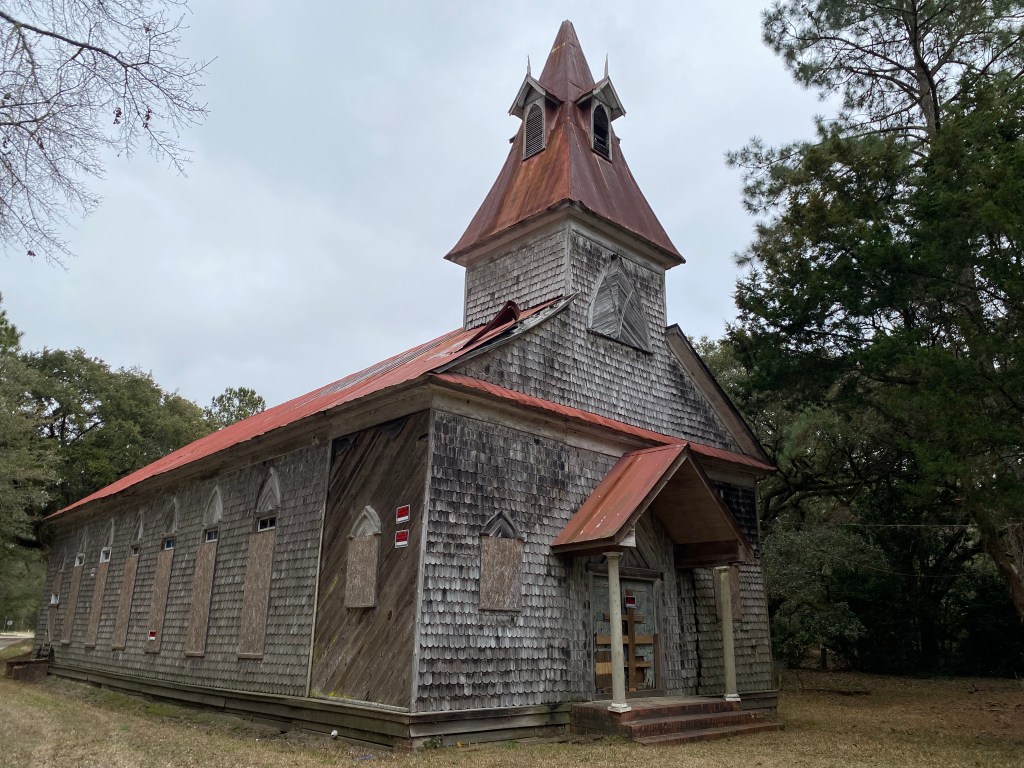
The Old Bethel AME (African-American Episcopal) Church in McClellanville, SC. A historic landmark built in 1872, The site of my story. (Photo taken by me in February, 2022).

I selected the photo of the Old Bethel AME Church as the topic for the Monday, 3/13/23, meeting of the Chatham Writers Group. I tried my hand at writing creepy, horror type stories this week (see Philadelphia Alley). I started writing my story and got carried away. I had several characters, some deaths and more gore, a couple of different locations, etc, and was approaching 2000 words on a story that was supposed to be no more than 1000 words. I eliminated characters, body count and scenes to concentrate on events at the church. At the end of my story, there will be a brief history of the Old Bethel AME Church.

The Old Bethel Church

Sheriff’s  Deputy Claire Simmons shifted uncomfortably in her chair and glanced at the business card in her hand, “Bennett Sisters Consulting”.  There was a phone number, and a satanic symbol with a red X through it. 

She made a quick inventory of the two African-American women sitting opposite her.  Identical twins, they appeared to be in their early 50’s, and were dressed almost identically with light blue denim shirts, jeans and walking shoes.  The only difference was one sister wore a navy blue bandanna around her neck and the other wore a pink one.  “And what type of, um, consultation do you provide?”, she asked.

The sister who had identified herself as Mae answered, “My sister, Lena, and I consult on matters of the occult.  We provide a cleaning service of sorts in that we remove demons, phantoms, those sorts of things.  They sometimes take over abandoned places of worship.  What’s your story Deputy Simmons?”

Choking back her emotion, the Deputy described how her Dad and his friend were walking past Old Bethel Church on their way to the pond to fish.  Her Dad suddenly stopped and started acting strange.  He was looking at the church and told his friend he needed to talk to someone, said to go on, he’d meet him at the pond.  His friend looked to where my Dad had been looking and saw the back of a man wearing overalls go into the side door of the church.  When my Daddy didn’t show up at the Pond, his friend went to look for him and found him behind the church with his throat ripped open.  

“Coroner said it was a rabid dog, but I believe the man in overalls had something to do with it.  Something ain’t right with that church.” 

“And your father’s friend didn’t tell his story to anyone else?”

“He was terrified Miss Bennett, so he only told me.  The man in the overalls didn’t appear to be real, he kind of shimmered.  My Daddy is buried in cemetery alongside the church.  When I go to visit him, the church seems to be mocking me.  I hear laughing and whistling coming from the slats on the belfry.  I told my Aunt, my Dad’s sister,  she told me about the two of you, and here we are.”

“Well, let’s go have a look see then.”, declared Lena.

“Now?” Deputy Simmons was incredulous.

“No better time than now.”  The three of them piled into the Bennett’s old Range Rover and drove off.

A pine tree lay across the dirt road that led to the Old Bethel Church.   The Range Rover clattered to stop and the three women climbed out to look at the tree.

“The pine must have fallen during the night,” said Deputy Simmons, “the road was clear when I patrolled it yesterday.”

“It knows we’re here.”, said Mae.  

The Bennett sisters opened the tailgate of the Land Rover and removed a few items.  Deputy Simmons was startled to see Mae carrying a viola case and Lena with a guitar gig bag slung over her shoulder. 

Without a word, the Bennett sisters climbed over the tree, and trudged down the dirt road.  The Deputy scampered over the downed pine and followed behind the twins.  A gentle breeze picked up, the moss draping the oaks that lined the road began to sway, seeming to beckon the three women to the church. 

The dirt road ended at a clearing.  Confronting them was the Old Bethel Church.  Deputy Simmons shivered, the air had gotten noticeably cooler.  “I feel it,” she said, “that church is looking at us.”

Not only did she feel as though the church was staring at them, she swore she could see it breathing.  The red tin roof and sides of the old building appeared expand and contract.  She sensed movement to the right of the church, shook her head and rubbed her eyes.   “Did those headstones just turn to look at us?”  Deputy Simmons inhaled deeply, she could see her father’s grave, his old fishing cap resting on it’s headstone.

“We’ll take it from here Deputy Simmons. You need to walk a ways back down the road,” ordered Mae.  

“You’re kidding!”, exclaimed the Deputy.  Mae stood holding a Super Soaker.  From her gig bag, Lena had assembled a 5 foot chrome rod with a cross on top and a spear point at the bottom.  Reaching for her pistol, Deputy Simmons said, “You’re gonna need more than a damn Super Soaker and a steel bar.  I’m going with you.”

“Suit yourself,” said Mae calmly, “You can figure out later how to explain what ya’ll will see.  And put that away, it won’t work,”  she added, pointing at the officer’s pistols. “ This Super Soaker has a mix of Holy Water and salts blessed in the Holy Land.  Lena’s rod is pure silver.  These things are demon killers.”

The side door flew open and slammed against the building, momentarily startling them. 

A figure wearing blue overalls appeared in the door.  Two bright, yellow orbs glittered in the shade cast by the wide brim hat on its head.  Waving a dismissive hand, the figure went back into the church.  The women looked at each other, then stepped through the door.  They stood for a few moments waiting for their eyes to adjust to the gloom.  Deputy Simmons thought the inside of the church had a metallic smell similar to that of a dead deer found along the side of the road.  Snapping on their on their flashlights, they circled the pews.  Lena broke away and began to move up the center aisle, holding the cross topped staff in front of her.  Mae and Deputy Simmons continued along the wall.  A shuffling noise came from behind them.  Simmons turned her beam in the direction of  of the sound.  She gasped.  The form shuffling towards them was her father, or what used to be her father.  A gaping, raw wound ran from his throat to just under his ear.  The dried blood from the wound had left a huge brown splotch on his fishing jacket.  His fishing hat, laced with lures, sat tilted on his head.

“Daddy?”, her voice choked with emotion.

“Claire! You’ve come to help me! Help me…” the apparition groaned and extended its arms.

Mae shouted, “No!”, and yanked the Deputy back.   The father/demon opened its mouth to reveal jaws lined with long piranha teeth, and began snapping at them.  Releasing a high pitched, fiendish giggle, it rapidly approached them.  The spear end of Lena’s silver staff jabbed through the front of its shirt, cutting off the laugh.  The demon looked down in surprise at the spear.  It turned a parchment brown color, broke apart and fluttered to the floor like tree leaves.  

A long howl ripped the air.  Lena aimed her flashlight toward the front of the church.  Caught in the beam of light, the yellow-eyed thing in bib overalls howled again, exposing a line of those piranha teeth..  It jumped from the pulpit and raced towards them, bounding along the backs of the pews, snarling.  Mae let loose a stream of the Holy Water concoction from her Super Soaker and stitched a line across the creature from right hip to left shoulder.  Without another sound, the thing fell apart in two pieces,  dissolving into a pile of parchment leaves as well.  Except for the sounds of their rapid breathing, the church was silent.

Two days later, Deputy Simmons and the Bennett sisters visited her father’s grave in the Old Bethel Church Cemetery.  The church was silent, the cemetery peaceful. Her father’s fishing hat rested on his headstone.  They were not certain if it was because of a sudden puff of wind, but it seemed as though the hat tipped, grateful for what they had done. 

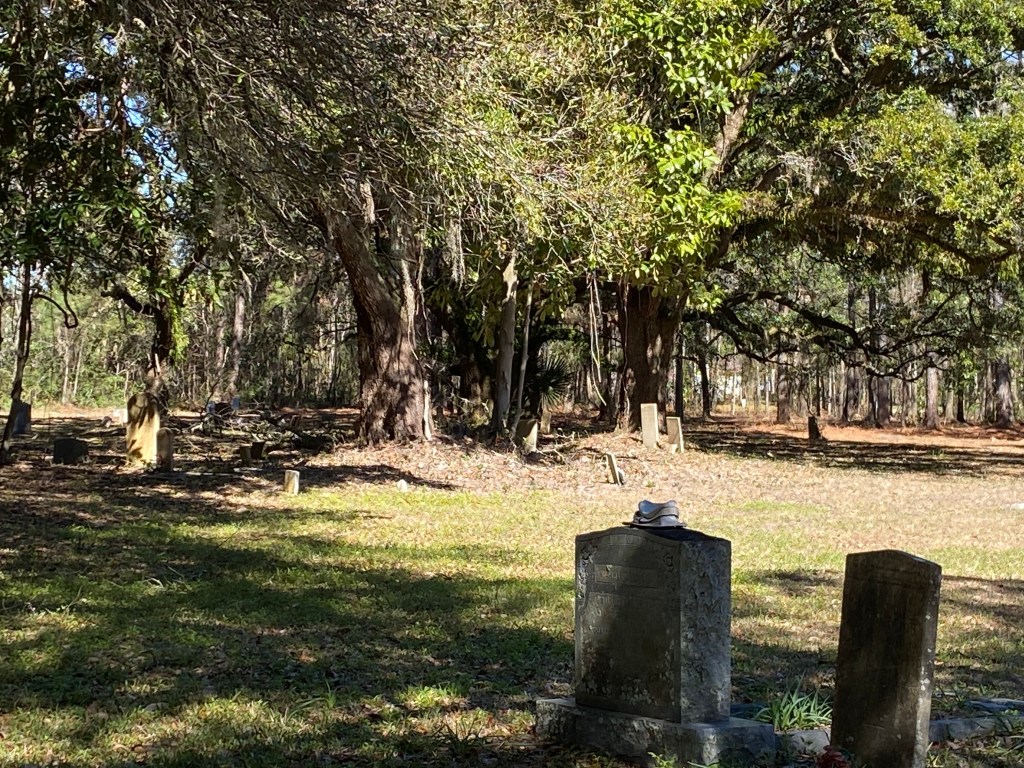
Fishing hat on headstone in the Old Bethel AME Church cemetery. Photo taken by my wife in February 2023.

The Old Bethel AME (African-American Episcopal) Church is the first AME Church created in McClellanville. With the end of the Civil War in 1865, former slaves were now allowed to build their own places of worship and the first congregation met under an oak tree in MClellanville in 1867. The Church was constructed in 1872, damaged by a hurricane in 1916, repaired and continued to host services until 1979, when a new Church was built for the growing congregation. In 1986, the Old Bethel Church was lifted off its foundation by Hurricane Hugo and almost all of its stained glass windows were shattered. It was supposed to be converted to a community center in 2002, but for some unexplained reason, it never happened. Old Bethel Church was used as a backdrop for a 2019 min-series called “Lowcountry”, but then was vandalized. The remaining windows were boarded up and it has remained vacant.

Ernie Stricsek

Chatham Writers Group

March 13, 2023

Philadelphia Alley

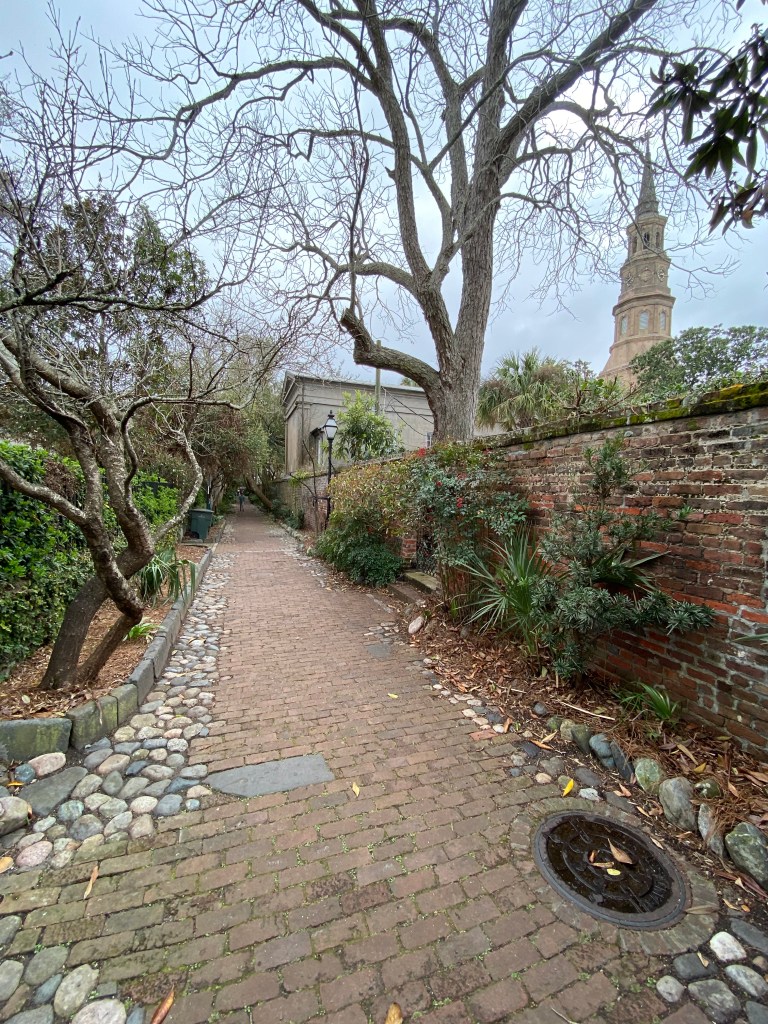
Philadelphia Alley, Charleston South Carolina. The steeple of St. Philip’s Church rises above the wall to the right. The setting for my story

This week’s prompt for the Sturgis Library Writing group was to write a story/memoir/poem using the photo of the alley shown above. My tale of mayhem follows.

Philadelphia Alley

Sergeant-Major Poe stood at  the parapet of Fort Moultrie, jotting down his observations of Sullivan’s Island in a notebook.  Shortly after his arrival at the Fort, the local inhabitants told tales that the pirate, Captain Kidd, had buried a substantial treasure somewhere along its shores.  The tales had given Poe an idea for a short story and he had begun to create a plot line.  To help potential readers develop an image in their minds of the story’s setting, he wanted to provide a description of Sullivan’s Island.   Poe stopped writing for a moment and gazed off to the west across the wide expanse of Charleston Harbor at the city of Charleston itself.  In the setting sun, he could just make out the stately homes on Battery Street and the tall spire of St. Philip’s Church.  His line of concentration was interrupted by the approach of one of the post’s orderlies.   He snapped Poe a crisp salute and pulled a folded piece of paper, sealed with wax, from his leather messenger bag.  “Lieutenant Griswold’s compliments Sergeant Poe, he asked me to pass this order to you.”   Poe thanked and saluted the orderly.  Breaking the seal and folding open the note, he read that he was being ordered to Charleston the following morning to oversee the unloading of munitions from a supply ship and to ensure their delivery to Fort Moultrie.  He would be met at the docks by Monsieur Paul Douxsaint and would be a guest at his house.  Poe signed the log book acknowledging receipt of the order and proceeded to his quarters to prepare for the trip.

The unloading of the supply ship began mid-afternoon and ceased at dusk.  As Poe stepped from the gangplank on to the dock, a rather well dressed man in top hat and carrying a bejeweled cane approached and introduced himself as Monsieur Douxsaint.   Gregarious and possessing a delightful French accent, he invited the sergeant to dine with him at a private club called the Vendue.  By the time they completed their dinner, darkness had fallen and the streets were illuminated by flickering gaslights.  Walking along Queen Street on the way to the Douxsaint house they had reached the intersection of Philadelphia Alley when their conversation was cut short by a horrible scream that made the hairs on the back of their necks stand up.  It was a woman’s scream and it came from somewhere in the Alley.  As they stared into the darkness, a second scream made them jump.  Poe started to make his way into the Alley but Douxsaint grabbed his arm.  

“Sergeant Poe, please, do not enter they Alley, it is dangerous.”

“But it sounds like a woman is in trouble Monsieur, she needs our help.”

“It could be a ruse to lure us in, Sergeant Poe.  We will be discovered in the morning with our skulls bashed in, our money and valuables taken.”

Women’s screams and the hoarse shouts of men disrupted the darkness of the Alley.

Poe retrieved a pistol from his valise and drew his sword.  “Tell me what’s down this Alley, Monsieur.  Someone is in desperate need of help.”

“A few apartments, the entry to the church cemetery on the left.  The Barnwell Mortuary on the right.”

Poe disappeared into the darkness.  Douxsaint uttered a curse, and began to shout for the police.  He gave the jeweled head of his cane a twist and pulled it, extracting a short sword from its hollow body.  “Wait for me Sergeant!”  

The two of them crept slowly along Philadelphia Alley, listening.  The shrieks and shouts had stopped for the moment.   A door swing open and slammed against the wall, making them retreat a few steps.  A shaft of light from the other side of the door broke through the darkness in the Alley.  They gasped as a man staggered from the door, the handle of a knife protruding from his neck.  Falling to the ground, blood from his severed jugular sprayed the Alley.  Poe and Douxsaint ran to the fallen man, but they saw he was beyond help.  Douxsaint stood and began to shout as loudly as he could for the police, anyone, “Murder! Murder!” he yelled.

Readying his sword and pistol, Sergeant Poe went through the open door.  What he saw revolted him, his dinner gave a huge roll in his stomach.  On the floor lay the body of another man, mouth open, empty eyes facing the ceiling.  It appeared he had been stabbed in the heart.  On a table was the body of a third man, but it was clear he was being prepared for burial.  “The morgue,” thought Poe.

“Oh Mother of God!”  exclaimed Douxsaint when he came through the door.

Shouts and screams from two women came from somewhere else in the building.  They pushed through a set of doors into a wide hallway.  To their left was a staircase leading to an upper floor.  The sounds seemed to be coming from there.  Bolting up the stairs they stopped to listen.  A struggle could be heard from a balcony behind them, in the front of the building.  Racing out to the balcony, they saw a woman gripping another woman by the throat with one hand, while trying to plunge a knife into her chest with her other hand.  The second woman was using both of her hands to keep that from happening.  Poe could hear the sounds of police whistles from the street below.

“Madame, please, put down the knife,” Douxsaint said softly.

The quiet French accent had an effect on the knife wielding woman.  She looked at Poe and Douxsaint, blinked and dropped the knife.  “They killed my husband,” she sobbed, “they cut him open down in that room.” Looking at her blood stained hands and clothing, she gasped, “What have I done?”

Police officers boiled out on to the balcony.  Quickly assessing the situation they escorted the knife wielding woman away.  From the woman who had been attacked they learned the knife wielder’s husband had died of consumption the previous day.  The morticians were in the process of preparing his body for burial when the distraught wife burst in.  Seeing her dead husband displayed on the table made her go berserk.  She grabbed a dissecting knife and stabbed one of the morticians in the heart then jammed the knife into the neck of the second mortician.  Then she grabbed another dissecting knife and came after her.  Gesturing at Poe and Douxsaint, she said, “The gentlemen arrived in time to save me.” 

Before giving their version of what they witnessed to the police, the gentlemen were asked to provide their full names and occupations.

“Monsieur Paul Douxsaint, shipping merchant.”

“Edgar Allan Poe, Sergeant-Major, Company H, 3rd United States Artillery.”

The police completed their questioning and allowed Poe and Douxsaint to leave.  Sipping brandy in the parlor of his home, Douxsaint shuddered.  Looking at Sergeant Poe he said, “My dear Edgar, this has been a truly horrific night.  I don’t know if I will ever see another restful night of sleep.  God, I will forever rue the night we came upon the murders at the morgue.”

Edgar Allan Poe looked at the brandy in his glass and swirled it once.  “Murders? Rue? Morgue? Hmmm…” he thought.

A drawing of Edgar Allen Poe in his uniform at the time he was at Fort Moultrie on Sullivan’s Island. The stripes on his sleeve are not those of a Sergeant-Major, he didn’t achieve that rank until later in 1828.
The house of Paul Douxsaint on Church Street in Charleston, S.C., built in 1725, still standing today. My story ends in the parlor of this home.
Saint Phillip’s Church. Philadelphia Alley runs behind the Church, the Douxsaint home is a block away.

I took some creative license in writing this story, what is factual follows:

  1. Edgar Allan Poe was a member of Battery H, 3rd U.S. Artillery at Fort Moultrie S.C. from 1827 to 1828.  He wasn’t promoted to Sergeant-Major until after his transfer to Fort Monroe in Virginia in December, 1828.
  2. For some some reason, Poe enlisted in the army using the name Edgar A. Perry, perhaps to disguise his age?  He said he was 22, but was really 18 when he enlisted.  He resigned from the service near the end of 1828, at which time he revealed his real name and age.
  3. Poe did use the setting of Sullivan’s Island and the rumors of Captain Kidd’s treasure as the inspiration for his short story, “The Gold Bug”.
  4. St. Philip’s Church was built in 1836, 9 years after the time line of my story.
  5. Paul Douxsaint was a real person, his home still stands, two blocks from St. Philip’s Church & Philadelphia Alley.  He built his home in 1725, so he would never had met Poe.
  6. The Vendue is a boutique hotel on Queen Street in Charleston, but didn’t exist at the time my story takes place.  I thought it was a cool name to use.

Ernie Stricsek, The Sturgis Library Writers Group, March 15, 2023

The Whistleblower

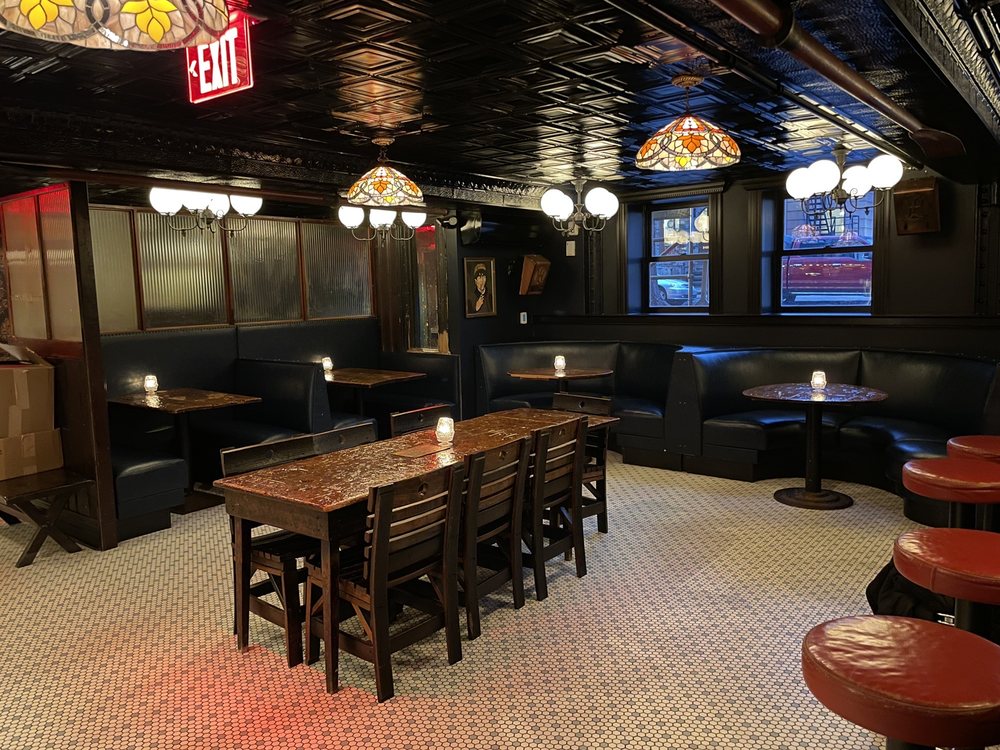
Cobalt Strip – the root of all evil in my story

I am getting behind on my story posts! The prompt for the Sturgis Library Writing Group last week was to write about a piece of mail you received, in any genre. A couple of years ago, I began writing writing a series of fiction stories, based on true events, using a young reporter working for a fictitious Pittsburgh newspaper (The Manchester Press & Journal). This young reporter hopes to someday become a sports writer covering his beloved Pittsburgh Steelers. But in the mean time, because he is relatively new, he keeps getting assigned to a hodgepodge of stories. The only “sports” type story he wrote about was a pigeon race held at a place called “World of Pigeons”, located in a small town in the north central Pennsylvania coal region. My story is sprinkled with Pittsburghese, a language I became fluent in. At the end of my story, I will reveal the real events this story is based on.

The Whistleblower

Sly from the mailroom interrupted my line of concentration in crafting a brilliant story about the cow patty bingo tournament I had witnessed at the Washington County Fair.

“Yo Rookie!  Looks like yinz got a fan.  There’s a real letter, addressed to you personally, mixed in with this stack of junk mail.”

Even though I have been with the Manchester Press & Journal for almost three years now, Sly still referred to me as “Rookie”.  

“Thanks Sly.  Even junk mail is typically addressed to me, though.”  I called the mailroom guy Sly because he was anything but Sly.  He liked me calling him Sly, but he wasn’t sly enough to note it was a slight.

Stuck in the fold of an ad telling me if I could draw the pictured lumberjack I would be eligible for a scholarship to some obscure art school, was a plain white envelope.  The address was from someone named Hamilton in Strabane Township, about 20 miles SW of Pittsburgh.  It seemed to me that most people from the Strabane area called Pittsburgh “Picksburg”, and I wondered if they spelled it that way.  Seeing Pittsburgh spelled correctly on the envelope dispelled any doubts I had.

I debated opening the letter, was it hate mail?  I wasn’t in the mood for hate mail.  But my curiosity got the better of me so I slit the envelope, pulled the contents out and began to read.  Astounded by what I read, I had to read it a second time and went from astonished to mystified.  The letter was sent by a fellow named Steve Hamilton.  He said he’d met me when I wrote a story about an industrial accident that occurred in the factory he worked at.  I vaguely remembered him.  In the body of his letter, he was essentially blowing the whistle on his company, specifically on a co-worker and a few people on its management team.  He was accusing them of stealing raw material and scrap and selling it for personal gain.  He referenced an incident where 10 tons of cobalt strip shipped to a company in Ireland for conversion into industrial diamonds never arrived.  When the crates were opened, they were full of sand.  That story did jog my memory, but I didn’t realize it involved the company Steve worked for.  He said about two months after that disappearance, two managers bought up-scale homes in Canonsburg and his co-worker was tooling around in a Datsun 280Z.  He said he would like to meet to show me some Polaroid photos he took as evidence and gave me a phone number to call, and a specific time to call, which made me believe I’d be calling a pay phone.  Making the call at the requested time,  the traffic noise in the background confirmed the pay phone guess.  Steve asked if we could meet in “Picksburg” he didn’t want anyone he worked with seeing him talking to a stranger, much less a reporter.  I suggested we meet at my favorite dive bar, The Three Deuces at 222 Federal Street.  They had great kielbasa sandwiches and Wednesday was pierogi night.  I asked him if he wanted to talk to the police, I was good friends with a couple of Pittsburgh’s finest and assured Steve they would be discreet.  He hedged a bit, then agreed.  It being Monday, we would meet in two days on Pierogi Wednesday.

The Three Deuces, 222 Federal Street on Pittsburgh’s North Shore. A favorite meeting place for my characters. Sadly, the Three Deuces was torn down several years ago.

A visit to Three Deuces is an experience that ends in sensory overload.  Directions to it were easy, cross the Roberto Clemente Bridge and the bouquet of kraut and kolacz will draw you to its doors.  The air in the bar was so dense with smoke from the grill and cigarettes, it would have resisted a chain saw.  I found the bar by bumping into it and was greeted by Eddie Stanko, the owner of Three Deuces and now a good friend.  

“There’s a guy with a big rent in his head askin’ for yah.  He’s in the booth you reserved.  I don’t mean to be nebby, but will the detectives be joinin’ yinz?”

“Yes,” was all I said. 

Eddie jammed an ice cold Iron City in my hand and said, “Try not to stare at the gash in his head, it might make him self conscious.”

“Thanks, like that’s all I’m going to see now.” 

Sure enough, Steve had a big cut on his head and a black eye.  Asking if the thieves were on to him and roughed him up, he said, “Nah.  My wife and I were at dinner celebrating our anniversary.  I said I wanted a divorce and she hit me with an ash tray.”

“Nobody will ever accuse you of being a romantic Steve.  That’s for certain.”

“My crook co-worker is her brother-in-law.  She knows what he’s up to and has dished up huge quantities of grief on me for not getting involved.  It’s gotten really bad.  I am not a crook, so I wanted out.  This is my reward.” He pointed at the cut on his head.

My Pittsburgh PD friends, detectives Pat Martin and Jack Rowan, joined us.  Their eyes flew wide when they saw Steve’s horrible head wound, but they said nothing.

We listened intently to Steve’s tale.  He laid out a dozen Polaroids he secretly snapped of his co-worker sneaking Cobalt scrap out to his car.  He had another batch of photos showing the two managers overseeing the loading of coils into a curiously unmarked truck.  When asked why he didn’t go to the higher authorities within the company, Steve said he thought they may be involved as well.  His wife had let something slip about the plant manager buying a summer home in the Outer Banks.  Suspicious of everyone, he felled compelled to reach out to me.

After hearing Steve’s story, Pat & Jack sat back, deep in thought.  Jack leaned forward and said he and Pat were going to have to run this past the Chief of Police.  Federal laws were violated, this was under the purview of the FBI.  Pat looked at me and said, “We can’t say anymore, your involvement ends for now.  If a story breaks, we will do our best to make sure you get the scoop.”  Thanking Steve for his bravery and me for involving them, they disappeared into the smoke.  

Out of the fog appeared Eddie holding a tray with a plate of pierogies and two frosty Iron City beers.

The FBI did conduct an undercover operation and sure enough, the corruption not only involved the plant manager, but also the regional sales manager and group vice-president.  True to their word, Jack and Pat did pull strings for me to scoop the story and I made the short drive to the factory to interview other management and hourly personnel.

While hammering the plant controller as to how he could have missed the large quantity of unaccounted materials and revenue, a motion outside the picture window in his office made me pause my line of questioning.  It was Steve Hamilton sprinting past.  A woman was chasing after him, but her high heeled sandals hampered her pursuit.  Picking up a rock, she screamed “You bastard!” And threw the rock at Steve, catching him between the shoulder blades. Roberto Clemente would have been proud. 

The controller turned to look back at me.  His eyes were bulging and his mouth agape.  He was trying to form words.

“They’re getting a divorce,” I said.


*Notes*: this story is based on true events. Forty two years ago, a work colleague was terminated for stealing and selling cobalt scrap for personal gain. The majority of the earth’s cobalt is mined in the Republic of Congo. Civil War erupted there in 1980 and the price of cobalt skyrocketed, almost quadrupling in price. The guy I worked with tried to cash in on the boon. Although he was never caught red handed with the goods, there were strong eyewitness accounts that led to his dismissal.

The story of the guy Steve (not his real name) getting brained with an ashtray after telling his wife he wanted a divorce is true. I was the first one to see him when he arrived at work and he told me his story. A short time later I saw him sprint past my office window, his wife chasing after him pelting him with rocks. Those decorative, white landscape type. She had a good arm!

Ernie Stricsek

The Sturgis Library Writing Group

February 20, 2023