400 Years, Tracking the Pilgrims


First Landing

2020 is the 400th Anniversary of the Pilgrim’s arrival in Massachusetts. This was supposed to be a huge celebration year with lectures, re-enactments, etc. Things came to a screeching halt in March as the Coronavirus roared into the state and things were shut down. Activities did eventually resume, albeit via webinars or socially distanced get togethers with limited numbers of participants. In 1620, the destination of the Mayflower was actually the mouth of the Hudson River. Crossing the Atlantic, the Mayflower drifted to the north and the first land to be observed was the northern shore of Cape Cod. Turning south, the Mayflower encountered what would become the graveyard of many ships, the shoals of Pollack Rip just off the coast of what is now the town of Chatham. The journey to the Hudson River was abandoned and the Mayflower turned north. Rounding the tip of Cape Cod the Mayflower dropped anchor in Cape Cod Bay on November 11, 1620, off latter day Provincetown.

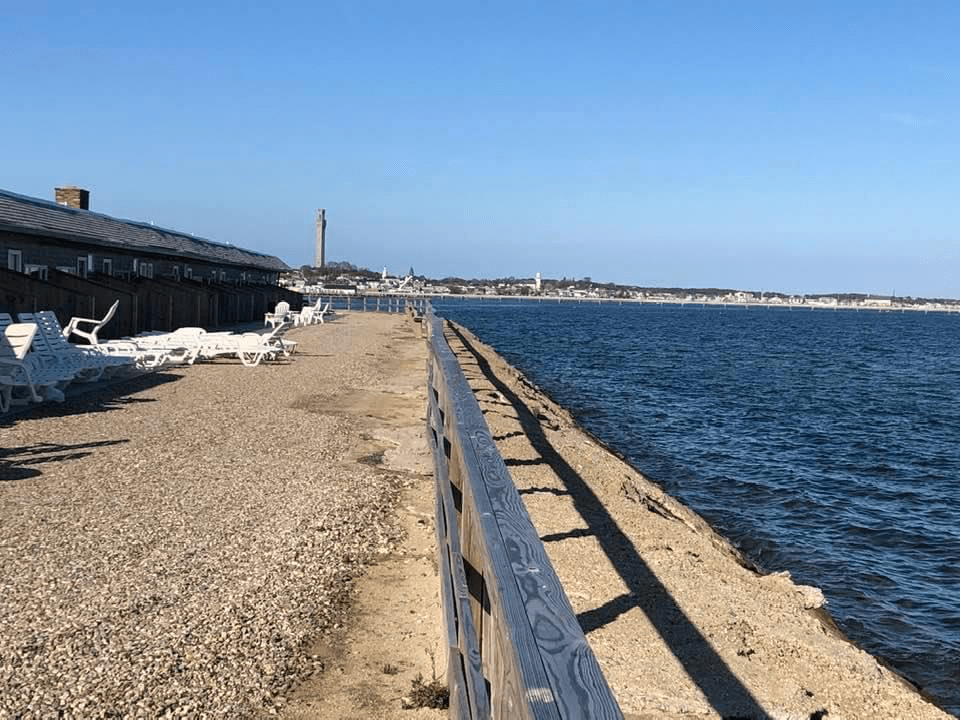
Barb and I attended a webinar last night about the Pilgrims first year in New England. Included in the talk was a map with a list of locations that the Pilgrims explored. Today we took advantage of a beautiful fall day to visit some of the sites. The images below are in Provincetown. In the image on the left the tall tower in the distance is the Pilgrim Monument. The Mayflower is believed to have anchored in the bay in the area just past the end of fence. The photo on the right is a small marker commemorating the arrival of the Pilgrims on November 11. The area is being renovated and we could not get closer to the monument.

Initial Shallot Excursions

The second stop on our tour of sites the Pilgrims explored was Corn Hill. Using a small skiff called a “shallot”, 16 men sailed from the Mayflower seeking likely places for food sources or inhabitants (Native Americans of the Payomet Tribe). Arriving at a stretch of beach with a high prominence behind it, the Pilgrims came ashore and began to explore. Climbing the hill they discovered several unoccupied dwellings (the Payomets were at hunting camps further south). The real find however were several bushels of ripe corn and seed corn. The Pilgrim’s food supply had gotten dangerously low, so they took the corn. They basically stole the Payomet’s food supply. Not being total spalpeens, the Pilgrims did leave a note promising to repay the “loan”. They also named the spot “Corn Hill”. The photo on the upper left below is Corn Hill today. The photo on the right is of Provincetown in the distance. The Pilgrims lit a bonfire signal so those on the Mayflower knew that all was well. The photo on the lower left is of a modern day pilgrim standing in front of the monument commemorating the campsite. The photo on the lower right is the monument.

On the First Thanksgiving, the feast being completed, the Pilgrim and Payomet menfolk were sipping brandy and smoking cigars. Payomet Chief Massasoit reluctantly brought up the subject of the corn debt with Pilgrim leader William Bradford (who would become the first Governor of Massachusetts). Bradford replied with the very first version of the reply that would pass down through the ages with some minor modifications: “Chief, the corn is in the mail”. I totally made up this last paragraph. The Pilgrims did repay the corn loan.

First Encounter

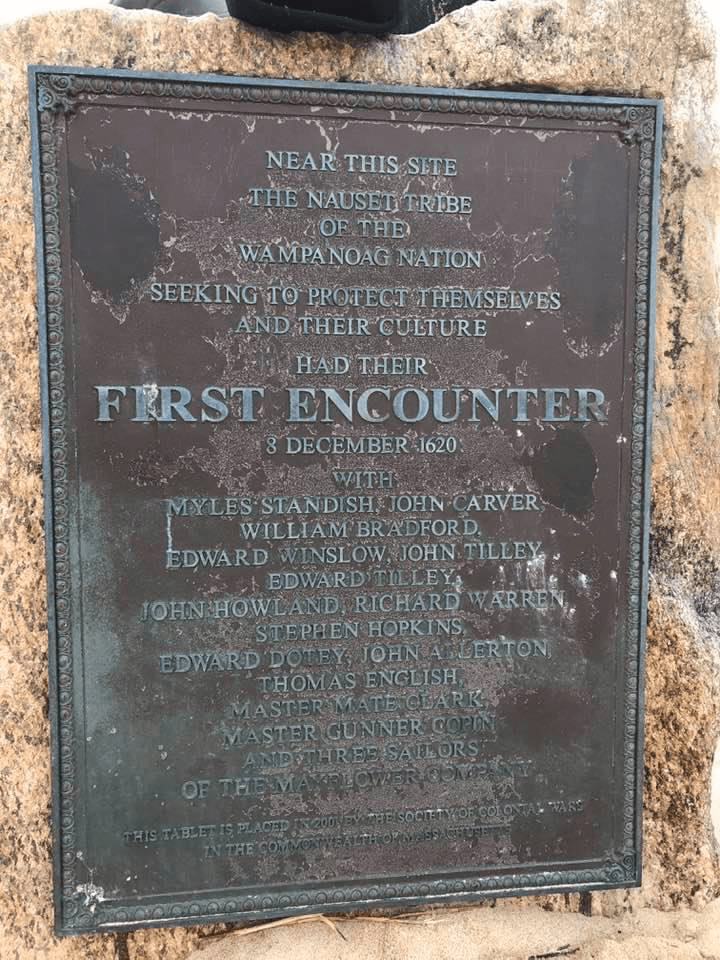
The last stop on our tour today was First Encounter Beach in Eastham. Making another excursion farther South along the Cape Cod Bay side of the Cape, the Pilgrims observed several Native Americans on the shore. As they approached the beach, the party on shore melted into the woods. A little uneasy, the Pilgrims established a rudimentary set of breastworks for protection before settling in for the night. The night would be anything but settling and restful as animal sounds and shuffling noises from the woods kept many of the Pilgrims awake. The noises were created by members of the Wampanoag Tribe preparing to confront the English settlers at first light. As dawn broke, the Pilgrim guards came scrambling back to the beach shouting “Indians! The woods are full of them”. The guards were no sooner behind their protective barrier when a shower of arrows zipped passed their heads. The Pilgrims replied with a hail of lead fired from their matchlock rifles. The noise and smoke sent the Wampanoags back into the forest. The Pilgrims broke camp quickly, piled into the shallot and sailed back to the Mayflower. The first encounter between Pilgrims and Wampanoags ended in a bloodless draw. It was not too long after this engagement that the shallot set out for one final time, heading west to their final destination in Plymouth.

The top photo below is First Encounter Beach looking north towards Provincetown. The 2nd photo is First Encounter Beach heading south to Orleans. The 3rd photo is monument commemorating the first encounter.

We are going to try and visit more sites dedicated to the Pilgrim’s Progress. I will update this story as we go along.
A Carpet Of Orange Blossoms

A ghost story….

A Carpet of Orange Blossoms 

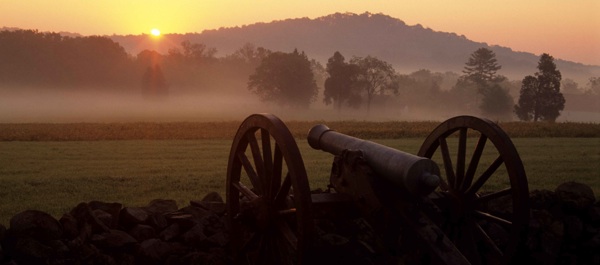
The approaching dawn found him in his usual position, perched on a boulder next to the statue of General Warren.  He had been doing this for a number of years now.  It was his favorite time of day in his favorite season of the year.  The sun would rise behind him, over the Round Tops.  The woods and fields from Seminary Ridge to the west of Gettysburg would be the first to benefit from the light of the rising sun.  Immediately below and to his front, Devil’s Den, the Peach Orchard and the Wheat Field would still be in the shadows of the Round Tops.  The early morning mist would lay heavy in the low points of the uneven ground.  Yes, he loved this time of day, the quiet before the throng of park visitors crowded the crest of Little Round Top, asking about where was it that Joshua Chamberlain and the 20th Maine changed the course of the Battle of Gettysburg.  

Over the next half hour, the sun cleared the Round Tops and the mists gave way to a haze which indicated that this late June day was going to be a hot one.  Loud voices off to his left shook him from his reverie.  Scowling at his watch, he mumbled “‘it’s a bit early for visitors”.  Not yet ready do deal with anyone, he stood up, stretched and slid down from his perch to move into the shade behind an observation tower to see how things would play out.  The approaching group was revealed to be a Boy Scout troop supervised by several adults.  Spotting the observation tower, the young scouts shouted “look, a castle tower!  Last one to the top is a rotten egg!”  The adults managed to stop the stampede. One adult, the Scout Master, said that before going up the tower, Mr. Brampton is going to tell us what happened here.  Still unseen behind the tower, the man cringed when this Brampton fellow began to speak in a flat monotone, reading from a small booklet.  It was obvious that most of the scouts could care less about Brampton’s talk as they sprinted off to the tower before he finished.   Peeking around the side of the tower, the man noticed that there were three scouts standing next to one of the adults.  He heard one scout ask “Dad, could you tell us a little more about what happened here?”  The father replied “sure, Jeremy, if you guys are interested”, and he began to talk.  The man behind the tower was curious now, as the father spoke from memory.  The man’s interest grew exponentially as the father spoke, initially with great enthusiasm, then with obvious emotion as his voice began to tremble.  When the father finished speaking, two of the scouts thanked him and joined their friends.  The father and son remained behind, peering through their binoculars at Devil’s Den.  The man now stepped into full view and eavesdropped on the conversation between father and son.  He heard the son say, “do you see those reflections of light from around the boulders in Devil’s Den?  What are those?  There is not anybody down there!”  The father replied “Jeez Jeremy, you are right.  I don’t see anybody, just those scattered flashes of light.”  With a smile, Jeremy’s father turned to him and said “if I did not know better, I would say they seem like muzzle flashes from Rebel snipers”.  Jeremy and his Dad both shrugged, laughed, and returned to peering through their binoculars.  The man stood staring at Jeremy’s father.  There was something awfully familiar about him.  “I think I need to make my presence known”, he thought, “this is certainly very curious”.  

Approaching father and son, the man now heard the father exclaim “Look over at Seminary Ridge Jeremy!  That looks like Rebel cavalry coming out of the tree line!”  Jeremy replied “I know! The haze makes them appear almost ghostly.”  Both father and son suddenly put down their binoculars and stood blinking at the distant ridge.  They looked at each other and spoke at the same time “did they just disappear”?  Both Jeremy and his Dad jumped when the approaching man said “Perhaps”.  

Jeremy’s dad was going to upbraid the approaching stranger for scaring the hell out of them but he was unable to speak. Mouth hanging open, he was staring at a man wearing a faded blue, Civil War era uniform of a Union infantry Colonel.  The man in the uniform had also stopped and was staring at Jeremy’s Dad.  A strong vibe of recognition passed between them.  Jeremy’s Dad shook his head as though clearing it of a bad dream and spoke first: “are you a re-enactor?  Or a living history volunteer for the park?”.  The man in uniform just stared back a moment longer then slowly said “Captain Nicoll, as I live and breath”.  Confused now, Jeremy’s Dad said “What? Who? Is that your name?  I am sorry, I am flustered.  Let me start over, Hi, my name is Ed Mullins, this is my son Jeremy.  Do you work for the park?”.  The man in uniform seemed to recover as well.  He replied, “Yes, I guess you could say I am part of the park”.  Jeremy Mullins, who had stood with a bewildered expression this whole time blurted out “You are Augustus Van Horne Ellis! Colonel of the 124th New York! The Orange Blossoms!  My Dad showed me your picture!” Pointing to Devil’s Den Jeremy continued “you were killed in that triangular shaped field just over there! Dad! We are talking to a ghost!  Is this real? Am I dreaming?”.  The man in the uniform chuckled and spoke “What a bright young man you are. I am indeed Colonel Ellis. This is no dream. Sadly, mine, and the bodies of my Orange Blossom regiment carpeted that Triangular Field”.  Pointing to Jeremy’s dad the man in uniform said “And you sir, I am certain, are Isaac Nicoll, Captain of my Company G.  You may be who you say you are today, but on July 2, 1863, you were my Captain Nicoll! You witnessed what happened here.  I am damn glad you have returned to us sir!  If the two of you want to see ghosts, I invite you to join me in Devil’s Den at dusk!  Nicoll, Mullins, whatever your name sir, you will see your old friends. And. We. Will. Have. A devil of a time sir! We will indeed”!

Ernie Stricsek

Chatham Creative Writing Group

8/9/2020

Lucky Numbers

The old Libby & Sons tobacco warehouse fronting the James River in Richmond, Virginia, was taken over by the Confederate government in 1861 to house captured Union officers.  By May of 1862, 1200 souls were imprisoned on the top two floors of the warehouse, now renamed Libby Prison.  Conditions were stark, the windows were open spaces with only iron bars on them.  Cold wind and rain buffeted the prisoners, the excessive summer heat took its toll.  Disease was rampant among the crowded prisoners, many died, to be replaced by fresh numbers daily.   Union officer, Lt. James Bartlett, a graduate of West Point Class of 1861 arrived at Libby Prison two days after being captured on May 13, 1862.  General John Winder, Inspector General of Confederate Prison Camps, would harangue the new arrivals “You Yankee scum are now the guests of Libby Prison.  Don’t think about escape, nobody escapes from Libby Prison.  Unless you are lucky and die.  As a matter of fact, I plan on killing more Yankees in prison, than Robert E. Lee can kill on a battlefield”.   Almost immediately, Bartlett resolved to escape.

Within a week, Lt. Bartlett had determined that his best chance of escape was to reach the James River.  Flowing only 40 feet away from the prison, it held a couple of possibilities.  If Bartlett could reach the river, he could steal a row boat, or stow away on a steamer or sloop, and reach the Union army outside of Richmond. Staring at the James River out of the barred window in the fading daylight, Bartlett went over the numbers in his mind again.  Forty feet, 16 paces, 13 seconds.  Exhaling, the number 13 came out softly on his breath.  He was startled and gave a small jump when a gruff voice behind him said “What’s that Lt. Bartlett?  Thirteen?  God Damn you are jumpy boy!  What about 13”?  “Yes Sir, Captain Jenks” replied Bartlett, “thirteen is my lucky number”.   Jenks’ mouth turned up on one side in a sneer.  “Thirteen!  Everyone fears the number 13 as being unlucky!  Hell, the Rebs captured on May 13!  How can that be lucky”?  Bartlett was revolted by the coarse Captain Jenks.  Hiding his disgust, he evenly replied “It’s my lucky number now.  Lightening does not strike the same place twice”.  With that, Bartlett slowly walked away.

Bartlett began to pay attention to the details of the prison, the timing of the guards turns, people coming and going, and he also observed that the prison’s doctor would make several trips to one or two of the ships tied up at the wharf and bring back boxes of supplies, also noticing that, given the Doctor’s unsteady gate, he greatly imbibed his medical stores. Bartlett’s escape plan unfolded in his mind.  He decided that the next time he was on kitchen duty, he was going to slip away from the kitchen, cross the wood shop and enter the prison infirmary.  The kitchen was never under any guard, because the Rebs were repulsed by the rats that inhabited the kitchen in great numbers.  It appeared to Bartlett that the wood shop was also rarely used.  He was going to try and disguise himself as the prison doctor to make his escape.  He would don the doctor’s white duster and steal his straw hat, walk out the infirmary door and mimic the doc’s unsteady gate to the James River wharf.  He estimated that would take 13 seconds, he would time his departure when the sentry was mid-way on his round.  Bartlett told no one of his plans.  There were Union prisoners who were all to keen to turn in fellow prisoners for misdeeds in order to curry favor with the Rebel guards for better food and clothing.  That was why Bartlett was evasive when Jenks asked him about the number 13, Jenks was a suspected stool pigeon.

Two days later, Bartlett began his kitchen duty.  In the dimming day, he went into action.  Leaving the kitchen, and crossing the wood shop, he quickly made it to the infirmary.  Opening the infirmary door a crack, he was startled by his good luck.  Hanging on a hook to the right of the door he was peering through was the doctors’ white duster and straw hat.  Bartlett slipped on the jacket and plopped the hat on his head.  He waited for the guard to make his turn and pass the infirmary.  When the guard was a safe distance away, Bartlett walked out the door and proceeded to the wharf.  Making it to the sloop, Bartlett was shocked to see the prison doctor start to make his unsteady way down from the deck of the boat.  Equally startled, the doctor stared at Bartlett.  In a drunken slur the doctor said “Sir, I do believe that is my hat and jacket, I demand you return them”!  The doctor began to shout at the guards.  Bartlett charged up the gang plank and pushed to doctor out of the way, forcing him to fall into the shallows of the river.  Bartlett scuttled across the deck of the sloop, looking to jump to another sloop moored nearby.  Guards yelled for him to stop and shots rang out.  Bartlett felt something slam into his head and he toppled from the sloop into blackness. 

The cool water of the James brought Bartlett back from unconsciousness.   As he bobbed to the surface, strong arms pulled him from the water.  A voice said “get him below, quickly”.  Bartlett passed into blackness again.   Awaking the next day to see light streaming through a port in the cabin he was laying in, Bartlett heard a cheerful voice say “Ahh, the good Lt. is back among the living”.   Bartlett turned his head – and did it hurt – in the direction of the voice.  The owner of the voice introduced himself.  “My name is Captain Joyce, and this is my steamer.  That is a nasty bump you got on your noggin there Lt.”.  Pointing to 4 men surrounding him, Joyce said “This is some of my crew.  These are free black men, I purchased their freedom, and they chose to work with me.  We are dropping off some lumber at Chafin’s Bluff”.  Bartlett stared at the Captain.  Did this mean he was going to be turned back over the Rebs?  Chafin’s was a Rebel supply base.   Captain Joyce’s eyes twinkled.  “I know what you are thinking, I see those wheels spinning.  We are going to make sure you get to your people, I am no secesh sympathizer for sure, but I do earn a good sum for the use of my boat.  You got out of Libby, nobody has ever done that.  We will take it from here, you will be safe.  You are now a temporary crew member of Steamer Number 45 in the service of the Confederate Navy.  Now get some rest”.  Captain Joyce winked and left Bartlett’s cabin.  As Bartlett began to slip back into sleep, he thought 45, my new lucky number”.    

Libby Prison

The above story is a work of fiction, based on some historical facts.