To Be, Or Not To Be…

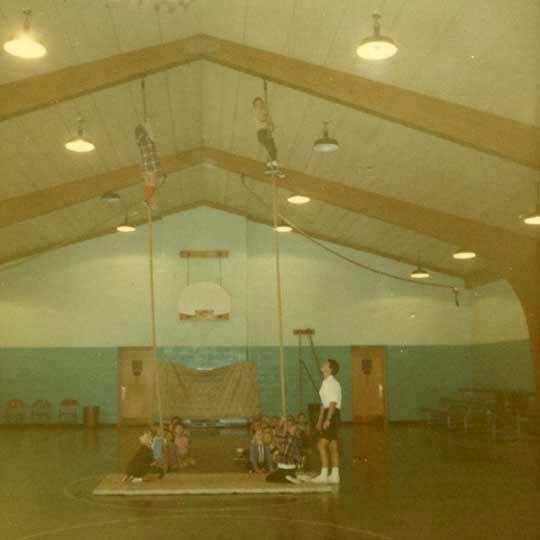
Photo of gym class ropes from Reddit. Like those kids spotting are going to arrest someone’s fall, or those postage stamp thick mats will prevent a bone break!

The prompt for the Chatham Writers Group was from The Bard himself: “To be, or not to be? That is the question.” I don’t know what made me think of climbing ropes in gym class. My memoir follows.

To Be or Not To Be…. A Memoir

Ernie Stricsek©

     “To be, or not to be? That is the question. Whether ‘tis nobler to suffer the slings and arrows” of misfortune. Or feign illness and not go to school tomorrow. It was late fall, 1968, and I lay in bed, struggling with a decision that I must make. For you see, the next day in gym class we are supposed to climb ropes. In another place and time, like 1966 in New Jersey, I was a total failure for this activity. At that point, I had difficulty with synchronizing my arms, legs and feet to propel myself 100 feet up with a coarse rope to the ceiling of the gym. It probably wasn’t 100 feet, maybe more like 30 feet, but to me the rope appeared to reach the sky. I remember stepping up to the rope, grasping in my hands and wrapping around my ankle to get a hold with both feet. My efforts in trying to climb were all motion and no progress. Eventually tiring, I would just swing back and forth. The gym teacher stalked over and shouted instructions. I closed the gap to the ceiling by maybe six inches. Disgusted, he told me to go sit “with the girls”. Those who were as unsuccessful as me. There were two other guys there, but he didn’t mention them.

     The gym teacher apparently felt becoming a master at the climbing arts was essential to success later in life. He waited for the Parent/Teacher Conferences to tell my parents about my failure. I envisioned him sitting in the gym’s corner before calling them in, taking a sip of carrot juice and swirling around in his mouth before swallowing. Then rubbing his hands vigorously before cackling in a ghoulish voice, “Ha! The Stricsek’s. Wait’ll they hear about their son! BWAH HA HA!”. He told my parents I was overweight and out of shape. If I didn’t learn how to climb a rope, my life was over.

     “Ernest’s future is bleak. He’ll be lucky to find employment if he can’t climb a rope. He might as well pick out a good-sized appliance box and look for a place to live alongside the Passaic River. Beneath the Route 46 bridge, so he stays out of the rain. Yes. Cardboard Village, beneath the Route 46 bridge.”

     That stuff about the appliance boxes and living under a bridge I totally made up. But he did talk about my weight and lack of physical ability. I don’t know how he figured I was out of shape. I lugged 60 pounds of newspapers on foot, every afternoon, six days a week. I rode my bike everywhere and walked miles to go fishing on Saddle River. But in the gym teacher’s mind. I was a slug.

     Two years later, I’m in a new place. In a new school. It’s 180 miles from my New Jersey home and I don’t know anyone. In a way, this is a new start for me. Nobody knows of my rope climbing folly. Not yet anyway. As it is, living in the New York City metropolitan area for all my 14 years, I dress differently and speak differently that the kids in this rural community. Someone pointed out that my shoes, which all the “cool” kids in my former school wore, looked like “old man shoes.” They weren’t the dorky penny loafers worn by most of the kids in Middletown. My hair was slicked back (when I still had hair) and not combed forward over the forehead. My shirts had high roll collars. I heard someone call me “Nicky New York”. After the first two months in this new place, the comments slacked off. In gym class, much to my surprise, I developed some football and basketball skills and gained a level of respect. But now the gym class curriculum had advanced to the dreaded ropes. I was in a quandary about what to do. I tossed and turned all night.

     The following morning, I made my decision. Or someone decided for me. My mom said, “I think you’ll feel better as the day goes on.” So, it was off to meet my fate.

     Gym was not until third period, and I sat in my Algebra and English classes staring out the windows. When the bell rang at the end of the session, I retrieved my blue denim bag with sneakers and gym clothes and trudged through the hallways like I was walking “The Green Mile”. As my classmates and I filed into the gymnasium, the gym teacher directed us over to the corner, where four ropes hung from the high ceiling. I had a sinking feeling because it was higher than the one in my 6th grade school. Assisting the gym teacher with “spotting” the climbers was the head football coach. His penetrating blue eyes flashed above a sneering smile.

     I pause in my narrative to ask what does “spotting” even mean? If a 150 lb. kid loses his grip on the rope and plummets to the floor, nobody’s going to try and catch him! The average person is going to yell “LOOKOUT!” I guess that’s what it means – I spotted someone falling and warned everyone on the ground. Back to my story.

     After receiving the briefest of climbing instructions, the activity began. The gym teacher and head football coach shouted different encouragements to the climbers.

     “You can do better than that! C’mon!” shouted the gym teacher.

     “Is that the best you can do? Damn good thing Charlie ain’t behind you with a bayonet! See how fast you climb then!” encouraged the head football coach. It was 1968, he was fond of using Vietnam references.

     Then it was my turn. The football coach handed me the rope, positioned my hands, legs, and feet, and said, “Let’s see how you do!”

     I did it! I began slowly, but realized I could do it and went faster. We were to climb the rope and touch the bar it hung from before coming back down. I was fearful of letting go, but I touched the bar and started down. My descent didn’t go as well as my climb. I came down too fast, and the rope left a foot long burn on my right calf. But I did it!

     I told the coach I had never done that before. He gave me a look of surprise, then took the time to show me how to come down the rope without burning my leg. “You did good,” he said.

     I stopped looking for empty refrigerator boxes that day.

Once Upon A Time

A brief story about our son, Jeremy, and a blanket puppet he loved when he was a mere wisp of a lad. Written to a prompt about things that are valued (inanimate things).

Once Upon a Time

Ernie Stricsek©

     Once upon a time in the New England state of Connecticut, there lived a child named Jeremy. Jeremy was bright-eyed and curious, with a heart full of wonder, whimsy and imagination.  He had a very special companion named ‘Bunny’, a soft and cuddly blanket bunny that had been with him since he was a baby.

     Bunny was, indeed, no ordinary bunny; he had pink, satiny inner ears surrounded by white felt outer ears. Bright eyes hovered over a pink, satin nose and a broad smile stitched on a face as fluffy as his ears. Bunny’s coat was a patchwork of colors that hung from his head like a cloak and two white cottony paws peaked from beneath it. From the moment Jeremy’s tiny fingers grasped him they formed a bond that was stronger than the strongest of steels. Every night Jeremy would tuck himself into bed with Bunny nestled nearby. He would become Jeremy’s protector, his confidant, and a great source of comfort in a world that felt big, overwhelming, and sometimes very scary. 

     For an inanimate object, Bunny developed a personality that was bigger than life and became a big part of the family. He went everywhere Jeremy went. The grocery store, on visits to the doctor, visits to grandparents, family trips. Sometimes Jeremy’s dad even let Bunny steer the car! When it was mealtime, he would sit next to Jeremy to make sure he ate everything. Because they were so inseparable, Bunny needed to bathe with almost the same frequency that Jeremy did. Jeremy in the bathtub, Bunny with the towels and linens in the Sears Hotpoint washing machine. He didn’t seem to be bothered by that; he would always emerge with the same broad smile on his face.

     One day, while shopping at the Pathmark grocery store, Jeremy was distracted and didn’t notice that Bunny had slipped from shopping cart seat. He only became aware of his absence whey they got home from the store. Jeremy’s mom called the store and discovered some kind person had found Bunny and brought him to the service desk for safe keeping. We all breathed a sigh of relief. 

     Bunny was so well loved that over time, his once magnificent coat became tattered and threadbare. However, Jeremy’s mom was able to fashion a new coat from a section of blanket that Jeremy had also loved. Which also became threadbare, but thankfully was quite large and provided enough fabric for several more wardrobe changes.

     However, the day that many children fear came. On a long trip from their comfortable home and familiar New England setting to a strange place that was flat as a pancake and surrounded by corn, Bunny disappeared. At a rest stop somewhere along the Ohio Turnpike, he tumbled out of the car, unnoticed by Jeremy and his family until they stopped at another rest area many, many miles away. Everyone was devastated. Jeremy’s dad called all the rest areas the family had stopped at, but the news from each of them was not good. A bunny with pink satin ears and well-loved cloak had not been brought to safety. Jeremy’s faithful companion, the symbol of his childhood innocence and unwavering friendship, was forever lost. No matter where his young life had taken him, Bunny was there, a constant reminder of love and resilience. 

    As time passed, the plucky, resilient Jeremy, would find another faithful companion. On a visit to an animal shelter, an orange tabby kitten called out to Jeremy when he walked past his cage. Sunny replaced Bunny and would be Jeremy’s constant companion for many more years.

Canoe Believe It?

A memoir about a memorable Boy Scout camping trip our son, Jeremy, and I went on… back in the day.

Shove Off – A Memoir

Ernie Stricsek©

April 2, 2024

     “It’s a lazy, meandering creek. You should have no troubles,” said the Scoutmaster about the upcoming camping and canoe excursion. 

     “Yes!” exclaimed the Assistant Scoutmaster, “Don’t worry! A piece of cake!”

     They were trying to allay my fears. It’s not that I was inexperienced with paddling a canoe, I had done so many times. However, my experiences were on ponds and lakes that I was familiar with. Places that were typically placid and where I didn’t have to navigate swift and unpredictable currents. 

     “How about kayaks? Will kayaks be available? I’d feel more comfortable steering a kayak on a river.” I asked.

     The Assistant Scout Master shook his head and answered me in a defensive tone, “IT’S NOT a river. It’s a stream. There are kayaks there. If you want to use one, I’m sure you can.” 

     His peevish response took me somewhat aback, but my unease dissipated when I learned that our son, Jeremy, and I could use kayaks. The good news was further enhanced by the prospect of Jeremy earning a kayaking merit badge along with the cooking merit, which was the main purpose of the weekend excursion.

     Four days before the camping trip, it began to rain. And it continued to rain until the morning of the day we were to leave on our trip. We arrived at the campsite on Friday night and had to erect tents and build campfires in the dark. Saturday morning, we awoke to a beaming sun and cloudless sky. After a quick breakfast, we made the short drive to the launch site of our mariner adventure. The torrential downpours had transformed the “meandering” creek into a fast-moving sluice of water. Also, there were zero kayaks available. I asked if it was safe enough to embark on the rapids. The canoe concession guy pointed to the sharp bend the creek made and told us it became calmer after making the turn. “You guys better shove off, you’re falling behind the other scouts,” he urged.

    Jeremy and I entered the first bend and the current drove us into a fallen tree. We were on the creek for less than a minute before we were in the creek. This was the first of seven unplanned dips in a body of water which the name of has been permanently blocked from my memory. The creek alternated from calm spots to racing rapids, especially on the numerous bends. People gathered on the shoreline at especially challenging turns to make sport of those unskilled in navigating such turns. Like us. 

    As we neared the end of this debacle, two especially heinous scouts rammed our canoe, sending Jeremy and I into the water one last time. As they glided by, snickering, I was encouraged to try to earn a “Wilderness Dentistry” merit badge. You know, the one where you extract a scout’s teeth with a canoe paddle. 

     Jeremy and I successfully steered our vessel to the canoe landing, mercifully ending our journey. The two miscreants who had sent us into the water during the home stretch of the expedition, stood on the shore, still snickering, and pointing us. In my mind, I had moved on from the dentistry merit badge. Because I thought that action would lead to “Spend A Night Behind Bars” badge. Not wanting that, I instead settled for the one award I had certainly earned, “Creative Use Of Cuss Words”. 

Why Not?

This is another one of my fish tales. A memoir from my Junior High School days. This was written to a prompt titled “Why Not?”

Why Not

A Memoir

Ernie Stricsek©

It was early March 1967. My friends and I were champing at the bit to go fishing, but the opening day of trout season was still over a month away. The windows that ran the entire length of one wall of 7th grade classrooms at East Paterson Memorial Jr. & Sr. High School faced the Passaic River and after several days of temperatures in the low 40’s, we noticed the jagged line of winter ice flows jammed on the river’s banks were melting, exposing large swaths of shoreline. This observation made us more antsy to drop our lines.

   During lunch, my friend Gary rushed to our table in the cafeteria, boiling over with excitement. He glanced out of the window during his algebra class and immediately became engrossed with what was happening on the river versus what equations Mrs. Nanfeldt was reviewing on the blackboard. Gary had seen a car pull over on the shoulder of River Road, and two guys with fishing rods began casting their lines into the water along an ice-free stretch of shoreline. Another one of my friends, Mike, asked if he saw them catching anything. He didn’t, but only because he was caught gazing out the window and “Granny Fanbelt”, as we called her with great fondness, scolded him and closed the shades. But what Gary had observed was enough, and he was trying to convince the rest of us to go fishing in the Passaic. The Passaic River was not a very pristine body of water. Marcal Paper, the Forstmann and Botany 500 textile mills had pumped dyes and chemicals out into the river for decades. Carp, suckers, and, maybe a stray catfish, were the only fish anyone could catch in the near putrid waters. One stood more of a chance of catching a shopping cart or tire. 

   None of these facts seemed to faze Gary. He just wanted to fish. We tried to reason with him. The shoreline across from the high school was ice-free, but what was it like elsewhere? None of this deterred Gary. He was aiming for a closer spot to fish, near Pizza Town USA, where Route 46 passes over the river.

   Mike and some of my other friends weakened under Gary’s enthusiastic onslaught. I remained skeptical and didn’t think it was a good idea. A kid named Tommy D, who was not part of this circle of friends, was sitting nearby and had been listening to our conversation. He blurted out, “Why not?”. We turned to look at him. He repeated, “why not?” Tommy D had been in my Sunday School classes from First Communion through Confirmation. He had a know-it-all attitude and enjoyed poking fun at people. He said he lived near the area we were talking about, and it was clear of ice. Tommy claimed to have been fishing there for days now and had caught several big goldfish. In his typical Tommy way, he challenged our fishing skills, telling us we couldn’t catch a cold.

   Backing off a bit when we bristled at his jibes, he said he would lead us to this “hotspot”. The key word being lead, meaning he wanted to go with us. I was totally against this. Through those years of Sunday school, Tommy D would refer to me as ‘Tennessee Ernie Ford or Ernie Bilko. When he grew weary of those names, he’d call me Ernie ‘Swipestack’. You can imagine my hesitancy in making him part of our group. After a few more ‘Why nots’ and twisting of arms by Gary, Mike and other friends, I caved. Plans were made to go fishing after school the next afternoon.

    We met at Tommy D’s house the next afternoon, after I finished my paper route. The ground was still too hard to dig for worms, so we raided our family’s pantries for cans of corn to use for bait. Taking into consideration the cool weather, and the thawing ground might have muddy spots, my friends and I were dressed appropriately. However, Tommy was still wearing the clothes he had worn at school, which were a pair of copper-colored slacks, while beneath his jacket was a black sweater and cream-colored shirt. On his feet were a pair of black loafers. I never saw a fisherman dressed like that. Ever. Even to this day. Tommy led us off in a single file.

   Taking a dirt path off the shoulder of Route 46, we meandered through a narrow, wooded area and emerged to see a wide semi-circular plane of marsh grass and reeds. To our left, about 100 yards away, coursed the Passaic River. Between clumps of reeds and grass, we could see large patches of mud and standing water. It didn’t look good. Mike told Tommy he was full of garbage, there was no way he could have cut through this swamp to go fishing. Tommy’s face reddened, and he said, “I’ll show you,” and he took us onto a narrower path leading to the river. The path tilted slightly to the right as we walked past areas that ranged from dry to muddy to small mucky ponds.

   Suddenly Tommy shouted and disappeared from sight. The path tilted more sharply to the right and his smooth soled loafers failed him causing him to rocket off the trail into a watery morass. Initial surprise and anger turned to fear because he was stuck to the knee-deep in the muck beneath the water. Tommy panicked, believing he had fallen prey to the boogeyman of all children – quicksand! But he wasn’t sinking. He was stuck in the much.

   Tommy shivered. His copper pants provided no insulation. He was too far out in the bog to grab our outstretched hands. Mike’s brother slipped and slid along the trail back to the woods and returned with a length of tree branch we could extend out to Tommy. Acting like a tug-of-war team, my four friends and I dragged him from the bog, minus his shoes and socks.

   The late afternoon sun was setting and the temperature dropping. Tommy was wet, without shoes or socks, and his teeth were beginning to chatter. He had to get home and get warm. He could move fairly quickly along the dirt path in his bare feet. Once on the pavement, we took turns carrying him along the shoulder of Route 46 until we got to cleaner pavement, and Tommy resumed walking. When we got to his house, neither of his parents were home from work yet. He was grateful for us ‘saving his life’, and never ragged me again about my name after that ‘why not’ fishing adventure.

The First Draft

I was listening to the Outer Cape radio station, WOMR, last week when ‘Uncle John’s Band’ by the Grateful Dead began playing. The opening lines of a poem popped into my head. After listening to the song a half dozen more times, I strung together this poetic take of what writing a first draft is like.

The First Draft

Ernie Stricsek ©

Well, the first words are the hardest words

When creating your first draft

You stare at a hummingbird

Versus working at your craft

Will they draw the reader in

Will my words be profound

Or will I sound crazy daft

At the end of my first draft

“A dark and stormy night”

Wait, why did I write that

How did such purple prose

Make it into the first draft

Words, words, words, words

I’m sounding like a hack

It’s only my first go round

So cut me some slack

A Thesaurus is in my hand

My face looks rather bland

“I’ve used first draft to many times”

My voice cracks and whines

Oh, this word fits good here

And these words look great there

Hot damn, I’m on a roll

Like a river, words flow

Happy New Year

Pittsburgh, the scene of my story. This photo from a Carnegie Library collection shows the “Point” where the three rivers flow, and Three Rivers Stadium.

The prompt for the Monday Chatham Writers Group was to open your story with a sentence using each letter from the greeting “Happy New Year”, in order and with no other word between them. My letters are in bold and italics. I called for help from my reporter for the fictional Manchester Press & Journal, headquartered in Pittsburgh’s Manchester neighborhood. I finally gave my young reporter a name, Andy Wink. My story follows.

Happy New Year

Hey Andy! Percy Pathemore Yancy’s Next Essay, ‘Would Yinz Eat A Raccoon?’, is going to be published in the City Paper this week. I’d like for you to interview that old buzzard and see just what the hell he means.”

 “Why me Chief?” I asked my editor.

 “Because you’re in my line of sight.”

 “So, if I was in the break room having a cup of coffee, I wouldn’t be getting this assignment?”

“Of course not! I would’ve waited for you to come back into my line of sight. That’s another thing. You spend a lot of time in that break room, drinking coffee and moonin’ over the view of Three Rivers Stadium, n’at.”

Normally, I would accept any assignment willingly. “Chief, I’d rather have pins stuck in my eyes than interview Mr. Yancy.”

My boss took the unlit cigar from his mouth. “You don’t mean that. You’d rather be blind than talk to a guy who seems to have taken a liking to eating raccoons? Come on, kid.”

“Mr. Yancy was my English teacher the entire time I was at Schenley High. English I, English II, English Comp and English Lit. It was four years of hell. Prisoners breaking rocks at Devil’s Island have an easier time.”

“But you must have done ok. You wouldn’t have gotten into Syracuse University journalism school if you were a hack.”

The boss had me there. “Alright, I’ll call him and see if he will let me interview him. That’s if he deems my writing skills worthy enough to grant an interview.”

“That’s the sport! Go get him, kid! Now where the hell’s my matches?” My boss stalked off.

I took a deep breath, grabbed the phone book and leafed to the Y’s section. Mr. Yancy still lived on Walnut Street in Pittsburgh’s Shady Side neighborhood. He used to walk the two blocks from his Victorian style home to Schenley High. I took another deep breath before calling. Mr. Yancy used to smoke a pipe in the teacher’s lounge. He would enter the classroom in his rumpled tan corduroy jacket, suede patches on its elbows, and pipe stem sticking out of the breast pocket. No amount of dry cleaning would ever remove the odor of his favorite brand of tobacco from his jacket. It was so engrained in its every fiber.

Pittsburgh’s historic Schenley High School. The cost for asbestos remediation forced the school’s closure in 2008.
Walnut Street in Pittsburgh’s Shady Side neighborhood, not too far from Schenley High School. Uncredited photo from Wikipedia.

One more gulp and I dialed his number. He picked up on the second ring. After identifying myself, my trepidation vanished.

“Mr. Wink! It’s a pleasure. I was pleased when I read yinz was hired by the Manchester Press & Journal.”

 Did he just say yinz?  

 He was even more delighted when I told him the purpose of my call.

 “An interview? Conducted by my prize student? Of course! Of course!”

 After establishing a day and time, Mr. Yancy said, “See yinz next week.”

 Yinz again! I definitely heard that! Yinz! In his classroom, Mr. Yancy showed no mercy to students who spoke “Pittsburghese”. His verbal floggings were severe enough to bring many to tears. He even paddled several students for referring to Agatha Christie’s Miss Marple for being, in their opinion, just a “nebby” neighbor, and not a real sleuth. Use of the slang “nebby” was a sin!

I was non-plussed by Mr. Yancy’s choice of words, but his appearance when he opened the door to his Walnut Street home floored me. I wasn’t expecting to see the tobacco infused sport coat. But I was thinking something along the lines of corduroy pants with the wales worn to a shiny luster, topped by a cardigan with suede elbow patches. The transformation of my English teacher was astonishing. A Pendleton flannel shirt and Carharrt overalls adorned his lanky frame. 

Seated in the study, he lit his pipe and motioned for me to begin the interview. Mr. Yancy told me a college friend had invited him and his wife to a “Wild Game Cookoff”. They had scoffed at the idea initially. Maybe nibble on some pheasant, or venison, down an IPA or two and call it a day. None of the food was identified until after it was consumed. The Yancy’s ate snake, mongoose, beaver, and ostrich, all prepared with seasonings and sauces like most beef, chicken, and pork dishes. It was the raccoon with sweet potatoes that overwhelmed Mr. Yancy. It was one of the best meals he had ever eaten. He had an epiphany. Yancy became engrossed in the cooking of wild game, especially raccoon. He created stews, soups, fried and filets, but his recipe for maple bourbon glazed raccoon pushed him over the top. His book of recipes shot to number one, and he was in such demand for cooking shows, he shed the smelly sport coat and retired to concentrate full time on his wild game creations. 

He peppered his conversation with classic Pittsburghese. Yinz instead of you, gumbands vs. rubber bands, it’s Jumbo, not baloney, alunimin foil. Dropping infinitives was a gut punch for me; “Young Man, this story needs told”, “I can’t think of anything more that needs done, than this.”

 Mr. Yancy saw my jaw dropping to the ground and paused for a moment.

“Are yinz surprised with my transformation, young Andy? Don’t be. I was too stuffy, too harsh.”

He apologized for being so tough on me. I was the best student he had ever had the pleasure of teaching. He wanted to see me achieve good things.

When the interview ended, Mr. Yancy wished me a Merry Christmas and a Happy New Year. We promised to meet again soon. I returned to the Press & Journal and presented a 1,500-word piece to my boss, which he knocked down to 1,000. 

“Maple Bourbon Glazed Raccoon. Damn, that sounds good, kid. Sounds good, but I’ll stick to a pastrami Reuben from Primanti’s. Go get me one.”

Bourbon Maple Glazed Raccoon. Photo from recipes section Realtree website.
Primanti Brothers pastrami sandwich. Photo from Primanti Brothers webpage. My favorite Primanti’s sandwich!

Ernie Stricsek, Chatham Writers Group, January 8, 2024

An Uninvited Guest

The prompt for The Chatham Writers Group was “your worst fear shows up on your doorstep”. My story is about a writer confronting his worst fear.

An Uninvited Guest

The study smelled like mahogany and leather. A Banker’s lamp on a large desk cast a soothing glow through its green shade. Light danced along the reddish-brown walls from a crackling fireplace. Angstrom was ensconced in an easy chair more tired, worn, and wrinkled than he was. His positions in the chair would range from slumped to sitting upright to leaning forward with elbows on his thighs. Deep in thought, he gazed at the fire, taking occasional sips of an amber liquid from a Glencairn perched on a side table.

So engrossed he initially didn’t hear the ring of his doorbell. Only the loud banging of the large brass pineapple door knocker finally roused him. Angstrom looked at his watch. “What the hell, who comes calling at ten p.m.?”  He looked over his shoulder, squinting in the direction of his front door. He couldn’t see the door; it was two rooms away, but he thought by looking hard in its direction, the wretch who was creating a racket at such a late hour would leave. 

“Angstrom! Open the door! I know you’re in there. I see the flickering light of a fire! Open up!”  The brass knocker beat a tattoo on the front door.

Angstrom exhaled, long, disgusted. He pushed himself up from the comfort of the leather chair and stomped to the front door. “Do you know what time it is? Leave me alone!”

“I need to tell you something, something serious. Let me in, I won’t be long.”

Angstrom let out another long exhale, unlocked and opened the door. He guided his visitor to the study and motioned for him to sit in another well-worn leather chair near the fireplace.  

Settling back into his chair, he asked, “So what is this thing of great importance to tell me at 10 o’clock in the evening?”

“Oh, you know all too well why I am here. The same reason I visited you before.”

“You’re mistaken; you have no business here.”

“I know you stare at that fire for hours….”  The visitor stopped for a moment and looked at the Glencairn. He tried to speak again, “You stare, um… uh. Excuse me, what’s that in your glass?”  

“Just some 12-year-old Red Breast.”

The visitor licked his lips. A long moment passed. Angstrom sat motionless, eyebrows raised, “what were you going to say about my staring?”

“Good God, Man! You are indeed a scoundrel! You sit there nursing a grand 12-year-old Irish whiskey and offer me none? Where are your manners? You scoundrel!”

Angstrom procured another Glencairn and poured his visitor two fingers of the Red Breast.  

“Why are you here? Go see Cameron. You can hector him.”

“Hah! I’ll never visit Cameron! The pages he writes aren’t fit to line the bottom of a birdcage! He puts words on paper without thought. ‘This is a good word. I’ll fit it here. Same with this exclamation point. Bah, writer’s block is one thing he’ll never suffer from! But you, on the other hand…”

Angstrom didn’t let his visitor finish his sentence. “Nah, your game is not going to work this time.”

“Oh, I believe it will!”

“No, this is how it starts. You show up at my doorstep. I let you in, and the next thing you know, we are talking as though we are two 19th-century Gilded Age twits. Then I start writing like a stuffy old bird. I don’t talk this way.”

A sinister smile began to form on the visitor’s face, “But Angstrom, you weren’t writing anything. You were staring at your fire.”

“I was doing some research in my mind. And there’s the second seed of doubt you plant. I begin to overthink my story and get bogged down in the details. I begin to worry if my readers will spot incorrect dates, locations, things that are out of place for the time.”

The visitor was now grinning like a Cheshire Cat.

“Finish your drink and leave. You need to go so I can begin to write about our encounter.”

The grin disappeared, replaced by a look of defeat.  

“Yeah, the blockade is cleared. When you finish that whiskey, you will return where you came from.”

Angstrom was struck by his resemblance to the visitor, who was now deflating like a balloon. He never finished his whiskey; writer’s block drifted up the chimney with the fire smoke. 

Angstrom’s eyes flew open. The dream of his encounter with writer’s block energized him. He quietly slipped out of bed to avoid disturbing his wife and went to the study. Flipping open his MacBook, he typed an 800-word story about overcoming writer’s block and fired it off to his editor. He reached for his notebook and furiously began to plot his next novel.