Uncle Joe

I went to bed last Thursday evening having written a memoir for the prompt “Showing Up”, then was awake at 5:00 AM Friday morning with a completely different story in mind. I woke up thinking about someone I once knew, and whom I had not thought of in a very long time. As one memory of him after another unfolded, I thought about how his curious behaviors were because of mental health issues. My recollections began to fall together in a pattern that, surprisingly, fit the melody of the song “The Weight” by The Band. My memoir poem/lyrics follow.

Uncle Joe

©October 17, 2025

Ernie Stricsek

Off the bus at Henry Street

Looking for his sister’s place.

Straw hat, tan suit, wingtips on his feet

As weathered as his face.

“Hey kiddo, you’re Mary’s grandson!

Here, help me with my suitcase.

I’ll take my duffle, ‘cause it weighs nearly a ton.”

Joe, you just can’t do this

To just show up ain’t right

Joe, you just can’t drop in

You need to call or write

Joe would sip his coffee, in halts and starts he talked.

Of all the places he’d been to, he took the bus or walked.

“I’ve seen the Grand Canyon! And hiked the Black Hills.

Didn’t care much for Chicago, the Windy City gave me the chills.

Joe, this ain’t what you do

To show up out without a clue

That you were coming this way

And needed a place to stay

Of my grandmother’s brother, not much was ever said.

My grandfather would grumble,

“He’s nothing but a hobo, and not right in the head.”

“Do good in school!” My grandmother urged. “If you don’t’,

You’ll end up like Uncle Joe instead.”

Joe, you just can’t do this

To just show up ain’t right

Joe, you just can’t drop in

You need to call or write

It would be years before I learned more

Of my grandmother’s brother Joe.

He returned from the war, hero’s honors and a small amount of fame

“Joe became a cop, got hurt breaking up a fight.

Took a pipe to the head, then never was the same.”

Joe, this ain’t what you do

To show up out without a clue

That you were coming this way

And needed a place to stay

Was early June of ’67 that I saw Joe walk past my school.

Waved to him from the window, as he trudged on by.

His tanned face cracked a smile; he waved and mouthed “Hi.”

“Where’s Uncle Joe?” I asked when I entered the house.

“We sent him on his way; the man is but a louse.”

Joe, you just can’t do this

To just show up ain’t right

Joe, you just can’t drop in

You need to call or write

Then one day a letter did arrive, would Uncle Joe be coming for a stay?

My grandmother opened it and learned her brother had passed away.

She sobbed, “He died alone, and in a strange place.”

For the rest of my life, I’ll remember his wave and the smile on his face.

Joe, this ain’t what you do

To show up out without a clue

That you were coming our way

And needed a place to stay

Storm Larry

Image from radio station I95 blog.

On Sunday, February 5, 1978, every major news network and every AM and FM radio station was flooding the airwaves with dire predictions for a rapidly approaching, massive winter storm that was going to strike the New England states beginning Monday morning. This prediction followed a winter storm that blew through New England at the end of January. A storm that accelerated the fatigue failure of the roof of the Hartford Civic Center, causing to collapse onto the empty stands and rink for the Hartford Whalers hockey team.

   I woke up 6:00 AM Monday morning, February 6th, went to my bedroom window and saw it wasn’t snowing yet, but the sky looked ominous, angry. Eating my breakfast in front of the TV, the weather people were in an excited state. Talking so fast, you could almost see the spittle flying from their mouths, waving hands as though conducting a symphony of weather maps. They created much excitement. All the while, a steady stream of school closings scrolled across the bottom of the TV screen. It was almost 7:00 AM. Time to leave my apartment and head to my place of work, a 20-minute drive.

   On the ride to work, even my favorite radio station ran through the list of school closings. WPLR in New Haven played rock & roll, 24/7/365. But nor the morning of February 6th. I switched to another rock station from Hartford to hear the same rundown of school cancellations north of New Haven. I scoffed when I heard that AMF-Cuno Division was cancelling all shifts for the day. “Hah!” I said to no one, “They cancel shifts if there’s a gentle breeze.” But looking at an even angrier sky, I envied the AMF-Cuno people.

   All the hourly and salaried people were anxious about the weather. At 7:30 in the morning, forecasters expected snow to arrive in southern Connecticut around 9:00 AM, for once the weather talkers were correct. At 9:00 AM on the dot, light snow fell. As the morning progressed, the wind picked up; the snow fell heavier. That morning, I spent more time looking out the window at the accumulating snow on the road.

   People listening to radios out in the manufacturing shop reported the state police and public works departments were urging people to go home and get off the roads. By the afternoon rush hour, the conditions were going to be “really” bad. Some of the hourly people asked their supervisors if they could punch out at noon and go home. Upper management discovered the early departures and the plant manager announced over the PA system that no one could leave early; everyone must complete their shifts. The snow continued to pile up.

   At 2:00 PM, two of my lab compatriots and I went to see the manager of our department to see if we could leave early. We were salaried after all, didn’t have to punch a clock and we promised to make up the 1 ½ hours left of our shift.

   “No,” he said without looking up from the report he was reading.

   “Shit,” we muttered under our breaths. But not low enough. His head shot up from his report and daggers flew from his eyes. We scampered away.

   By 3:00 PM, the snow was falling so heavily, visibility was almost nil. The wind was howling. The radio weather people reported winds were 50 MPH, increasing to 80 MPH by late afternoon. From the lab window, I watched the cars of the first shift workers slowly leaving the parking lot. Some fishtailing before gaining traction. The snowplows passed over the road twice, but you wouldn’t know it. Louie, in bright orange thermal coveralls, startled me when he zoomed past on his motorcycle. “Brave dude!” I thought. Thirty minutes later, plus an additional five minutes after clearing nearly 6 inches of snow off my car, I pulled out of the parking lot, fishtailing on the road like everyone else had done when they left work.

  The snow had been falling at a rate that plows could not keep up with. Snow covered secondary roads, and cars blocked tertiary roads. Many cars had skidded off the road, into each other, or slid backwards down steep inclines, unable to gain traction. Two jackknifed tractor trailers blocked the fourth road I tried, a connector between interstate highways. Making a u-turn, I headed to my last option, a less traveled tertiary road.

   Things looked promising on that road. There was not a car in sight. The snow-covered trees and small creek that meandered alongside the road made for a picturesque scene. But I was not in a photo taking mood. Suddenly, a line of six cars blocked my side of the road. A guy was walking along the line of cars, puffing clouds of condensation, as he leaned over to tell each driver something. Arriving at my car, he said, “There are two cars off the road up ahead. It’s not safe.”

   I asked whether he was a cop or a road crew member, and whether the road was blocked. “No,” he replied.

   “Step aside,” I said, “I’m gonna give it a go.”

   Maintaining a speed of 25 mph, I barely made it through the treacherous curve where the stuck cars were. I breathed easier.

   Three hours after leaving work, I was safely in my apartment, leaving only once to cross country ski over to the grocery store to get the necessities; toilet paper, milk and bread. It would be 3 days before I returned to work as the State of Connecticut dug out of Storm Larry.

Trespassers

Google Maps view of the upward slope (from our house) of Cherry Hill. It seemed like Mount Everest when we were kids.

My arrival to the big leagues of bicycle ownership came on my 10th birthday, in January 1964. I was now the proud owner of a brand, spanking new three-speed bicycle! I would no longer be lumbering about the neighborhood in the saddle of the battleship sized, single speed with lots of chrome Roadmaster. Well, the new bike sported many chrome features as well. Front and rear fenders, headlight, spring loaded trap… Wait, did I say headlight? Yes! Also, a taillight! Both powered by a generator with a small wheel that rolled along the white sidewall of my front tire. The color of the bike was gold and on the frame beneath the seat were four broad silver, horizontal stripes. Between each stripe was a large silver letter – A M F. I am forgetting to mention the gold and chrome chain guard with the word “Hercules” written in cursive with red letters. A saddle bag and chrome tire pump completed the accessories. Lots of chrome and doodads, but even so, it was a much sleeker looking velocipede than the Roadmaster. I took it for a short ride, just long enough to test each of the speeds. But it was January, with near freezing temperatures and several inches of slushy snow on the ground. I would have to wait a bit to go on a longer ride.

Over the next 18 months, it became the three-speed began to manifest symptoms of being a lemon. The narrow tires were prone to getting flats. Having the pump clipped to the frame was quite fortuitous and I kept the saddle bag stocked with a wrench, rubber patches and a tube of glue. The bulb in the headlight would burn out – I didn’t often ride the bike at night, so it wasn’t from overuse. The cable for the speed control snapped and it required a week’s stay at the bike shop to be repaired. Somehow the threads in the right pedal stem became stripped and the pedal fell off, requiring an even longer stay in the repair shop.

It was late June, school was out, and I had no mode of conveyance. I was reduced to relying on shanks mare to get around. So, when my mother said I needed to “run” over to the Birchwood Delicatessen to get either some cold cuts, or sour cream, I don’t really remember exactly what, but what I do recall is it was a hot day and perishable items were involved, and speed was of the essence. I asked if I could borrow my brother’s bike to ride to and from the deli.

“It’s Ken’s bike. You need to ask him,” replied my mom.

When I asked, Ken offered to give me a ride over. He had one of the Sting Ray bikes with a banana seat that had plenty of room for a passenger. I hopped aboard and off we went to the Birchwood Delicatessen, exactly a mile from our house. A whole mile, distances seemed greater when you are a kid.

We rode through the Cherry Hill School complex and struck Cadmus Avenue. After riding about 200 yards from our home, we encountered the steep grade of Cherry Hill. Again, when you are a kid, it was the equivalent of Mount Everest, so we both dismounted and Ken walked the bike up the hill. Reaching the summit of the hill, climbed back on the bike and began to roll down the back side of Cherry Hill. This is where the adventure begins.

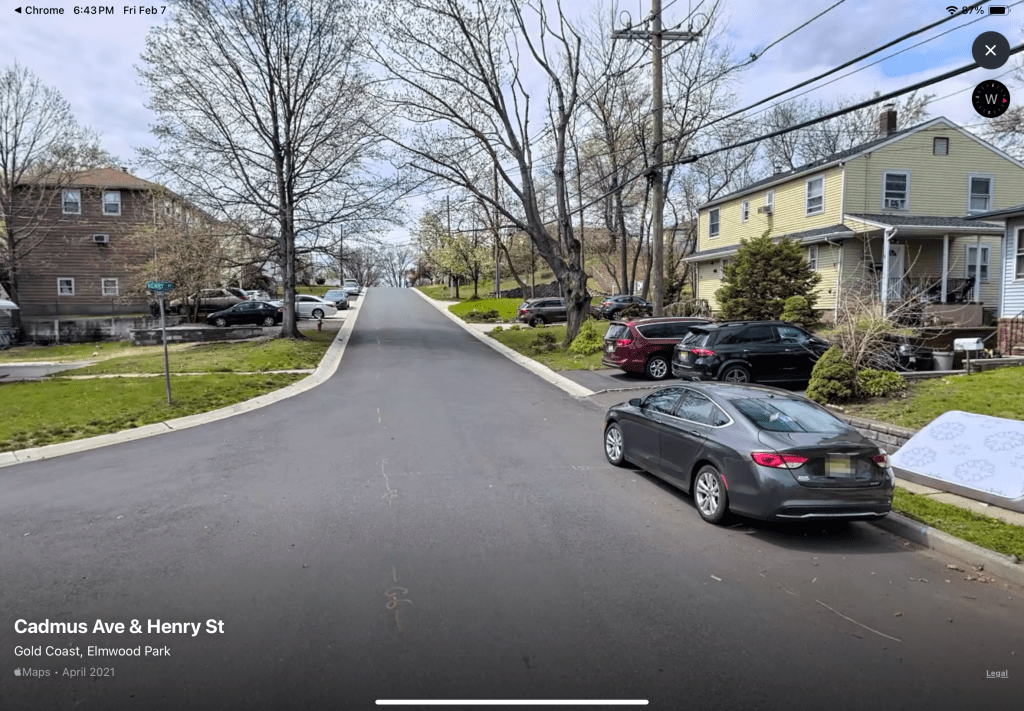
From Google Maps, beginning of downward slope of Cherry Hill.

On the downward grade, instead of coasting and braking, Ken began to pedal like a mad man. I yelled in his ear, “What are you doing!”

Ken’s reply was a maniacal laugh, and he pedaled harder. I wrapped my arms around his waist as we jetted down the hill. I didn’t close my eyes, because I was desperately looking for modes of escape. The road took a sharp turn to the right and I was terrified we weren’t going to make it. That we were going to be embedded in the living room wall of my friend Billy Stewart’s house, which was right at the curve.

From Google street view. The fist curve on Cherry Hill. My friend’s house is the one with the silver car in the driveway.

Ken pedaled furiously through the curve and fate was kind, we made it without mishap. But the road took an even sharper, 90 degree turn to the left. I knew we weren’t going to make that one. I was yelling for Ken to slow down. He just giggled.

Reaching the intersection, Ken maybe realized I was right. We were going too fast to make that sharp of a turn without disastrous consequences. He made a slight correction to the left, heading straight toward a hedge surrounding a house at the intersection. I thought he was going to try and soften the blow by running into the hedge versus getting most of our skin erased by the pavement. A husband and wife were doing yard work at the house. I envisioned them bandaging our wounds and driving us home with the wrecked bike in the trunk of their car. Somehow, Ken spotted the narrowest of openings in the hedge and we rocketed through it, unscathed. We passed between the startled husband and wife at the speed of light, Ken now aiming the bike to a wider opening in the hedge. I heard a woman’s voice screech “Trespassers!” But we were safely out of the yard, on the sidewalk, speeding away from the angry couple. Ken never stopped laughing throughout the whole yard ordeal.

From Google street view, the 2nd turn. The two family house was not there in 1965. There was a waist high hedge.

The rest of the trip to the deli was uneventful. Wisely, we both decided to take a different route home, about a half mile longer than the wild ride route. Ken and I made it home safely, the perishables hadn’t perished..

The home whose owners we terrorized was along my paper route. Fortunately, they were not customers of mine. Every time I walked past, if they were working in the yard, I would be preoccupied rolling a paper, head down, making no eye contact. Initially, not too long after the incident, they would eye me suspiciously. But no questions were ever asked.

Fly (off the handle) Fishing in America

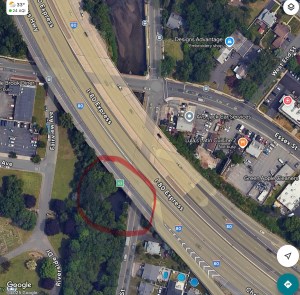
Saddle River flows beneath Route 80 in this Google Maps image. The area circled in red was the spot we fished from many times in 1966 – 1968.

By the summer of 1967, my brothers, my friends, and I fashioned ourselves as seasoned anglers. Pouring over issues of Field & Stream and Outdoor Life, watching the Joe Foss outdoor series, The American Sportsman on TV, we knew which fishing lures were good for catching trout, and which ones were good for catching bass. We caught no bass, but we had the best lures. We purchased some stuff called Buss Bedding and maintained worm farms. Red worms for trout, night crawlers for every other species of freshwater fish. Everything we knew and practiced was for using spin casting rods and reels (produced by Mitchell-Garcia, THE BEST, according to Field & Stream magazine).

    Cliff, one of the kids in our group, puzzled us with his declaration that he wanted to try fly-fishing. We had no experience in this mode of fishing. The equipment was entirely different. Fly-fishing uses a longer, much more flexible rod and a simple reel. Second, it required a certain level of skill to cast and place the bait – something that resembled a fly. It had to land lightly on the water’s surface. You couldn’t use a weight or lead sinker. We looked at Cliff like he had two heads. “What do you know about fly-fishing?” We asked.

     “I watched The Flying Fisherman on TV. I know how to do it.” Cliff said with great confidence, “I’m going to try it the next time we go fishing!”

    “Cliff, we are going to the Saddle River. There are no trout in that river,” we tried to reason with him.

     He squinted at us, much like a wizened old angler would, and said, “That’s because we aren’t using the right bait. Trout like flies.”

     That settled it. Cliff was going to try fly-fishing in a river known as a home for carp, catfish, whatever washed off the Route 80 overpass in a rainstorm, an occasional tire and an abandoned shopping cart or two.

     It was a beautiful late June day for our fishing excursion. Gathered in front of my house were 9 accomplished pre-teen anglers; my brothers and me, the two Garys, brothers Mike and Dean, and the brothers Cliff and Robert. With fishing rods in one hand, a tackle box in the other we lined up like a squad of soldiers and trooped off to our Saddle River fishing site. Cliff was really excited about fly-fishing. Over the course of our two-mile journey, he bragged about the fly lure he bought and talked up the number of trout it was going to catch for him. He carped against our comments about that section of the river being only suitable for carp. For the rest of the hike, we tuned out Cliff’s droning and thought about how many carp we would catch, and that Cliff would get skunked.

   Finally arriving at our destination, we broke out our gear attaching hooks and sinkers, applied our bait, and cast our line into the murky waters of the Saddle River. Typical with most fishing events involving the brothers Cliff and Robert, things were about to go sideways.

   It became readily clear that Cliff had not the foggiest idea of how to fly fish. He started swinging his fishing pole overhead in a frenetic fashion. He looked like a stagecoach driver whipping a team of horses. His fly-bait dangled but a few inches from the tip of his fishing rod. Perplexed, he switched his stance and, using both hands, started swinging his fishing pole as though it were a baseball bat. He now looked like Mickey Mantle taking batting practice. We gave him a wide berth for fear of getting snagged by the fly hook. While he was flailing away, the rest of us reeled in carp and goldfish. As a testament to the quality of the Saddle River, my brother, Ken, reeled in a discarded Wonder Bread bread bag. Inside of the bag was a live goldfish, still counts as a catch!

   Cliff finally wearied of his fly-fishing flailing and plopped down on the ground, breathing heavily, his face covered in sweat. Seeing the rest of the squad having some moderate success catching fish, he quietly removed the fly from his fishing line, attached the standard hook and sinkers, and pulled a worm from his brother’s bait can.

    Robert, meanwhile, had seen some carp jump out of the water in the middle of the river. He had caught nothing yet and attached a sinker heavy enough to enable a cast to where the fish were. He chose a pyramid shaped, 2-ounce sinker for the job. Starting his casting motion, the fishing line slipped from his finger on his backswing. The line shot straight back; the sinker striking his brother, Cliff, right in the mouth. Cliff screamed and doubled over. Robert turned and looked at his brother, dumbfounded.

    Cliff straightened and removed his hand from his face, revealing a small split in his lip. His face was red, his eyes even redder. “Robert! You bastard! I AM GOING TO KICK YOUR ASS!” His snarl turning to a screech. He charged at his brother.

    It was now Robert’s turn to screech. The only thing on his mind was flight, so he took off in the only direction he could. Into the river he ran, fishing pole in hand, the 2-ounce sinker dragging behind him, leaving a small trail in the sand. We guessed he decided drowning the better option to getting his ass kicked. Robert’s plan worked. Cliff wouldn’t venture into the river. Instead, he jumped up and down on the shoreline, howling invectives at Robert.

   For his part, Robert was able to work his way up-river past a point where the shoreline disappeared, and Cliff couldn’t follow him. He screamed back, “I’m going home to tell Mom you swore at me!” Then he climbed out of the river, covered in muck from the waist down.

   Cliff stood silently now, clenching and unclenching his fists. He turned and walked over to his tackle box to pack up his gear. “I have to go now, my mouth hurth.” His injured lips had swollen to the point where he now spoke with a lisp.

   The rest of us had enough excitement for the day, so we packed up our gear, grabbed Robert’s tackle box and trudged off towards home. We caught up with Robert. He hadn’t gotten too far. We spotted him sitting on the step of a pharmacy, crying. He saw us approaching and yelled, “I’m sorry Cliff! It was an accident.”

   Cliff was much subdued now. From his swollen mouth he lisped, “I know it was an acthident. Pleath don’t tell Mom I thwore.” We all walked the rest of the way home in silence. Cliff never attempted to fly fish again, nor did he ever bring it up in conversation.

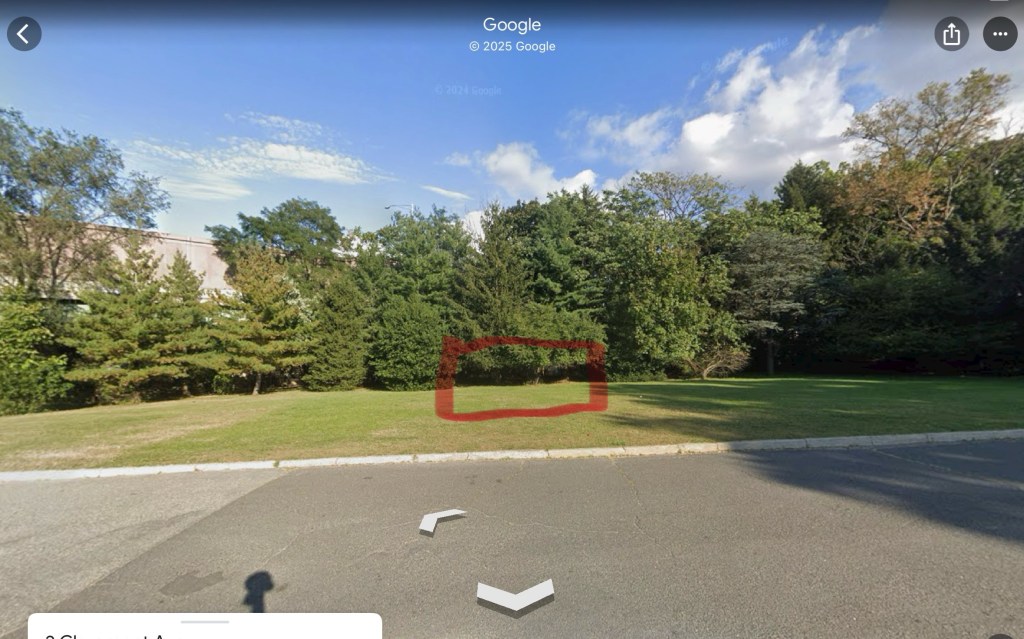
Ground level Google Maps view of tree line along the Saddle River. In the 57 years since my story took place, the trees have grown substantially. The red square was clear of trees when we fished there, that was our approach to the river. There is a fence there now, behind the trees.

Bummer Of A Summer

What was to be the 70th summer of my life became the summer of the fight of my life. In June, an MRI revealed a blockage in my bile duct which turned out to be cancerous. In July, I underwent a surgical procedure called the Whipple. I am currently undergoing an aggressive chemo and radiation therapy program that will continue into February of 2025. I feel very confident that I am going to be ok. Also, I feel really, really good! Better than before my surgery. I feel so good, it is difficult to wrap my head around the fact that there is anything seriously wrong with me.

The writing prompt for the Chatham Memoir Group was “Angels In My Life”. For some reason, Jackson Brown’s song, “These Days”, popped into my head and I started scribbling down words to fit the tune. Please keep in mind I don’t consider myself to be a poet, but my effort to fit the prompt and the song follow.

Angels In My Life

Ernie Stricsek©

I was told that I had cancer

Of the cause there was no answer

Those days

I was full of anger, dread, and tears

Then the angels of my life drew near

And I saw I had nothing to fear

My wife is my first angel

Of her love and devotion, she’s so giving

These days

She has made me feel not afraid

To live each day as all is fine

And that I’ll be around for a long, long time

My other angels are so many

Family, friends, and Doc’s give me reasons

All of these days

These days I think and hope

Their love and care will guide me through more seasons

I’ve been given a second chance

The rest of my life will be a different dance

To Be, Or Not To Be…

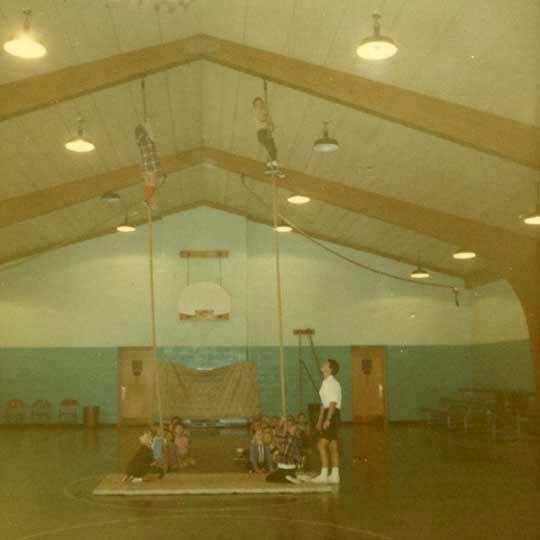
Photo of gym class ropes from Reddit. Like those kids spotting are going to arrest someone’s fall, or those postage stamp thick mats will prevent a bone break!

The prompt for the Chatham Writers Group was from The Bard himself: “To be, or not to be? That is the question.” I don’t know what made me think of climbing ropes in gym class. My memoir follows.

To Be or Not To Be…. A Memoir

Ernie Stricsek©

     “To be, or not to be? That is the question. Whether ‘tis nobler to suffer the slings and arrows” of misfortune. Or feign illness and not go to school tomorrow. It was late fall, 1968, and I lay in bed, struggling with a decision that I must make. For you see, the next day in gym class we are supposed to climb ropes. In another place and time, like 1966 in New Jersey, I was a total failure for this activity. At that point, I had difficulty with synchronizing my arms, legs and feet to propel myself 100 feet up with a coarse rope to the ceiling of the gym. It probably wasn’t 100 feet, maybe more like 30 feet, but to me the rope appeared to reach the sky. I remember stepping up to the rope, grasping in my hands and wrapping around my ankle to get a hold with both feet. My efforts in trying to climb were all motion and no progress. Eventually tiring, I would just swing back and forth. The gym teacher stalked over and shouted instructions. I closed the gap to the ceiling by maybe six inches. Disgusted, he told me to go sit “with the girls”. Those who were as unsuccessful as me. There were two other guys there, but he didn’t mention them.

     The gym teacher apparently felt becoming a master at the climbing arts was essential to success later in life. He waited for the Parent/Teacher Conferences to tell my parents about my failure. I envisioned him sitting in the gym’s corner before calling them in, taking a sip of carrot juice and swirling around in his mouth before swallowing. Then rubbing his hands vigorously before cackling in a ghoulish voice, “Ha! The Stricsek’s. Wait’ll they hear about their son! BWAH HA HA!”. He told my parents I was overweight and out of shape. If I didn’t learn how to climb a rope, my life was over.

     “Ernest’s future is bleak. He’ll be lucky to find employment if he can’t climb a rope. He might as well pick out a good-sized appliance box and look for a place to live alongside the Passaic River. Beneath the Route 46 bridge, so he stays out of the rain. Yes. Cardboard Village, beneath the Route 46 bridge.”

     That stuff about the appliance boxes and living under a bridge I totally made up. But he did talk about my weight and lack of physical ability. I don’t know how he figured I was out of shape. I lugged 60 pounds of newspapers on foot, every afternoon, six days a week. I rode my bike everywhere and walked miles to go fishing on Saddle River. But in the gym teacher’s mind. I was a slug.

     Two years later, I’m in a new place. In a new school. It’s 180 miles from my New Jersey home and I don’t know anyone. In a way, this is a new start for me. Nobody knows of my rope climbing folly. Not yet anyway. As it is, living in the New York City metropolitan area for all my 14 years, I dress differently and speak differently that the kids in this rural community. Someone pointed out that my shoes, which all the “cool” kids in my former school wore, looked like “old man shoes.” They weren’t the dorky penny loafers worn by most of the kids in Middletown. My hair was slicked back (when I still had hair) and not combed forward over the forehead. My shirts had high roll collars. I heard someone call me “Nicky New York”. After the first two months in this new place, the comments slacked off. In gym class, much to my surprise, I developed some football and basketball skills and gained a level of respect. But now the gym class curriculum had advanced to the dreaded ropes. I was in a quandary about what to do. I tossed and turned all night.

     The following morning, I made my decision. Or someone decided for me. My mom said, “I think you’ll feel better as the day goes on.” So, it was off to meet my fate.

     Gym was not until third period, and I sat in my Algebra and English classes staring out the windows. When the bell rang at the end of the session, I retrieved my blue denim bag with sneakers and gym clothes and trudged through the hallways like I was walking “The Green Mile”. As my classmates and I filed into the gymnasium, the gym teacher directed us over to the corner, where four ropes hung from the high ceiling. I had a sinking feeling because it was higher than the one in my 6th grade school. Assisting the gym teacher with “spotting” the climbers was the head football coach. His penetrating blue eyes flashed above a sneering smile.

     I pause in my narrative to ask what does “spotting” even mean? If a 150 lb. kid loses his grip on the rope and plummets to the floor, nobody’s going to try and catch him! The average person is going to yell “LOOKOUT!” I guess that’s what it means – I spotted someone falling and warned everyone on the ground. Back to my story.

     After receiving the briefest of climbing instructions, the activity began. The gym teacher and head football coach shouted different encouragements to the climbers.

     “You can do better than that! C’mon!” shouted the gym teacher.

     “Is that the best you can do? Damn good thing Charlie ain’t behind you with a bayonet! See how fast you climb then!” encouraged the head football coach. It was 1968, he was fond of using Vietnam references.

     Then it was my turn. The football coach handed me the rope, positioned my hands, legs, and feet, and said, “Let’s see how you do!”

     I did it! I began slowly, but realized I could do it and went faster. We were to climb the rope and touch the bar it hung from before coming back down. I was fearful of letting go, but I touched the bar and started down. My descent didn’t go as well as my climb. I came down too fast, and the rope left a foot long burn on my right calf. But I did it!

     I told the coach I had never done that before. He gave me a look of surprise, then took the time to show me how to come down the rope without burning my leg. “You did good,” he said.

     I stopped looking for empty refrigerator boxes that day.

In The Beginning

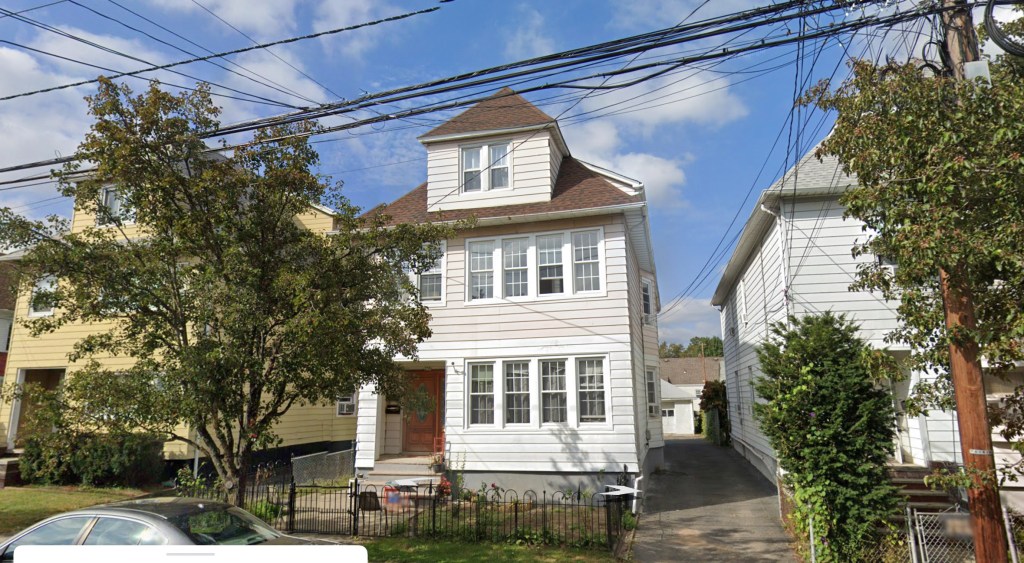
The house we lived in on Lanza Avenue. Our apartment was on the second floor.

The prompt for the Chatham Memoir Group was “Beginnings”. I heard the Emerson, Lake & Palmer song, “From the Beginning”, playing somewhere. Thinking about my earliest memories and where we lived at the time, I began to string some lines together in my mind.

In the Beginning – Lanza Avenue

Ernie Stricsek©

There are some things I can recall

Fire trucks screaming by

Sirens and lights new to my eye

We sit on the basement steps

The landlord nods with a smile

He shovels coal from a pile

Fragments in my mind

In my mind I can see

When it was my mom, dad and just me

In the beginning

Classical music on the phonograph

Hunters searching the woods

Peter catching the wolf

I jump and leap to an Offenbach tune

There’s a knock on the door

The landlord tells us no more

In my mind I can see

When it was my mom, dad and just me

In the beginning

Across the street looms Saint Stan’s Church

The bells sounding loud

The colorful crowd

I remember the bassinet

First with my brother Ken

Then my brother Dave

In my mind I can see

A family larger than three

Memories of the beginning

Once Upon A Time

A brief story about our son, Jeremy, and a blanket puppet he loved when he was a mere wisp of a lad. Written to a prompt about things that are valued (inanimate things).

Once Upon a Time

Ernie Stricsek©

     Once upon a time in the New England state of Connecticut, there lived a child named Jeremy. Jeremy was bright-eyed and curious, with a heart full of wonder, whimsy and imagination.  He had a very special companion named ‘Bunny’, a soft and cuddly blanket bunny that had been with him since he was a baby.

     Bunny was, indeed, no ordinary bunny; he had pink, satiny inner ears surrounded by white felt outer ears. Bright eyes hovered over a pink, satin nose and a broad smile stitched on a face as fluffy as his ears. Bunny’s coat was a patchwork of colors that hung from his head like a cloak and two white cottony paws peaked from beneath it. From the moment Jeremy’s tiny fingers grasped him they formed a bond that was stronger than the strongest of steels. Every night Jeremy would tuck himself into bed with Bunny nestled nearby. He would become Jeremy’s protector, his confidant, and a great source of comfort in a world that felt big, overwhelming, and sometimes very scary. 

     For an inanimate object, Bunny developed a personality that was bigger than life and became a big part of the family. He went everywhere Jeremy went. The grocery store, on visits to the doctor, visits to grandparents, family trips. Sometimes Jeremy’s dad even let Bunny steer the car! When it was mealtime, he would sit next to Jeremy to make sure he ate everything. Because they were so inseparable, Bunny needed to bathe with almost the same frequency that Jeremy did. Jeremy in the bathtub, Bunny with the towels and linens in the Sears Hotpoint washing machine. He didn’t seem to be bothered by that; he would always emerge with the same broad smile on his face.

     One day, while shopping at the Pathmark grocery store, Jeremy was distracted and didn’t notice that Bunny had slipped from shopping cart seat. He only became aware of his absence whey they got home from the store. Jeremy’s mom called the store and discovered some kind person had found Bunny and brought him to the service desk for safe keeping. We all breathed a sigh of relief. 

     Bunny was so well loved that over time, his once magnificent coat became tattered and threadbare. However, Jeremy’s mom was able to fashion a new coat from a section of blanket that Jeremy had also loved. Which also became threadbare, but thankfully was quite large and provided enough fabric for several more wardrobe changes.

     However, the day that many children fear came. On a long trip from their comfortable home and familiar New England setting to a strange place that was flat as a pancake and surrounded by corn, Bunny disappeared. At a rest stop somewhere along the Ohio Turnpike, he tumbled out of the car, unnoticed by Jeremy and his family until they stopped at another rest area many, many miles away. Everyone was devastated. Jeremy’s dad called all the rest areas the family had stopped at, but the news from each of them was not good. A bunny with pink satin ears and well-loved cloak had not been brought to safety. Jeremy’s faithful companion, the symbol of his childhood innocence and unwavering friendship, was forever lost. No matter where his young life had taken him, Bunny was there, a constant reminder of love and resilience. 

    As time passed, the plucky, resilient Jeremy, would find another faithful companion. On a visit to an animal shelter, an orange tabby kitten called out to Jeremy when he walked past his cage. Sunny replaced Bunny and would be Jeremy’s constant companion for many more years.

Canoe Believe It?

A memoir about a memorable Boy Scout camping trip our son, Jeremy, and I went on… back in the day.

Shove Off – A Memoir

Ernie Stricsek©

April 2, 2024

     “It’s a lazy, meandering creek. You should have no troubles,” said the Scoutmaster about the upcoming camping and canoe excursion. 

     “Yes!” exclaimed the Assistant Scoutmaster, “Don’t worry! A piece of cake!”

     They were trying to allay my fears. It’s not that I was inexperienced with paddling a canoe, I had done so many times. However, my experiences were on ponds and lakes that I was familiar with. Places that were typically placid and where I didn’t have to navigate swift and unpredictable currents. 

     “How about kayaks? Will kayaks be available? I’d feel more comfortable steering a kayak on a river.” I asked.

     The Assistant Scout Master shook his head and answered me in a defensive tone, “IT’S NOT a river. It’s a stream. There are kayaks there. If you want to use one, I’m sure you can.” 

     His peevish response took me somewhat aback, but my unease dissipated when I learned that our son, Jeremy, and I could use kayaks. The good news was further enhanced by the prospect of Jeremy earning a kayaking merit badge along with the cooking merit, which was the main purpose of the weekend excursion.

     Four days before the camping trip, it began to rain. And it continued to rain until the morning of the day we were to leave on our trip. We arrived at the campsite on Friday night and had to erect tents and build campfires in the dark. Saturday morning, we awoke to a beaming sun and cloudless sky. After a quick breakfast, we made the short drive to the launch site of our mariner adventure. The torrential downpours had transformed the “meandering” creek into a fast-moving sluice of water. Also, there were zero kayaks available. I asked if it was safe enough to embark on the rapids. The canoe concession guy pointed to the sharp bend the creek made and told us it became calmer after making the turn. “You guys better shove off, you’re falling behind the other scouts,” he urged.

    Jeremy and I entered the first bend and the current drove us into a fallen tree. We were on the creek for less than a minute before we were in the creek. This was the first of seven unplanned dips in a body of water which the name of has been permanently blocked from my memory. The creek alternated from calm spots to racing rapids, especially on the numerous bends. People gathered on the shoreline at especially challenging turns to make sport of those unskilled in navigating such turns. Like us. 

    As we neared the end of this debacle, two especially heinous scouts rammed our canoe, sending Jeremy and I into the water one last time. As they glided by, snickering, I was encouraged to try to earn a “Wilderness Dentistry” merit badge. You know, the one where you extract a scout’s teeth with a canoe paddle. 

     Jeremy and I successfully steered our vessel to the canoe landing, mercifully ending our journey. The two miscreants who had sent us into the water during the home stretch of the expedition, stood on the shore, still snickering, and pointing us. In my mind, I had moved on from the dentistry merit badge. Because I thought that action would lead to “Spend A Night Behind Bars” badge. Not wanting that, I instead settled for the one award I had certainly earned, “Creative Use Of Cuss Words”. 

Why Not?

This is another one of my fish tales. A memoir from my Junior High School days. This was written to a prompt titled “Why Not?”

Why Not

A Memoir

Ernie Stricsek©

It was early March 1967. My friends and I were champing at the bit to go fishing, but the opening day of trout season was still over a month away. The windows that ran the entire length of one wall of 7th grade classrooms at East Paterson Memorial Jr. & Sr. High School faced the Passaic River and after several days of temperatures in the low 40’s, we noticed the jagged line of winter ice flows jammed on the river’s banks were melting, exposing large swaths of shoreline. This observation made us more antsy to drop our lines.

   During lunch, my friend Gary rushed to our table in the cafeteria, boiling over with excitement. He glanced out of the window during his algebra class and immediately became engrossed with what was happening on the river versus what equations Mrs. Nanfeldt was reviewing on the blackboard. Gary had seen a car pull over on the shoulder of River Road, and two guys with fishing rods began casting their lines into the water along an ice-free stretch of shoreline. Another one of my friends, Mike, asked if he saw them catching anything. He didn’t, but only because he was caught gazing out the window and “Granny Fanbelt”, as we called her with great fondness, scolded him and closed the shades. But what Gary had observed was enough, and he was trying to convince the rest of us to go fishing in the Passaic. The Passaic River was not a very pristine body of water. Marcal Paper, the Forstmann and Botany 500 textile mills had pumped dyes and chemicals out into the river for decades. Carp, suckers, and, maybe a stray catfish, were the only fish anyone could catch in the near putrid waters. One stood more of a chance of catching a shopping cart or tire. 

   None of these facts seemed to faze Gary. He just wanted to fish. We tried to reason with him. The shoreline across from the high school was ice-free, but what was it like elsewhere? None of this deterred Gary. He was aiming for a closer spot to fish, near Pizza Town USA, where Route 46 passes over the river.

   Mike and some of my other friends weakened under Gary’s enthusiastic onslaught. I remained skeptical and didn’t think it was a good idea. A kid named Tommy D, who was not part of this circle of friends, was sitting nearby and had been listening to our conversation. He blurted out, “Why not?”. We turned to look at him. He repeated, “why not?” Tommy D had been in my Sunday School classes from First Communion through Confirmation. He had a know-it-all attitude and enjoyed poking fun at people. He said he lived near the area we were talking about, and it was clear of ice. Tommy claimed to have been fishing there for days now and had caught several big goldfish. In his typical Tommy way, he challenged our fishing skills, telling us we couldn’t catch a cold.

   Backing off a bit when we bristled at his jibes, he said he would lead us to this “hotspot”. The key word being lead, meaning he wanted to go with us. I was totally against this. Through those years of Sunday school, Tommy D would refer to me as ‘Tennessee Ernie Ford or Ernie Bilko. When he grew weary of those names, he’d call me Ernie ‘Swipestack’. You can imagine my hesitancy in making him part of our group. After a few more ‘Why nots’ and twisting of arms by Gary, Mike and other friends, I caved. Plans were made to go fishing after school the next afternoon.

    We met at Tommy D’s house the next afternoon, after I finished my paper route. The ground was still too hard to dig for worms, so we raided our family’s pantries for cans of corn to use for bait. Taking into consideration the cool weather, and the thawing ground might have muddy spots, my friends and I were dressed appropriately. However, Tommy was still wearing the clothes he had worn at school, which were a pair of copper-colored slacks, while beneath his jacket was a black sweater and cream-colored shirt. On his feet were a pair of black loafers. I never saw a fisherman dressed like that. Ever. Even to this day. Tommy led us off in a single file.

   Taking a dirt path off the shoulder of Route 46, we meandered through a narrow, wooded area and emerged to see a wide semi-circular plane of marsh grass and reeds. To our left, about 100 yards away, coursed the Passaic River. Between clumps of reeds and grass, we could see large patches of mud and standing water. It didn’t look good. Mike told Tommy he was full of garbage, there was no way he could have cut through this swamp to go fishing. Tommy’s face reddened, and he said, “I’ll show you,” and he took us onto a narrower path leading to the river. The path tilted slightly to the right as we walked past areas that ranged from dry to muddy to small mucky ponds.

   Suddenly Tommy shouted and disappeared from sight. The path tilted more sharply to the right and his smooth soled loafers failed him causing him to rocket off the trail into a watery morass. Initial surprise and anger turned to fear because he was stuck to the knee-deep in the muck beneath the water. Tommy panicked, believing he had fallen prey to the boogeyman of all children – quicksand! But he wasn’t sinking. He was stuck in the much.

   Tommy shivered. His copper pants provided no insulation. He was too far out in the bog to grab our outstretched hands. Mike’s brother slipped and slid along the trail back to the woods and returned with a length of tree branch we could extend out to Tommy. Acting like a tug-of-war team, my four friends and I dragged him from the bog, minus his shoes and socks.

   The late afternoon sun was setting and the temperature dropping. Tommy was wet, without shoes or socks, and his teeth were beginning to chatter. He had to get home and get warm. He could move fairly quickly along the dirt path in his bare feet. Once on the pavement, we took turns carrying him along the shoulder of Route 46 until we got to cleaner pavement, and Tommy resumed walking. When we got to his house, neither of his parents were home from work yet. He was grateful for us ‘saving his life’, and never ragged me again about my name after that ‘why not’ fishing adventure.