A Father’s Sorrowful Search

Civil War artist Samuel Ward captured Lt. Bayard Wilkeson in action.

This historical fiction story was written to the prompt “In peace, sons bury their fathers. In war, fathers bury their sons”, a quote from Herodotus. The fictional characters are Captain Bartlett and Sergeant Boyle. Samuel Wilkeson, Lieutenant Bayard Wilkeson, Major Thomas Osborn and General John Buford were present at the Battle of Gettysburg. With two exceptions, all of the dialogue between the characters is fictional. See my notes at the end of the story.

Gettysburg, PA, July 4, 1863
The rain was falling in sheets as Bartlett and his aide, Sergeant Boyle, reined their horses to a stop in front of the Fairview Cemetery gatehouse.
    “Ahh, this weather’s manky, sir. Truly ‘tis!” Boyle exclaimed.
    Bartlett smiled from inside the hood of his rubber poncho. “Manky. I’ve not heard you say that since Fredericksburg, Sergeant Boyle. This isn’t nearly as bad as that.”
    “For sure it’s not Captain. I’m just a tad surly after three days of racing all over this battlefield, dodgin’ every shot and shell the Johnnies could throw at us.”
     Bartlett nodded his head in agreement. The horrors he had seen over the past three days left him feeling numb. Gettysburg was not his first battle by far, but it was the most savage one he had been part of. Maybe because they fought to repel an invasion of northern soil. “Sergeant let’s get off these nags and take shelter in the gatehouse arch,” he said.
      Under the cover of the arch, they shook the rain from their ponchos like two golden retrievers and tugged off their hoods. From where he stood, Bartlett could see the stretch of the Baltimore Pike toward army headquarters.
     Boyle flipped the poncho over his shoulder and pulled a watch from his vest pocket. “When are you expecting the man from the New York Times, Captain, sir?”
    “Any minute now.”
    “If you don’t mind me askin’, sir, but do ya really think your friend, I mean Mr. Wilkeson’s son, might still be alive?”
     Bartlett inhaled deeply and let out a long sigh. “I don’t know, Sergeant. Major Osborn saw Lt. Wilkeson being carried away from his battery. His right leg was gone.”
    “Your man, Lt. Wilkeson, is a tough nut, sir. I heard his leg was mangled by a round shot that went through his horse. I heard he used his pocketknife to finish what the cannon ball started.”
    Bartlett sighed again and turned his gaze from Boyle to the Baltimore Pike. The heavy rain had lightened to a misty drizzle. Plodding towards them along the Pike was a team of horses hitched to an ambulance. Next to the teamster, Samuel Wilkeson sat bolt upright, shoulders squared, and head held high. His hands rested on his thighs.
     “Here they come,” Bartlett told Boylan. He walked out from the cemetery gatehouse to the middle of the Pike and raised his hand to halt the ambulance.
     “Good morning, James. To what do I owe the honor?”
     He noted Sam Wilkeson’s flat voice before saying, “Sergeant Boylan and I would like to help you look for your son.”
     “I would be honored,” Wilkeson’s voice trembled, “And please, sit with me. I need a friend to talk to.”
     Bartlett nodded, tethered his horse to the ambulance and climbed aboard and squeezed next to Sam. With a snap of the reins, the wagon jerked into motion and rolled towards town. Sergeant Boylan guided his horse to fall in alongside.
     After riding along in silence for a few moments, Sam Wilkeson turned to face Bartlett and said, “Thank you again for offering to help James. But I know where Bayard is. Major Osborn said he was carried to the Alms House after receiving his wound. I suspect he is still there.”
     “I know where that house is, Mr. Wilkeson. I saw it early in the morning of July 1st while scouting with General Buford. So, Bayard has been behind Rebel lines for the past three days.”
     “Yes. I pray he received adequate care from their surgeons.”
      The ambulance rolled slowly along the road through town. Sam Wilkeson spoke again. “James, the survivors of Bayard’s battery told me they were ordered to an exposed area. Rebels were firing on them from three directions. They fought back hard. The Rebs swept the remaining Yankees from the field after Bayard got wounded. He should not have been sent there. Bayard should not…” his voiced trailed off. He let out a long sigh and said no more.
     The ambulance passed through town and came to a halt in the yard of the Alms House. Wounded soldiers were everywhere. Bartlett and Wilkeson climbed off the wagon. Joined by Sergeant Boylan, they walked through the door into a den of pure misery. The cries of men being operated on, the sights and smells, were overwhelming.
     Bartlett stopped a medical attendant who tried to scurry past them. “Excuse me, this man is looking for his son. He was wounded on July 1st.”
     “Name? What’s his name?” The impatient attendant asked.
     Sam Wilkeson tried to hide his anger, but it was clear when he spoke, “Lt. Bayard Wilkeson. Battery G, 4th U.S. Artillery.”
    “Don’t know him.” The attendant pulled free from Bartlett’s grasp and hustled off.
    “Sir, we know where your son is.” The soft voice startled the three men, and they turned to see two young women approaching. “We took care of him after he was brought here.”
    Wilkeson’s shoulders sagged. “Cared. You said cared.”
    “Yes sir. We’re sorry, he passed on the evening of July 1st. We stayed by his side to the end.”
    His voice was heavy with emotion, Wilkeson asked, “Where is he? Can you take me to him?”
    The women led him out of the building to a mound of dirt beneath a tree. Bartlett and Boylan trailed along. Wilkeson stared at the ground where his son rested. Falling to his knees, he placed his hand on the grave and cried out in anguish, “He was only 19 years old! Dear God.” Sam Wilkeson sobbed.
     Boylan looked away and noticed Bartlett wiping tears from his face. Tossing aside regulations, he laid his arm over his commander’s shoulders. “I’m profoundly sorry for the loss of your friend, sir. I truly am. He was a fine man.”
     “Thank you, Sergeant Boylan. We will miss him forever. Like so many in this war. Now he sleeps the sleep that knows no earthly waking.”*
     Boylan turned his gaze back to the scene at the grave. “‘‘Twas it Herodotus, sir? Who said ‘In peace, sons bury their fathers. In war, fathers bury their sons.”
     “It certainly was,” replied Bartlett. Patting the sergeant on his back, he said, “Let’s see what we can do for Mr. Wilkeson.”
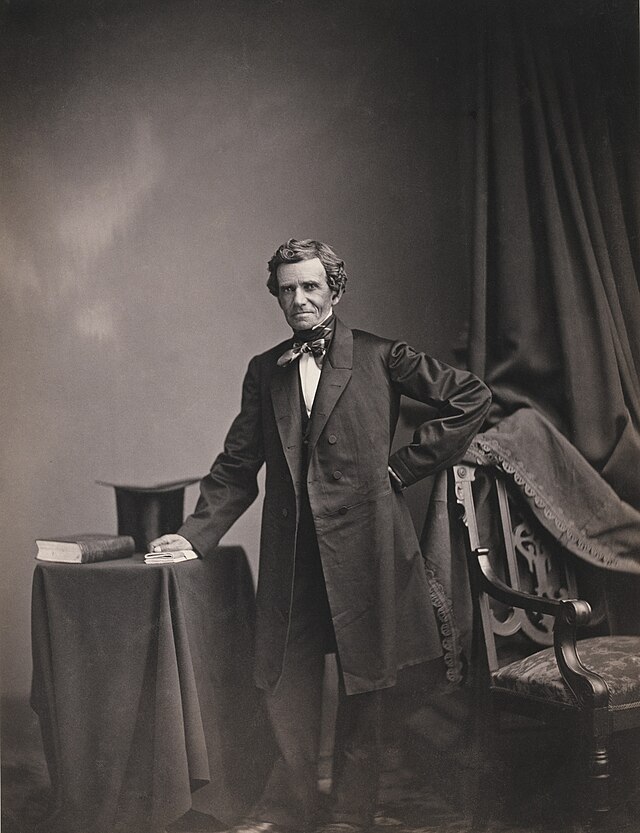
Samuel Wilkerson, Jr.. War correspondent for New York Times and father of Bayard Wilkeson.

Lieutenant Bayard Wilkeson, commander of Battery G, 4th U.S. Artillery.


Notes
1)    The Wilkeson’s were a prominent family from western New York. Samuel Wilkeson’s father was one of the founders of the city of Buffalo and his wife was the sister of suffragist Elizabeth Cady Stanton. After working for Horace Greeley and the New York Herald, Sam Wilkeson joined the New York Times as a war correspondent and was reporting on the battle of Gettysburg when he learned of his son being wounded on the morning of July 1st.
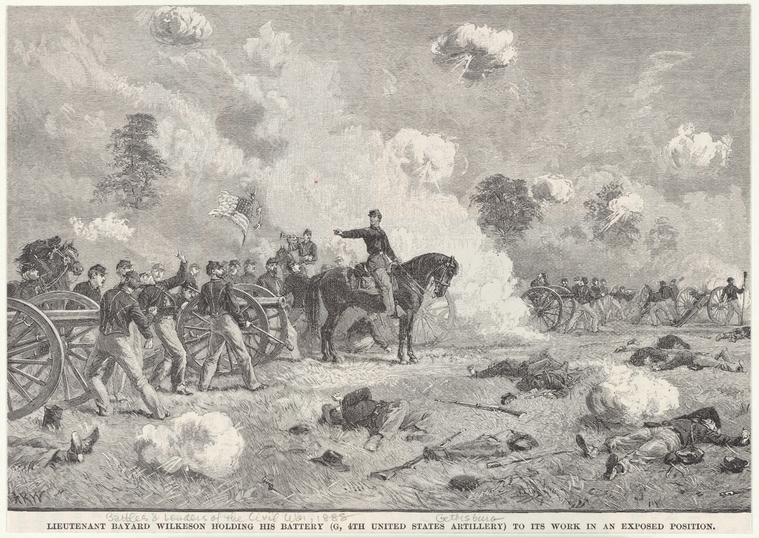
2)    Nineteen-year-old Lieutenant Bayard Wilkeson was a rising star in the Army of the Potomac and led Battery G, 4th U.S. Artillery. On the morning of July 1, 1863, his battery wreaked havoc on the Rebels advancing on the town of Gettysburg. So efficient was his leadership, Rebel artillery commanders ordered their gunners to aim directly at the young Lieutenant, prominently exposed on horseback. An artillery round struck the horse, passing through it and mangled Bayard’s right leg. He used his pocketknife to sever through the couple of tendons still connected to his leg. Carried to the county poor house, he died from shock and loss of blood the evening of July 1st.
3)    The words, “sleeps the sleep that knows no earthly waking” were not spoken by my character, James Bartlett. They appeared in a letter of condolence written to Samuel Wilkeson by Eunice Beecher. Eunice was the wife of noted minister, orator, and abolitionist Henry Ward Beecher. Her sister-in-law was Harriett Beecher Stowe.
 

Other People

The following story was written to a prompt for the Sturgis Library Writing Group titled “Other People”. I had been researching some of the activities of the First Day of the Battle of Gettysburg and decided to write a short historical fiction piece using my recurring character, James Bartlett, a young topographical engineer officer in the Union Army of the Potomac. After my story, I’ll provide some of the historical facts.

Lieutenant Bayard Wilkeson at Gettysburg. One of the central characters in my story. Print is from Battles & Leaders of the Civil War

Other People

Captain James Bartlett slowly made his way through hospital tent looking for Bayard Wilkeson.  The two had met at Fredericksburg back in December and became fast friends.  Poised and confident, Wilkeson seemed older than 19.  Bartlett had heard his friend’s artillery battery had suffered severe pounding that morning and it was rumored that Wilkeson was wounded.  Ambulances laden with casualties were caught up in the retreat from the fields north of Gettysburg and had delivered their cargoes of misery to the field hospitals that had been hastily erected below Cemetery Hill.  He was hoping to find someone from Wilkeson’s unit that could tell him of his friend’s whereabouts.  Bartlett had searched through two tents already, calling out for anyone from Battery G.  But nobody had answered.  He would have to report to headquarters soon, he’d have to find it first, so this would be his last tent for now.   The sounds in the hospital defied description.  The moans of the wounded, the soft voices of those calling for their mother, the screech of the bone saws and screams of men losing their limbs were sounds he could never push aside, even after two years of war.  Above those spine-tingling sounds, Bartlett heard a voice call out, to no one in particular, “‘Twas those other people again!”

“What “other people”?” a second voice questioned.  Bartlett couldn’t place the accent.  It sounded more Russian than German.  

“You know who I’m talking about.  Those damn Dutchmen in Eleven Corps.  They turned tail and ran again.  The whole line began to fold up ‘cause of them.” the first voice replied.

“DAMN YOU!” the accented voice roared.  

Bartlett watched as the voice’s owner struggled to stand.  A blood-stained bandage was wrapped around his head and one pant leg was sliced to reveal another bandage on his thigh.  The ruby red chevrons on his jacket sleeves indicated he was an artillery sergeant.  

“DAMN YOU!”, he bellowed again. Stabbing his crutch at his accuser, he continued, “I’m in the 11th Corps!  We did not run!” 

Wounded men nearby called out defending the 11th Corps.  “It’s true, they didn’t run.”  Their chorus of voices shut down the accuser.  The argument exhausted the artillery Sergeant and he tried to lay back on his bed of straw.  Bartlett stepped over to help ease him down.

“Thank you, sir.  Most kind of you.  “Other people”, I am sick of hearing “other people”.  Our ancestors were once “other people”.”

“No trouble Sergeant.  I have many friends who traveled here from Europe.  I understand and I wish this animosity didn’t exist.”
Bartlett helped the Sergeant get comfortable then said, “You are in the 11th Corps artillery.  Do you by chance know a Lieutenant Wilkeson?”
“I know him very well Captain.  He’s my battery commander.  We were wounded by the same shell.”

“He’s wounded you say.  Where is he?”

“I am sorry sir; he was badly wounded, and I hope is under the care of Rebel doctors.”

“How badly wounded?”

“His leg was nearly severed.”  Reaching into his jacket pocket, the Sergeant removed a pocketknife and passed it to Bartlett, “He used this to complete the job.” 

Bartlett recognized the knife immediately; his friend’s initials were etched into its bone handle.

Seeing Bartlett’s distress, the Sergeant gently grasped his shoulder and said, “I am sorry about your friend, sir.  Keep his knife.  You can give it back to him when you see him next.”

The man who accused the 11th Corps of cowardice called out, “I am sorry about me saying “other people”, Sergeant.  We were wounded fighting together.  Please accept my apology. I don’t need any more enemies.”

Historical Notes

At the time of the Battle of Gettysburg, nineteen-year-old Lieutenant Bayard Wilkeson led Battery G, 4th U.S. Artillery, in the artillery brigade of the Army of the Potomac’s 11th Corps. The majority of the soldiers in the 11th Corps were immigrants from Germany, their regiments and brigades led by officers named Von Gilsa, Von Steinwehr, Schimmelfennig, Schurz, Amsberg. But many had combat experience and were excellent soldiers.

Their reputation as “cowards” came about during the Battle of Chancellorsville in early May of 1863. The Corps suffered the brunt of “Stonewall” Jackson’s surprise attack and were routed. This came about due to poor leadership by Corps commander, Major General Oliver Otis Howard, who dismissed reports of a large body of Confederate soldiers lurking in the thick woods on the exposed flank of the Corps. However, the rout earned the 11th Corps the nickname “The Flying Dutchmen” (Dutch being misrepresented for Deutsch).

During fighting North of Gettysburg on July 1st, Lt. Wilkeson and his battery rushed to aid the beleaguered division of Francis Barlow, who foolishly advanced to an exposed position. Wilkeson commanded his battery, from atop his white horse, with such devastating efficiency that he attracted the attraction of several Confederate artillery batteries. While exposed, a shell from a Rebel gun passed though Wilkeson’s horse and practically severed his leg. Carried to the nearby Adams County Almshouse, he removed the remains of his mangled leg with his pocket knife. Bayard Wilkeson died from shock and loss of blood a few hours later. His father, Samuel Wilkeson, was a reporter for the New York Times and was at Gettysburg covering the battle. He found his son’s body after the Confederate retreat on July 4, 1863.

Photo of Wilkeson and his knife from Time-Life Civil War book series, Gettysburg issue.

The Picket Line

Yankee and Rebel pickets meet on the Rappahannock River at Fredericksburg, Virginia. The setting of my story.

Two summers ago I joined a fiction writing group that was designed to provide guidance and insight for writers intending on creating a novel. Over that summer I wrote six chapters of what I hope to become a historical novel set during the American Civil War. Besides needing to get back to that effort, I have written three stand alone stories using the same characters. The prompt for the Tuesday Sturgis Library Writers Group was “I Heard That…”. I went back to my historical novel characters and wrote a fourth stand alone story, which could be incorporated into the novel. I italicized and emboldened the prompt in the following story.

The Picket Line

Fredericksburg, Virginia, December 12, 1862

The waning Gibbous Moon illuminated the rutted path to the Rappahannock River crossing.  The temperature had dropped as the sun set making the path icy in spots.  Fearing his horse may slip, the rider dismounted, tied its reins to a sapling and walked the rest of the way to the river.

A voice with an Irish brogue called out of the shadows of the trail, “Halt! Who goes there!”  

“Captain James Bartlett, Corp of Engineers, and aide to General Burnside.”

The guard called for Bartlett to approach.  After exchanging salutes, Bartlett noted the brass numbers and letters on the guards’ cap, “69th New York Volunteers, cheers to the Irish Brigade!”

“Thank you, sir.  How can I be of service?”

“Can you direct me to the sergeant of the guard?”

“Follow the path to the river sir, Sergeant Quincannon’s ‘is name.”  Bartlett thanked the guard and continued towards the river.  Soon he could hear the river gurgling over the stones at the crossing.  The guards at the crossing had lit a small fire.  There were blankets tied to the tree trunks and branches to conceal its flickering flames.  Quincannon, sitting near the fire and sipping from a tin cup, stood and saluted Bartlett, then offered him a cup of tea.  Inquiring about the Captain’s visit, Bartlett answered, “I heard that men on the picket lines engage in commerce with our Rebel opponents across the river.”

Quincannon stammered, “That’s against regulations sir.”

Bartlett chuckled and said, “Don’t worry Sergeant, I know it happens.  I need to get a message to a friend on the other side. How do I arrange for that transaction?”

Quincannon hesitated a moment, leaned out from the cover of the blankets and called into the dark, “Corliss, you over there?”

A voice called back, “Howdy Quinn, what can I do fer ya’ll?”

“There’s an officer of engineers here says he needs to get a note to someone, can you help?”

“And what’s this officer of engineers have to offer us to be his messenger?”

Quincannon gave Bartlett a questioning look.  “Coffee and some brandy.”

Quincannon called back, “He’s got coffee and brandy Corliss.”

“I’ll be damned!  Send him over Quinn.”  Corliss told the other Rebels with him to not shoot.

Bartlett splashed across the cold, shallow river and walked into a circle of rather seedy looking Rebel soldiers.  Corliss stepped forward and gave a lazy salute.  Bartlett saluted back and handed over the brandy and coffee.  The circle of Rebels gasped.  Reaching into his coat pocket, Bartlett withdrew a letter and asked Corliss if he could get it to a cavalry officer named Captain Redmond Downes.  

“T’aint no cavalry here Captain”, said Corliss.

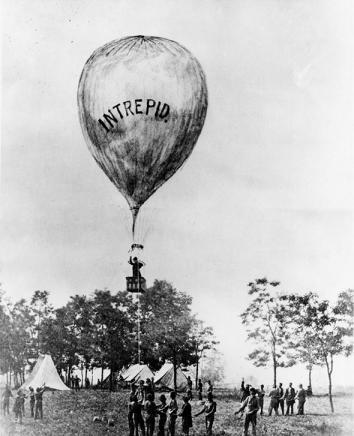
“I know there is, I saw them from the observation balloon today,” replied Bartlett.

Corliss was astounded.  “You were in that thang? I saw it today!  What’s it like to be so high up?”

“Scary as hell when it’s windy.  But you can see for miles. Please get this letter to Captain Downes,it is about a mutual friend of ours.  A young woman named Lizz.. Miss Elizabeth Haw.”

Balloons filled with hydrogen gas were used by the Union Army for aerial observation in the Virginia Theater of War until May of 1863. It was cumbersome transporting the balloons and gas generating equipage.

Corliss’ eyes narrowed, then his mouth twisted in a wry grin.  “Mutual friend, eh?  Soon to be closer to one than t’other I’m guessin’.”

“Please see that he gets it Mr. Corliss. I’d also like for him to know that I am still alive.”  

Corliss became serious again, “I am sorry Captain, I was just joshin’ with ya’all.  I’ll do my best.”

A Rebel burst through the brush startling everyone.  “Officers approaching”, he blurted out breathlessly.

Corliss turned to Bartlett, “You have to scoot sir.  I’m gonna to count to 10 and then we will fire off a volley.  Tell Quinn we’ll be shootin’ high, we’d be much obliged if ya’ll return the favor.”

Bartlett slipped, tripped and scrambled his way back to the Yankee side of the river, counting to 10 as well.  Reaching for Quincannon’s outstretched hand he told him what was about to unfold.  Sure enough, a volley rang out from the Rebel side of the river, the bullets humming through the branches high above their heads.  The Yankees aimed high and fired off a volley into the heavens over the Rebs.  A few insults were hurled back and forth.

Catching his breath, Bartlett thanked Sergeant Quincannon for his help.  Reaching into his sack, he handed the Sergeant a flask of brandy.

“Be’Jesus, you’re a saint sir.  You surely are!” Sergeant Quincannon exclaimed.

Bartlett shook the Sergeant’s hand and walked up the moonlit trail to his tethered horse.

Ernie Stricsek

Sturgis Library Writers Group, Barnstable MA

April 25, 2023

The Perfect Day

Young Robert Smalls

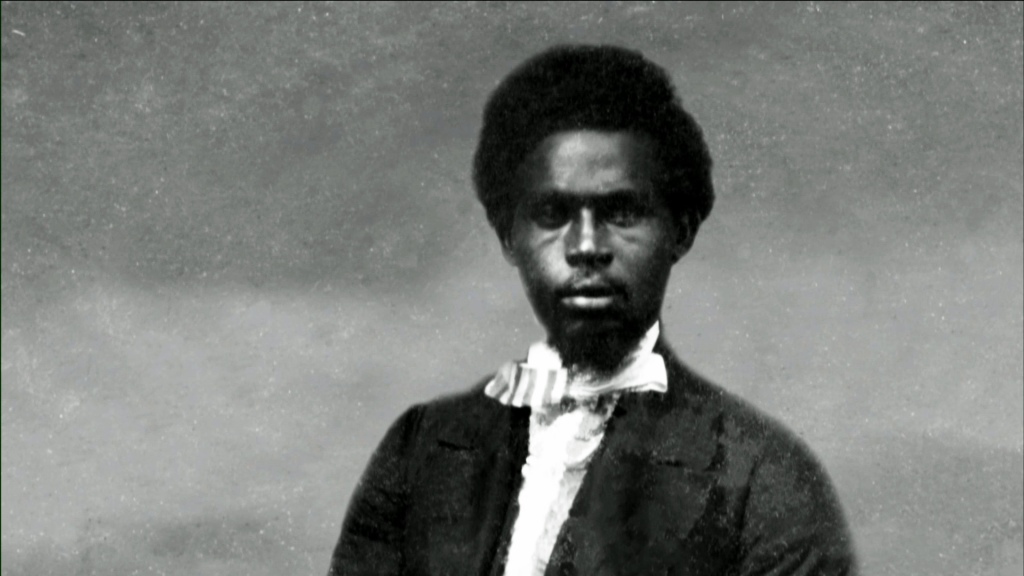
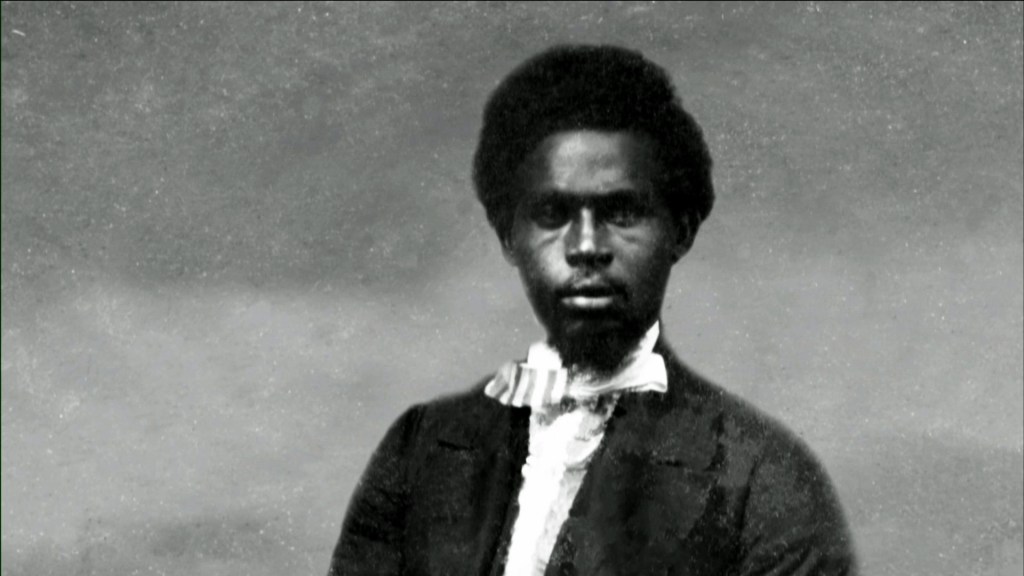
This is third blog entry I have made about Robert Smalls. His story is so truly remarkable, so inspiring, I can’t write enough about him. I recently joined another writing group, meeting at the Sturgis Library in Barnstable Village. The prompt for the meeting this week was “The Perfect Day”. I chose to write about the exhilarating day Robert Smalls, his family, and 13 other brave individuals had. The story itself is 100% true, no names have been changed to protect the innocent. With the exception of one sentence, the dialogue in my story is fabricated. I did this to keep the story moving along and to present factual information in a more interesting manner.

The battered facade of Fort Sumter, shortly after the opening shots of the Civil War on April 12, 1861

The Perfect Day

Charleston, South Carolina. April, 1861

Robert and Hannah Smalls gazed out into Charleston Harbor at the battered ramparts of Fort Sumter.  In the place where the Stars and Stripes of the United States flag once billowed over the fort, was now the new flag of the Confederate States of America.

“Hannah, what is your idea of the perfect day?”

“That’s easy Robert, Christmas Eve 1856, our wedding day.  Nothing tops that.”

Robert laughed softly, “I agree, I agree.  That has been my most perfect day.  Although the arrival of Lizzie and Robert, Jr. were pretty close too.” Then he grew silent, his gaze returning to Fort Sumter and its new flag.

“What’s troubling you, my love?”

Robert turned to face Hannah, “Today I asked Mr. Kingsman if I could purchase yours and the children’s freedom.  He said yes, but it would cost $800.”

All Hannah could say was, “Oh my, oh my.”

Robert said, “Right. Oh my.” Taking Hannah’s hand, they walked slowly home.  As the nation careened towards Civil War, Robert Smalls had grown increasingly anxious that Hannah’s master, Samuel Kingsman, would tear his family apart by selling his wife and children to other plantation owners in the South.  The price of freedom was high.  He and Hannah had managed to save $100.  Raising another $700 was near impossible.  Robert made $16 a month as a wheelman, or pilot, of a steamship delivering goods to ports along the South Carolina and Georgia coastlines.  He had to send $15 a month to his master, Henry McKeein Beaufort, SC.  Hannah made only $5 a month as a hotel maid and had to give three of those dollars to Kingsman each month.  Within a few days, Robert would begin working as a wheelman on a new ship named the Planter.  He planned on asking for extra duties in the hopes of earning more money to purchase his family’s freedom.


As Robert approached his new vessel, moored in Charleston Harbor, he was greeted by a man wearing a wide brimmed hat and a linen coat that hung to his ankles.


The C.S.S. Planter.

“Good morning Mr. Smalls!  Welcome aboard the Planter. I’m Captain Relyea.  I must say, your reputation as an outstanding wheelman and your knowledge of these inter coastal waterways will be highly valued.”

Over the next 12 months, Smalls and Relyea would learn a great deal about each other.  Shortly after the start of the Civil War, President Lincoln had ordered a blockade of all seaports in the newly created Confederate states.  Floating just outside of Charleston’s harbor were huge warships and fast gunboats of the United States Navy, waiting to pounce on any ships attempting to move cargo and supplies into the port.  Captain Relyea watched Robert Smalls closely and admired how he seemed to know every inch of coastline, every shoal, and to know which tidal creek to use to avoid detection by the blockading ships.  For his part, Robert watched everything Captain Relyea did.  From the donning of his big hat and long coat each day, to the signals he used to permit the Planter to safely pass the Confederate occupied forts in Charleston Harbor and along the coast. Robert also noted that Relyea, and the other two ship’s officers, trusted he and the 6 enslaved crew members enough to occasionally spend the night ashore.  This was a direct violation of Confederate Navy regulations specifying at least one white officer remain aboard a vessel with a black crew.  On the evening of May 12, 1862, Captain Relyea and the two officers decide they are going to spend the night ashore with their families.  Robert Smalls offers to remain aboard with the other crew members to prepare the Planter for the next day’s activities.

St. Phillip’s Church in Charleston, South Carolina. From a photo I took while visiting in early 2020.

The bell in St. Phillip’s Church chimes twice.  It is 2:00 AM  and most of the inhabitants of Charleston, South Carolina are sound asleep.  Most, but not all.  At Northern Wharf, the crew of the steamer Planter are making final preparations to cast off.  The ship’s cargo of 4 cannons and 200 missiles for those cannons, are to be delivered to the Confederate garrison on Morris Island.  Casting off, the Planter makes one stop at the West Atlantic Wharf to pick up 11 passengers.  By 3:25 AM, the steamer is slowly maneuvering its way past the 5 forts that protect the harbor from Yankee invaders.  As each fort is approached, the steamer sounds it’s whistle 3 times.  The occupants of each fort wait to verify the Planter’s markings & note the shipping schedule to confirm it’s destination then signals the ship to continue on.  At 4:15 AM, the Planter looms from the early morning mist and approaches the last of the 5 forts, Fort Sumter.  The guards on Sumter’s parapet wave a signal lantern, the Planter responds with the 3 snorts from its whistle.  As the it draws closer to the fort, the guards observe the familiar form of Captain Relyea, leaning against the pilot house, arms folded, his signature wide brimmed straw hat on his head and his long linen coat almost dragging on the deck.  With the ship’s identity and destination verified, Sumter’s guards wave to Relyea.  Relyea waves back and disappears into the pilot house.  The last of the forts being passed, the steamer chugs faster in the direction of Morris Island.

The site in Charleston Harbor where Robert Smalls picked up his passengers before steaming past the forts. My photo from visit in early 2020.

However, something is amiss!  As the earliest blush of dawn appears on the horizon, the guards notice that the Planter has changed course!  Rather than Morris Island, it is heading towards the open sea!  Steaming directly for the Union ships that blockade the harbor!  The Planter is now out of range of Sumter’s cannon and cannot be stopped.  Things are definitely not as they seem.  Upon entering the pilot house, Captain Relyea discards the broad hat and linen cloak to reveal that he is instead, 22 year old Robert Smalls himself, now a runaway slave.  His six crew members are also now runaway slaves.  The 11 passengers include Hannah, their two children, the wives and children of four crew members and 3 additional men – all runaway slaves.  It has been a harrowing trip past the forts.  Smalls, of similar height and stature to Relyea, also spent the past year studying his movements and gestures while planning this escape.  He hoped and prayed that the dim light and early morning mists would help shield his true identity.  As the Planter steams towards the Union naval vessels stalking the harbor entrance, Smalls has the Confederate flag & South Carolina state flag pulled down from its mast.  In their place he runs up the largest white bed sheet his wife has, to indicate his desire to surrender the Planter to the blockading Yankees.  However in the misty morning, the white flag is almost invisible.  As the mystery ship steams through the mists, Union officers on the U.S.S. Onward order the gun ports opened and cannons run out stop the rapidly approaching steamer..  At virtually the last moment, a breeze flips the white sheet sideways, a gunner on the Onward sees it and shouts to his mates that the approaching ship is flying a white flag.  The Onward stands down.  The Captain and the officers of the Onward crowd the deck to observe the approaching ship.  As the Planter pulls alongside and cuts its engines, Robert Smalls steps forward from the pilot house.  He calls up to the Captain of the Onward, “Good morning sir!  I have brought you some of the United State’s guns sir!”  More importantly, Robert Smalls has ferried himself and 17 others from slavery to freedom.

The passengers scurry up the ladder from below the Planter’s deck, tears cascading down their cheeks.

Robert reaches for Hannah, she collapses against him, her pent up tension releasing like the steam from the ship’s whistle.  Looking into her husband’s eyes, Hannah whispers, “We are free.  All of us, and we are together.  What a perfect day.”

Ernie Stricsek

Sturgis Library Writing Group

January 17, 2023

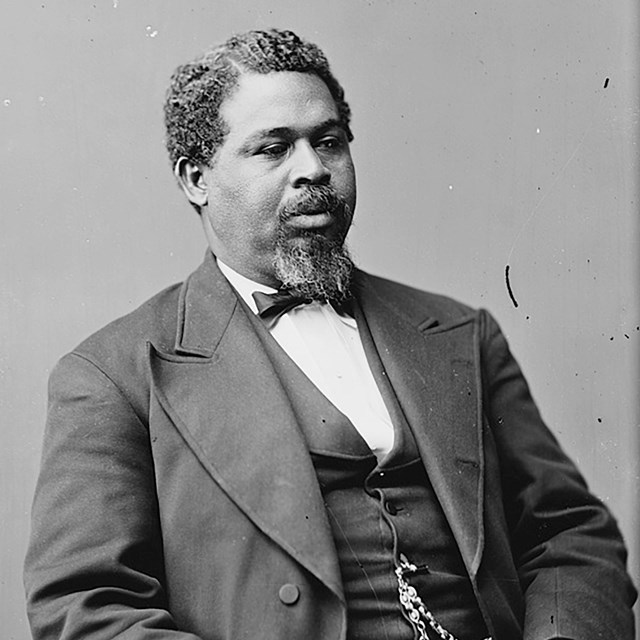
Congressman Robert Smalls, United States House of Representatives.

Robert Smalls house on Prince Street in Beaufort, SC. Photo I took in February, 2022.
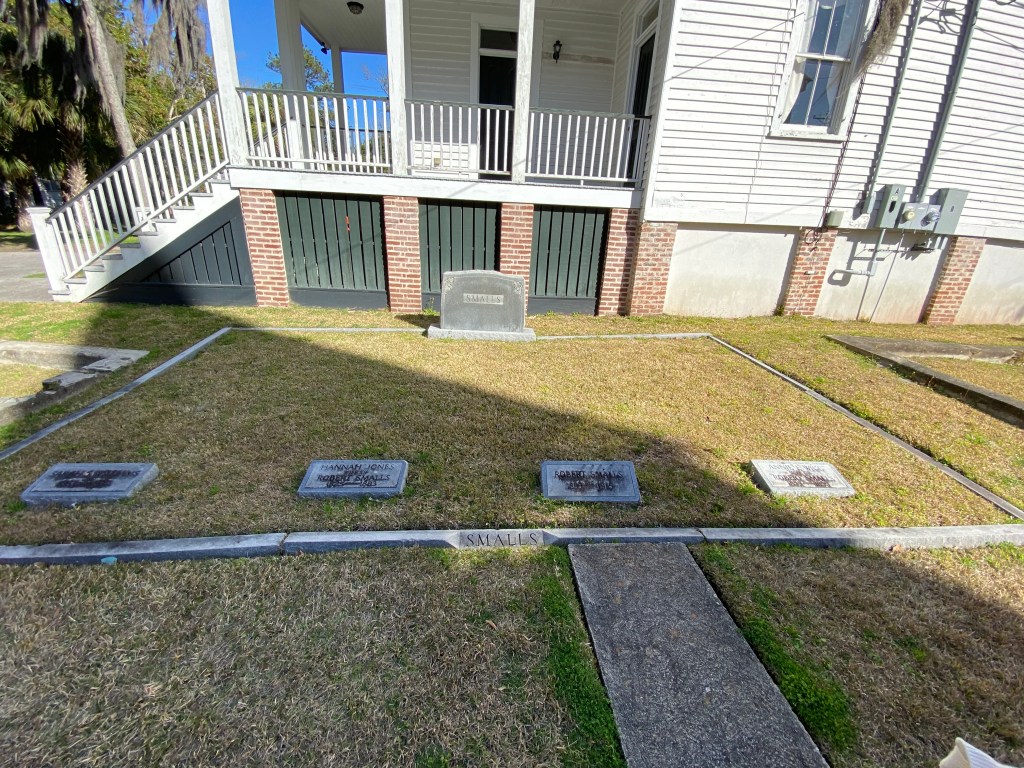
Burial site of Robert Smalls & his family in Tabernacle Baptist Church Cemetery, Beaufort, SC. Photo taken by me in February 2022.
Burial site of the McKee Family in the Baptist Church of Beaufort, SC, cemetery. The McKee’s were slave owners and owned Roberts Smalls and his mother. Photo taken by me from visit in February 2022.
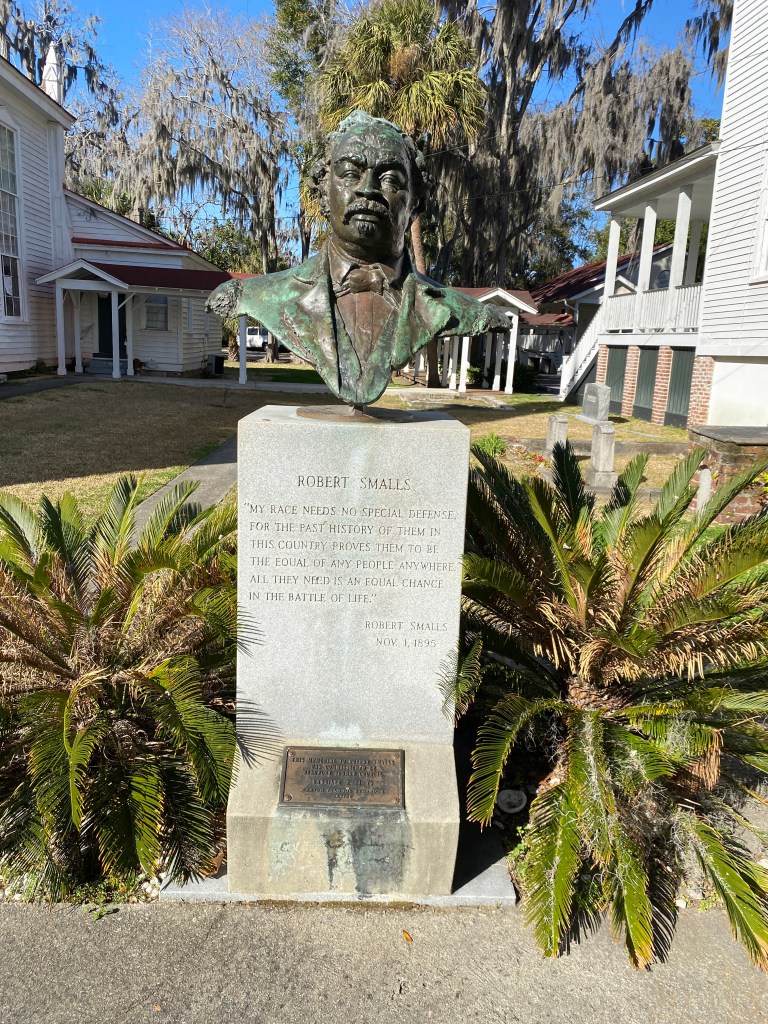
Bust of Robert Smalls in Tabernacle Baptist Church Cemetery, Beaufort, SC. Photo taken by me during visit in February, 2022.

Robert Smalls was, truly, a remarkable man. The sources for my story are from several of my books and periodicals.

Shadows

The prompt for the Writers Group this week was “Shadows”. I was uncertain as to what I was going to write about. I had started to read a book about Civil War Spies and decided to write about Elizabeth Van Lew. The large portion of this story is true. Some of the dialogue between Captain Gibbs and Elizabeth’s sister-in-law is not. Members of Richmond society did make comments about Elizabeth’s appearance.


Shadows

Elizabeth Van Lew could sense a shadow pass across her face.  Standing in the pantry, she could hear the tipsy cackle of her sister-in-law Mary rattling from the dining room.  “Elizabeth is not nearly as pretty as that portrait makes her to be”, Mary said.  “And if you have not noticed, she is a bit eccentric”.  There was a bit of an upward lift to Mary’s voice when she said the word “eccentric”.  Mary was talking to Captain Gibbs and his wife.  Gibbs was the new commander of the tobacco warehouse complex that housed the imprisoned Yankees captured in some of the earliest battles of the Civil War.  Gibbs and his wife had taken up temporary residence at the Van Lew’s Richmond, Virginia, mansion until permanent quarters could be secured.  Mary continued her rant, “I do declare that I believe the Van Lew family; Elizabeth, her mother and my husband are all a bit off.  All of these slaves that have been waiting on us hand and foot are considered staff!  The Van Lew’s have spent a lot of money purchasing their freedom.  Yet they still remain!  Now my daft sister-in-law is asking you if she could come and feed those vile Yankees in Libby Prison!  The thought gives me the vapors!”.  “I do not see any problem with Miss Van Lew providing some comfort to those men, even though they are devils”, replied Captain Gibbs.  The shadow quickly dissolved and a beaming Elizabeth emerged from the pantry into the dining room.  She would now be able to launch the plan she had spent several months developing.  

Forty-three years old, birdlike in appearance, the unmarried Elizabeth Van Lew was, in fact,  perceived as an eccentric by much of Richmond’s high society.  She was also an outspoken opponent of the institution of slavery and considered secession an act of treason.  The plan she was about to launch called “The Richmond Underground” would become one of the largest and most successful spy operations of the Civil war.  Now allowed to visit the Union prisoners, Elizabeth was able to obtain key details of how they were  captured and of what they observed on their way to imprisonment.  The details included the numbers and locations of Confederate units, which direction they appeared to be marching and who their leaders were.  Heading back to her home with this information, Elizabeth would transcribe the details onto paper – using invisible ink she developed and written in a coded cypher she created.  Applying milk to the paper would make the letters visible.  The notes were given to trusted acquaintances who would ensure that they would be delivered to the appropriate people on the Union side.  These trusted acquaintances, or operatives discovered that there were other people within the city of Richmond that had sympathies much aligned with Elizabeth’s.  The operatives had access to most of the departments within the Confederate government and, as such, could provide her with additional key information to be transcribed into the coded notes.

Gaining the confidence of the Union prisoners, they began to tell her about impending escape attempts and asked if she could provide maps with detailed escape routes from Richmond.  Elizabeth would hide escaped prisoners and Union loyalists trying to return North in a large, secret room on the 3rd floor of her family’s mansion, using the trusted members of her shadow organization to lead or transport them to safety.  Much of this activity in her home was conducted under the nose of her odious sister-in-law, and for a short time Captain Gibbs.  Elizabeth was aware that Confederate loyalists were suspicious of her, despite all of the secrecy and subterfuge practiced by the underground organization.  Leaving Libby Prison early one evening, Elizabeth became aware a hulking presence shadowing her movements.  When she picked up her pace, her follower did, likewise when she slowed.  She increased her pace to a jog, but her pursuer began to outpace her and caught up with her.  Grabbing Elizabeth’s arm and roughly spinning her around, he got close to her face and hissed “we know what you are up to.  You need to stop, or what happens to you and your mother will be very unpleasant”.  He released her and slipped away into the dark.  Despite being shaken, the assault only made her more determined to continue her operations.

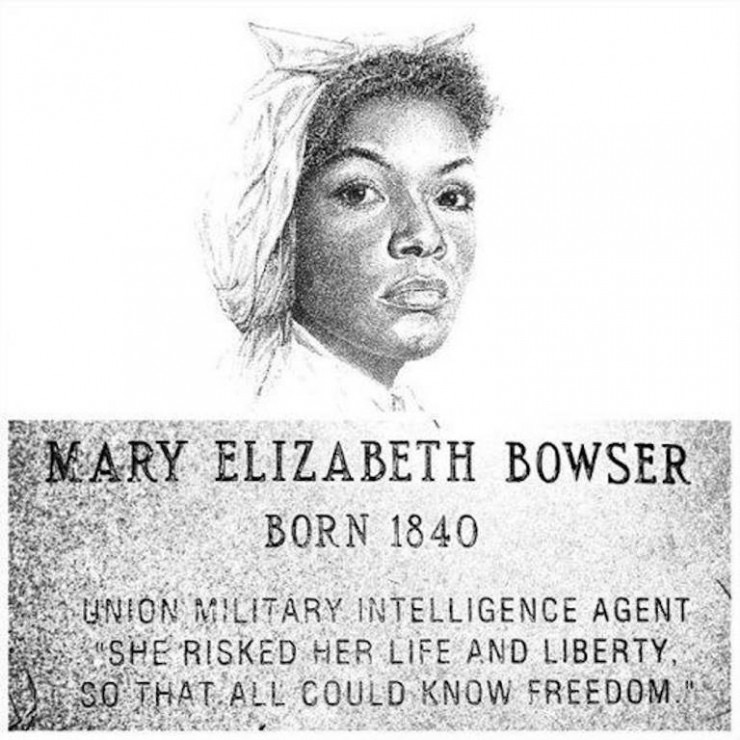
Not long after her encounter, Elizabeth received a gift in the form of a want ad in the Richmond Examiner.  Varina Davis, wife of Confederate President Jefferson Davis, was seeking a seamstress.  She would visit Mrs. Davis and offer the services of the Van Lew family seamstress, Mary Bowser.  The President’s wife was exceedingly grateful in accepting Elizabeth’s offer and could not wait for Miss Bowser to start work.  This venture began to pay huge dividends to the Richmond Underground operation.  Mary Bowser possessed a photographic memory, for both the spoken and written word.  After starting her job in the executive mansion, Mary would return to the Van Lew home and recite the documents she had seen on President Davis’ desk, and conversations she overheard between President Davis and his cabinet, or with senior Generals.  What was overwhelming for Elizabeth were the notes of praise she received from Union authorities about the accuracy of her communications and how much they helped in planning for the fall of the Confederacy.  Gazing out her window at the sky, Elizabeth noticed the clouds had caused a shadow to fall across the front of the “White House of the Confederacy”.  Is this some type of prophecy? Is the end of this folly near she thought?


Ernie Stricsek

Chatham Writers Group

4/19/2021

Union David Sinks Rebel Goliath

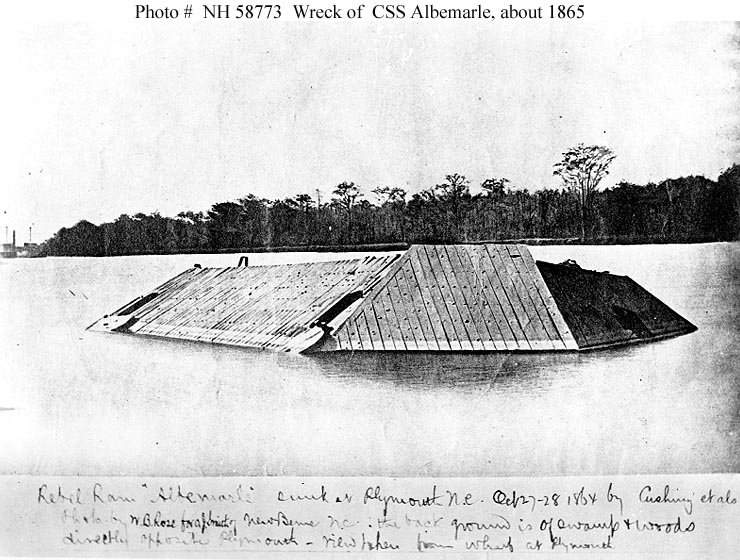
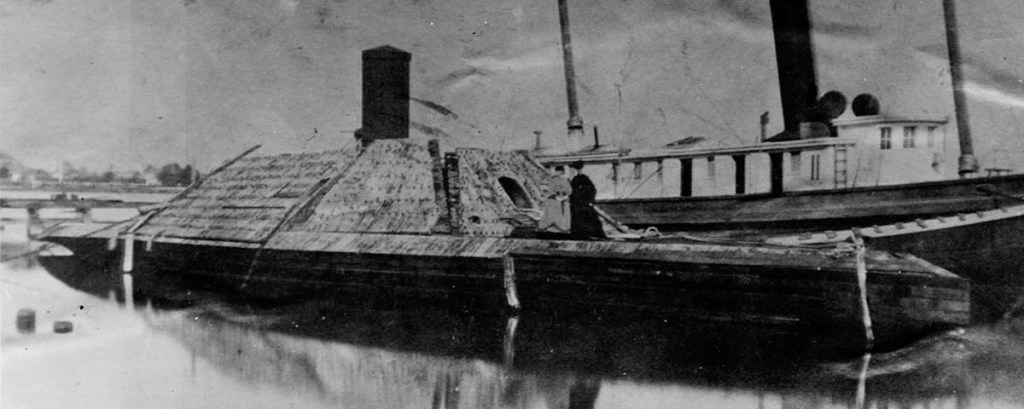
In the summer and early fall of 1864 a Confederate iron clad ram, the CSS Albemarle, prowled the outlet of the Roanoak River at Plymouth NC, wreaking havoc on the wooden steamers and gunboats of the U.S. Navy. After attacking, the Albemarle would quickly return to its heavily defended port to avoid capture or sinking by its pursuers. Union Naval commanders were evaluating several plans to penetrate the harbor defenses of Plymouth and destroy the Albemarle. Young Lt. William Cushing devised and proposed a daring plan to sink the ironclad ram. It was bold, it was risky, it was dangerous. The commanders accepted the plan. In the wee hours of the morning of October 28, 1864, Lt. Cushing and 13 volunteers in a light steam launch with a small howitzer and a “torpedo” fastened at the end of a 14 foot spar, silently approached the Albemarle. Slipping past outposts along the river, the Albemarle loomed closer and closer, protected by a ring of floating logs and armed sentries. Ordering the pilot of the skiff to apply full steam to generate enough speed to propel them over the logs, Cushing crawled forward to pull the cord that would detonated the torpedo beneath the hull of the Albemarle. The sentries began to fire upon Cushing, shredding his uniform coat and shooting off his boot, but a blast from the howitzer sent them scattering. Cushing’s launch went up and over the log barrier, he lowered the boom and detonated the charge beneath the ram. At exactly the same moment, the ram fired on the skiff. The twin explosions sent Cushing and all of his men into the water. Two of Cushing’s men drowned trying to swim to shore, 11 men were fished out of the water and captured, Cushing miraculously was unscathed and managed to avoid capture. The Albemarle sank. With the loss of the Albemarle, the Confederates had to relinquish control of the sea and rivers around Plymouth. Cushing received the Thanks of Congress for his daring accomplishment. Today, 28 October 2020, is the 156th Anniversary of the sinking of the Albemarle.

Lt. William B. Cushing, United States Navy
At the Norfolk Navy Yard, Virginia, after salvage, circa 1865. Two ladies are standing on her deck, near a section of displaced casemate armor. Courtesy of Mr. J.C. Hanscom. U.S. Naval History and Heritage Command Photograph.
Operational, scaled down replica of C.S.S. Albermarle on display at Port O’ Plymouth Museum in Plymouth, North Carolina.

William Cushing’s brother, Alonzo, received the Medal of Honor for his leadership and skill directing the efforts of his artillery battery at the Battle of Gettysburg in July of 1863. Alonzo Cushing’s battery was located next to the Copse of Trees that served as the target of Pickett’s Charge on 3 July 1863. Suffering from several serious wounds, Cushing refused to relinquish command of his battery. As Pickett’s men swarmed over the wall in front of his battery, Cushing himself fired a cannon at point blank range into the Rebels. Alonzo Cushing was shot in the face and killed.

400 Years, Tracking the Pilgrims


First Landing

2020 is the 400th Anniversary of the Pilgrim’s arrival in Massachusetts. This was supposed to be a huge celebration year with lectures, re-enactments, etc. Things came to a screeching halt in March as the Coronavirus roared into the state and things were shut down. Activities did eventually resume, albeit via webinars or socially distanced get togethers with limited numbers of participants. In 1620, the destination of the Mayflower was actually the mouth of the Hudson River. Crossing the Atlantic, the Mayflower drifted to the north and the first land to be observed was the northern shore of Cape Cod. Turning south, the Mayflower encountered what would become the graveyard of many ships, the shoals of Pollack Rip just off the coast of what is now the town of Chatham. The journey to the Hudson River was abandoned and the Mayflower turned north. Rounding the tip of Cape Cod the Mayflower dropped anchor in Cape Cod Bay on November 11, 1620, off latter day Provincetown.

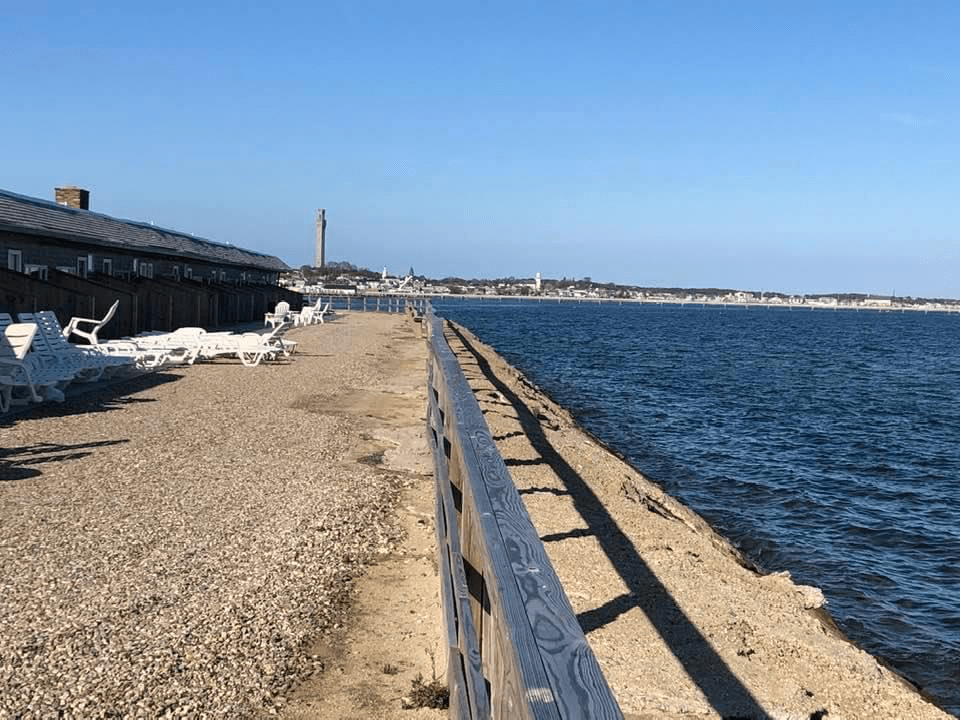
Barb and I attended a webinar last night about the Pilgrims first year in New England. Included in the talk was a map with a list of locations that the Pilgrims explored. Today we took advantage of a beautiful fall day to visit some of the sites. The images below are in Provincetown. In the image on the left the tall tower in the distance is the Pilgrim Monument. The Mayflower is believed to have anchored in the bay in the area just past the end of fence. The photo on the right is a small marker commemorating the arrival of the Pilgrims on November 11. The area is being renovated and we could not get closer to the monument.


Initial Shallot Excursions

The second stop on our tour of sites the Pilgrims explored was Corn Hill. Using a small skiff called a “shallot”, 16 men sailed from the Mayflower seeking likely places for food sources or inhabitants (Native Americans of the Payomet Tribe). Arriving at a stretch of beach with a high prominence behind it, the Pilgrims came ashore and began to explore. Climbing the hill they discovered several unoccupied dwellings (the Payomets were at hunting camps further south). The real find however were several bushels of ripe corn and seed corn. The Pilgrim’s food supply had gotten dangerously low, so they took the corn. They basically stole the Payomet’s food supply. Not being total spalpeens, the Pilgrims did leave a note promising to repay the “loan”. They also named the spot “Corn Hill”. The photo on the upper left below is Corn Hill today. The photo on the right is of Provincetown in the distance. The Pilgrims lit a bonfire signal so those on the Mayflower knew that all was well. The photo on the lower left is of a modern day pilgrim standing in front of the monument commemorating the campsite. The photo on the lower right is the monument.

On the First Thanksgiving, the feast being completed, the Pilgrim and Payomet menfolk were sipping brandy and smoking cigars. Payomet Chief Massasoit reluctantly brought up the subject of the corn debt with Pilgrim leader William Bradford (who would become the first Governor of Massachusetts). Bradford replied with the very first version of the reply that would pass down through the ages with some minor modifications: “Chief, the corn is in the mail”. I totally made up this last paragraph. The Pilgrims did repay the corn loan.

First Encounter

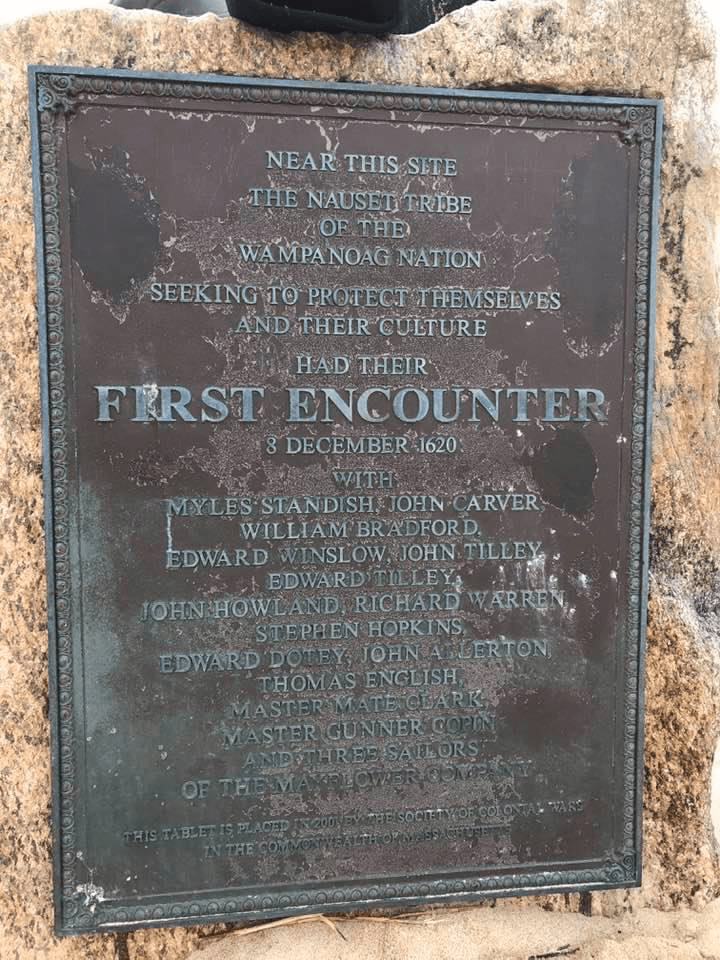
The last stop on our tour today was First Encounter Beach in Eastham. Making another excursion farther South along the Cape Cod Bay side of the Cape, the Pilgrims observed several Native Americans on the shore. As they approached the beach, the party on shore melted into the woods. A little uneasy, the Pilgrims established a rudimentary set of breastworks for protection before settling in for the night. The night would be anything but settling and restful as animal sounds and shuffling noises from the woods kept many of the Pilgrims awake. The noises were created by members of the Wampanoag Tribe preparing to confront the English settlers at first light. As dawn broke, the Pilgrim guards came scrambling back to the beach shouting “Indians! The woods are full of them”. The guards were no sooner behind their protective barrier when a shower of arrows zipped passed their heads. The Pilgrims replied with a hail of lead fired from their matchlock rifles. The noise and smoke sent the Wampanoags back into the forest. The Pilgrims broke camp quickly, piled into the shallot and sailed back to the Mayflower. The first encounter between Pilgrims and Wampanoags ended in a bloodless draw. It was not too long after this engagement that the shallot set out for one final time, heading west to their final destination in Plymouth.

The top photo below is First Encounter Beach looking north towards Provincetown. The 2nd photo is First Encounter Beach heading south to Orleans. The 3rd photo is monument commemorating the first encounter.

We are going to try and visit more sites dedicated to the Pilgrim’s Progress. I will update this story as we go along.

Ferry to Freedom

I have written about Robert Smalls before. This entry was written in response to a prompt for The Chatham Writers Group. The prompt was what program or series would we like to see on TV.

Ferry To Freedom

May 13, 1862

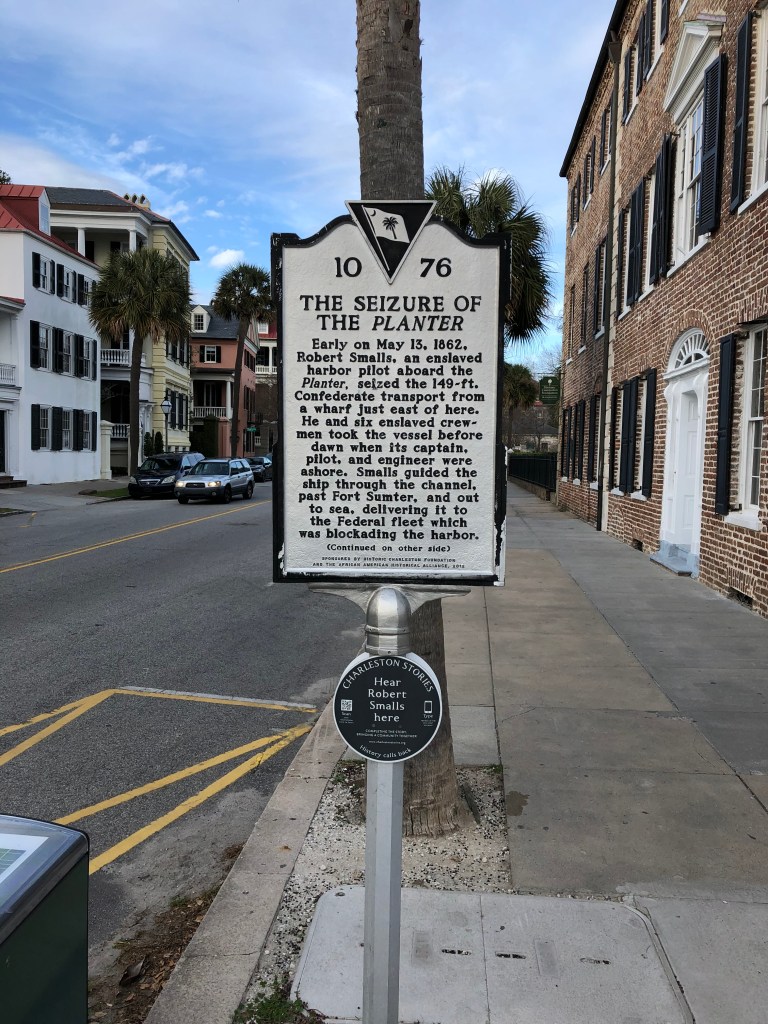
The bell in St. Phillip’s Church chimes twice.  It is 2:00 AM and most of the inhabitants of Charleston, South Carolina are sound asleep.  Most, but not all.  At Northern Wharf, the 7 crew members of the steamer C.S.S. Planter are making final preparations to cast off.  The ship’s cargo of 4 cannons and 200 missiles for those cannons are to be delivered to the Confederate garrison on Morris Island.  Casting off, the Planter makes one stop at the West Atlantic Wharf to pick up 11 passengers.  By 3:25 AM, the Planter is slowly maneuvering its way past the 5 forts that protect the harbor from Yankee invaders.  As it approaches each fort, the Planter sounds it’s whistle 3 times.  The occupants of the fort wait to verify the Planter’s markings & note the shipping schedule to confirm destination then signal passage to the ship.  At 4:15 AM, the Planter looms from the early morning mist and approaches the last of the 5 forts, Fort Sumter.  The guards on Sumter’s parapet wave a signal lantern, the Planter responds with the 3 snorts from its whistle.  As the Planter draws closer to the fort, the guards observe the familiar form of the Ship’s Captain, C.J. Relyea, leaning against the pilot house, arms folded, his signature wide brimmed straw hat on his head and his linen cloak over his shoulders.  With the ship’s identity and destination verified, Sumter’s guards wave to Relyea.  Relyea waves back and disappears into the pilot house.  The last of the forts being passed, the Planter chugs faster in the direction of Morris Island.

However, something is amiss!  As the earliest blush of dawn appears on the horizon, the guards notice that the Planter has changed course!  Rather than Morris Island, it is heading towards the open sea!  Steaming directly for the Union ships that blockade the harbor!  The Planter is now out of range of Sumter’s cannon and cannot be stopped.  Things are definitely not as they seem.  Upon entering the pilot house, Captain Relyea discards the broad hat and linen cloak to reveal that he is instead, 22 year old Robert Smalls, now a runaway slave.  His six crew members are also now runaway slaves.  The 11 passengers consist of Roberts wife Hannah, and their two children , the wives and child of four crew members and 3 additional men – all runaway slaves.  It has been a harrowing trip past the forts.  Smalls, of similar height and stature to Relyea, spent months studying his movements and gestures while planning this escape.  He hoped and prayed that the dim light and early morning mists would help shield his true identity.  As the Planter steams towards the Union naval vessels stalking the harbor entrance, Smalls has the Confederate flag & South Carolina state flag pulled down.  In its place he runs up the largest white bed sheet his wife has, to indicate his desire to surrender the Planter to the blockading Yankees.  However in the misty morning, the white flag is almost invisible. As the a Planter approaches, Union officers on the U.S.S. Onward order the gun ports opened and cannons run out stop the Rebel ship.  At virtually the last moment, a breeze flips the white sheet sideways, a gunner on the Onward sees it and shouts to his mates that the approaching ship is flying a white flag.  The Onward stands down.  The Captain and the officers of the Onward crowd the deck to observe the approaching ship.  As the Planter pulls alongside and cuts its engines, Robert Smalls steps forward holding his hat.  He calls up to the Captain of the Onward, “Good morning sir!  I have brought you some of the United State’s guns sir!”.  More importantly, Robert Smalls has ferried himself and 17 others from slavery to freedom.

This prelude introduces us to the sweeping 10 part miniseries that will chronicle the incredible life of Robert Smalls.  You will follow his rise from slavery, to his life as a river pilot, learn of his thrilling escape and join him in the halls of Congress.  You will also meet Robert’s mother, Lydia Polite, who asked the slave owning patriarch to put Robert to work in the cotton fields, so he could experience what the horrible world of slavery was really like.  Henry McKee, the aforementioned patriarch was, in all likelihood, Robert’s father, would treat Robert with kindness, even after Robert purchases the McKee house after the end of the Civil War.  Henry’s wife, Jane, will suffer from dementia and move back into her old home to be cared for by the Smalls’ family.  You will meet Robert’s wife, Hannah Jones, a slave and hotel maid in Charleston, South Carolina.  Unable to purchase her freedom, Robert plans his fantastic escape to carry her from slavery’s clutches.  You will witness the dereliction of duty by the C.S.S. Planter’s Captain, C.J. Relyea, as he leaves his ship under the control of 7 slaves, without any white officers to watch over them.

This is but one vignette of a truly remarkable story that I would love to see as a mini-series.  I am struck by the fact that no attempt has been made to produce a series illustrating the adventurous and successful life of Robert Smalls.

Robert Smalls home in Beaufort, South Carolina

A Carpet Of Orange Blossoms

A ghost story….

A Carpet of Orange Blossoms 

The approaching dawn found him in his usual position, perched on a boulder next to the statue of General Warren.  He had been doing this for a number of years now.  It was his favorite time of day in his favorite season of the year.  The sun would rise behind him, over the Round Tops.  The woods and fields from Seminary Ridge to the west of Gettysburg would be the first to benefit from the light of the rising sun.  Immediately below and to his front, Devil’s Den, the Peach Orchard and the Wheat Field would still be in the shadows of the Round Tops.  The early morning mist would lay heavy in the low points of the uneven ground.  Yes, he loved this time of day, the quiet before the throng of park visitors crowded the crest of Little Round Top, asking about where was it that Joshua Chamberlain and the 20th Maine changed the course of the Battle of Gettysburg.  

Over the next half hour, the sun cleared the Round Tops and the mists gave way to a haze which indicated that this late June day was going to be a hot one.  Loud voices off to his left shook him from his reverie.  Scowling at his watch, he mumbled “‘it’s a bit early for visitors”.  Not yet ready do deal with anyone, he stood up, stretched and slid down from his perch to move into the shade behind an observation tower to see how things would play out.  The approaching group was revealed to be a Boy Scout troop supervised by several adults.  Spotting the observation tower, the young scouts shouted “look, a castle tower!  Last one to the top is a rotten egg!”  The adults managed to stop the stampede. One adult, the Scout Master, said that before going up the tower, Mr. Brampton is going to tell us what happened here.  Still unseen behind the tower, the man cringed when this Brampton fellow began to speak in a flat monotone, reading from a small booklet.  It was obvious that most of the scouts could care less about Brampton’s talk as they sprinted off to the tower before he finished.   Peeking around the side of the tower, the man noticed that there were three scouts standing next to one of the adults.  He heard one scout ask “Dad, could you tell us a little more about what happened here?”  The father replied “sure, Jeremy, if you guys are interested”, and he began to talk.  The man behind the tower was curious now, as the father spoke from memory.  The man’s interest grew exponentially as the father spoke, initially with great enthusiasm, then with obvious emotion as his voice began to tremble.  When the father finished speaking, two of the scouts thanked him and joined their friends.  The father and son remained behind, peering through their binoculars at Devil’s Den.  The man now stepped into full view and eavesdropped on the conversation between father and son.  He heard the son say, “do you see those reflections of light from around the boulders in Devil’s Den?  What are those?  There is not anybody down there!”  The father replied “Jeez Jeremy, you are right.  I don’t see anybody, just those scattered flashes of light.”  With a smile, Jeremy’s father turned to him and said “if I did not know better, I would say they seem like muzzle flashes from Rebel snipers”.  Jeremy and his Dad both shrugged, laughed, and returned to peering through their binoculars.  The man stood staring at Jeremy’s father.  There was something awfully familiar about him.  “I think I need to make my presence known”, he thought, “this is certainly very curious”.  

Approaching father and son, the man now heard the father exclaim “Look over at Seminary Ridge Jeremy!  That looks like Rebel cavalry coming out of the tree line!”  Jeremy replied “I know! The haze makes them appear almost ghostly.”  Both father and son suddenly put down their binoculars and stood blinking at the distant ridge.  They looked at each other and spoke at the same time “did they just disappear”?  Both Jeremy and his Dad jumped when the approaching man said “Perhaps”.  

Jeremy’s dad was going to upbraid the approaching stranger for scaring the hell out of them but he was unable to speak. Mouth hanging open, he was staring at a man wearing a faded blue, Civil War era uniform of a Union infantry Colonel.  The man in the uniform had also stopped and was staring at Jeremy’s Dad.  A strong vibe of recognition passed between them.  Jeremy’s Dad shook his head as though clearing it of a bad dream and spoke first: “are you a re-enactor?  Or a living history volunteer for the park?”.  The man in uniform just stared back a moment longer then slowly said “Captain Nicoll, as I live and breath”.  Confused now, Jeremy’s Dad said “What? Who? Is that your name?  I am sorry, I am flustered.  Let me start over, Hi, my name is Ed Mullins, this is my son Jeremy.  Do you work for the park?”.  The man in uniform seemed to recover as well.  He replied, “Yes, I guess you could say I am part of the park”.  Jeremy Mullins, who had stood with a bewildered expression this whole time blurted out “You are Augustus Van Horne Ellis! Colonel of the 124th New York! The Orange Blossoms!  My Dad showed me your picture!” Pointing to Devil’s Den Jeremy continued “you were killed in that triangular shaped field just over there! Dad! We are talking to a ghost!  Is this real? Am I dreaming?”.  The man in the uniform chuckled and spoke “What a bright young man you are. I am indeed Colonel Ellis. This is no dream. Sadly, mine, and the bodies of my Orange Blossom regiment carpeted that Triangular Field”.  Pointing to Jeremy’s dad the man in uniform said “And you sir, I am certain, are Isaac Nicoll, Captain of my Company G.  You may be who you say you are today, but on July 2, 1863, you were my Captain Nicoll! You witnessed what happened here.  I am damn glad you have returned to us sir!  If the two of you want to see ghosts, I invite you to join me in Devil’s Den at dusk!  Nicoll, Mullins, whatever your name sir, you will see your old friends. And. We. Will. Have. A devil of a time sir! We will indeed”!

Ernie Stricsek

Chatham Creative Writing Group

8/9/2020

Gettysburg, 1 – 3 July, 1863

Gettysburg: July 1, 1863 – Daybreak
The humidity at dawn on July 1, 1863 was already thick. Pickets (patrols) of General John Buford’s Calvary Division of The Army of the Potomac were in situated in a large arc, scouting the roads to the north and northwest of Gettysburg, looking for units of Robert E. Lee’s Army of the Northern Virginia. Picketing the Chambersburg Pike heading northwest from Gettysburg was Lt. Marcellus Jones and his company of troopers from the 9th Illinois Cavalry. Peering through his field glasses, Lt. Jones observed movement along the Pike, coming in his direction. The shimmering morning heat made the figures approaching him appear almost ghostly. At about 600 yards from his position, the figures became clearer. What Jones was seeing was the advance elements of Confederate General Henry Heth’s division. Lt. Jones asked to borrow the Sharpe’s carbine from the trooper standing next to him, Sgt. Levi Schafer. Taking aim at an officer atop a white horse (believed to be Col. Burkett Fry), Lt. Jones squeezed off a shot. He missed Col. Fry, at 600yards it was not an easy shot for a carbine. It was 7:30 AM. Lt. Marcellus Jones just fired, what is believed to be, the first shot of the 3 day Battle of Gettysburg.

Lieutenant Marcellus Jones fires first shot to open the three day battle of Gettysburg, July 1-3, 1863

Sources: Edwin Coddington: “The Gettysburg Campaign”, Stephen Sears: “Gettysburg”, Bruce Catton: “Glory Road”, Blue & Gray Magazine, issues dedicated to the Gettysburg Campaign.

Gettysburg: July 1, 1863 – Mid-morning

“T’aint no militia! It’s those damn Black Hat fellers!” “Those damn Black Hat fellers” we’re members of one of the elite, and I would say THE ELITE, brigades in the Union army during the Civil War. It was the only brigade in the Army of the Potomac consisting of all mid-Western regiments – the 2nd, 6th, 7th Wisconsin, the 19th Indiana, and the 24th Michigan. Their distinctive uniforms; the tall black “Hardee”, long blue coat and buff gaiters over their boots made them easily recognizable. They were proud of the fact that their official designation was the 1st Brigade, 1st Division, 1st Corps, Army of the Potomac. As such, they imagined that if the Army of the Potomac were lined up for review by President Lincoln, they would be The First unit he would see.

During the opening hours of the Battle of Gettysburg, 153 years ago today, the Iron Brigade was rushed forward to halt the advance of Heth’s Division of theConfederate Army of the Northern Virginia. Up to this point the Rebels thought that only Yankee cavalry and some local Pennsylvania militia opposed them. Upon seeing The Black Hat Fellers, the Rebs knew they were in for a bigger fight than imagined.

The Iron Brigade would be decimated on July 1st of 1863 and would never again function as the elite fighting force they were prior to the Gettysburg battle. The whole 1st Corps of the Army of the Potomac was wrecked on that day, their sacrifice allowed time for the rest of the Yankee army to arrive on the field and change the course of the battle.

Men of the Iron Brigade (on the left) repulse Confederate soldiers of James Archers Brigade (on right). Archer was captured in the action.

Gettysburg: July 1, 1863 – Late Morning

As the fighting the fighting between Archer’s Brigade and the Iron Brigade was raging, rebel troops were observed entering a railroad cut to try and flank the Union position on the right of Seminary Ridge. The 14th Brooklyn and the 6th Wisconsin regiments were ordered to stop the advance. Charging the railroad cut, and with great loss, both regiments were able to stop the Confederate advance through the cut. The rebels lost heavily as well. The commander of the rebel brigade that advanced into the cut was Joseph R. Davis, nephew of Confederate President Jefferson Davis. His advance into the cut without adequate reconnaissance caused the wreckage of his brigade and in the reorganization of the Army of Northern Virginia after the battle, he was shunted off to a less important role. The official designation of the 14th Brooklyn Regiment was the 84th Regiment of New York Volunteers, a designation they detested. They were mustered in as the 14th Brooklyn after Fort Sumter, were the 14th Brooklyn at Bull Run, but could not convince the State of New York to allow them to keep the 14th designation. They steadfastly refused to adopt the regulation blue uniform and wore their distinctive uniform, patterned after a French Zouave design. They were ferocious fighters and nicknamed “The Red Legged Devils”. The 6th Wisconsin was part of the famed Iron Brigade, “The Damned Black Hats”. Stopping the assault through the railroad cut gave the Union army only a temporary respite. More rebel troops began to arrive on the battlefield and the Yankees had to retreat through town to occupy the positions they would hold for the remainder of the battle.

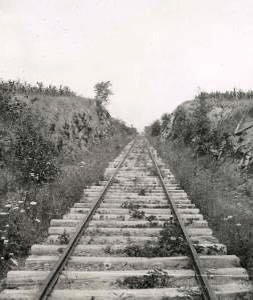
Photo of “The Railroad Cut”, taken after the battle
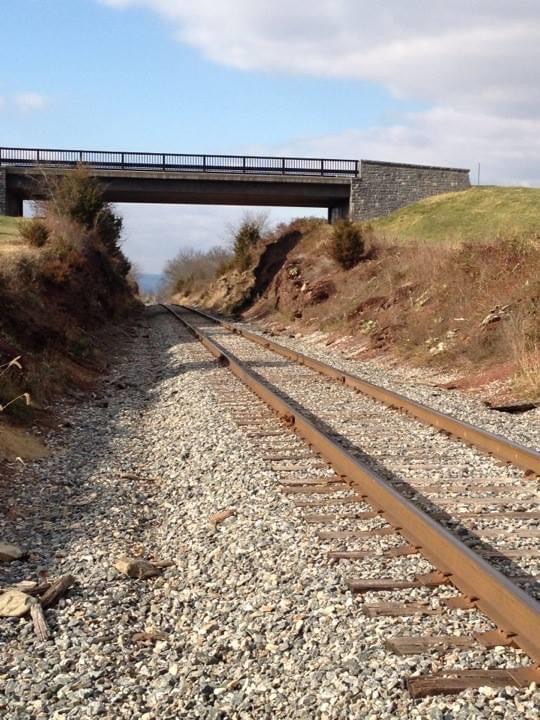
Current photo of Railroad Cut, taken by me in 2013.
The 14th Brooklyn charging the Railroad Cut
The 6th Wisconsin attack on the Railroad Cut. Davis’ Brigade is trapped in the bottom of the cut.
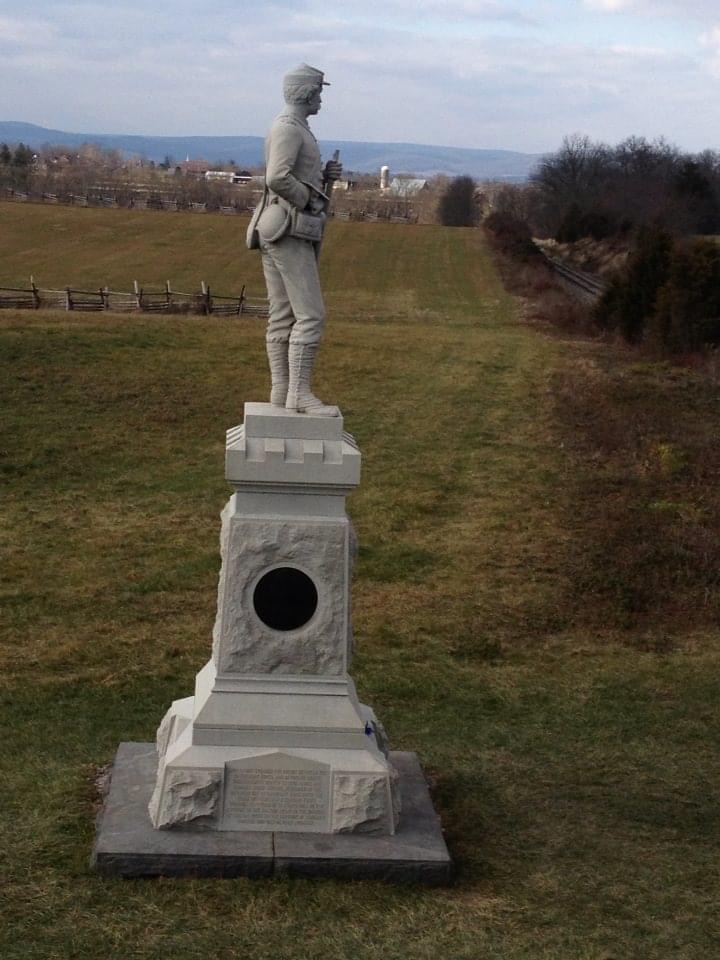
Photo I took of the 14th Brooklyn Monument near the Railroad Cut.

Sources: David Martin: “Gettysburg, July 1, 1863”, Lance J. Herdegen & William J.K. Beaudot: “In the Bloody Railroad Cut at Gettysburg”, Harry Pfanz: “Gettysburg The First Day”.