
The following story was written to a prompt for the Sturgis Library Writing Group titled “Other People”. I had been researching some of the activities of the First Day of the Battle of Gettysburg and decided to write a short historical fiction piece using my recurring character, James Bartlett, a young topographical engineer officer in the Union Army of the Potomac. After my story, I’ll provide some of the historical facts.
Other People
Captain James Bartlett slowly made his way through hospital tent looking for Bayard Wilkeson. The two had met at Fredericksburg back in December and became fast friends. Poised and confident, Wilkeson seemed older than 19. Bartlett had heard his friend’s artillery battery had suffered severe pounding that morning and it was rumored that Wilkeson was wounded. Ambulances laden with casualties were caught up in the retreat from the fields north of Gettysburg and had delivered their cargoes of misery to the field hospitals that had been hastily erected below Cemetery Hill. He was hoping to find someone from Wilkeson’s unit that could tell him of his friend’s whereabouts. Bartlett had searched through two tents already, calling out for anyone from Battery G. But nobody had answered. He would have to report to headquarters soon, he’d have to find it first, so this would be his last tent for now. The sounds in the hospital defied description. The moans of the wounded, the soft voices of those calling for their mother, the screech of the bone saws and screams of men losing their limbs were sounds he could never push aside, even after two years of war. Above those spine-tingling sounds, Bartlett heard a voice call out, to no one in particular, “‘Twas those other people again!”
“What “other people”?” a second voice questioned. Bartlett couldn’t place the accent. It sounded more Russian than German.
“You know who I’m talking about. Those damn Dutchmen in Eleven Corps. They turned tail and ran again. The whole line began to fold up ‘cause of them.” the first voice replied.
“DAMN YOU!” the accented voice roared.
Bartlett watched as the voice’s owner struggled to stand. A blood-stained bandage was wrapped around his head and one pant leg was sliced to reveal another bandage on his thigh. The ruby red chevrons on his jacket sleeves indicated he was an artillery sergeant.
“DAMN YOU!”, he bellowed again. Stabbing his crutch at his accuser, he continued, “I’m in the 11th Corps! We did not run!”
Wounded men nearby called out defending the 11th Corps. “It’s true, they didn’t run.” Their chorus of voices shut down the accuser. The argument exhausted the artillery Sergeant and he tried to lay back on his bed of straw. Bartlett stepped over to help ease him down.
“Thank you, sir. Most kind of you. “Other people”, I am sick of hearing “other people”. Our ancestors were once “other people”.”
“No trouble Sergeant. I have many friends who traveled here from Europe. I understand and I wish this animosity didn’t exist.”
Bartlett helped the Sergeant get comfortable then said, “You are in the 11th Corps artillery. Do you by chance know a Lieutenant Wilkeson?”
“I know him very well Captain. He’s my battery commander. We were wounded by the same shell.”
“He’s wounded you say. Where is he?”
“I am sorry sir; he was badly wounded, and I hope is under the care of Rebel doctors.”
“How badly wounded?”
“His leg was nearly severed.” Reaching into his jacket pocket, the Sergeant removed a pocketknife and passed it to Bartlett, “He used this to complete the job.”
Bartlett recognized the knife immediately; his friend’s initials were etched into its bone handle.
Seeing Bartlett’s distress, the Sergeant gently grasped his shoulder and said, “I am sorry about your friend, sir. Keep his knife. You can give it back to him when you see him next.”
The man who accused the 11th Corps of cowardice called out, “I am sorry about me saying “other people”, Sergeant. We were wounded fighting together. Please accept my apology. I don’t need any more enemies.”
Historical Notes
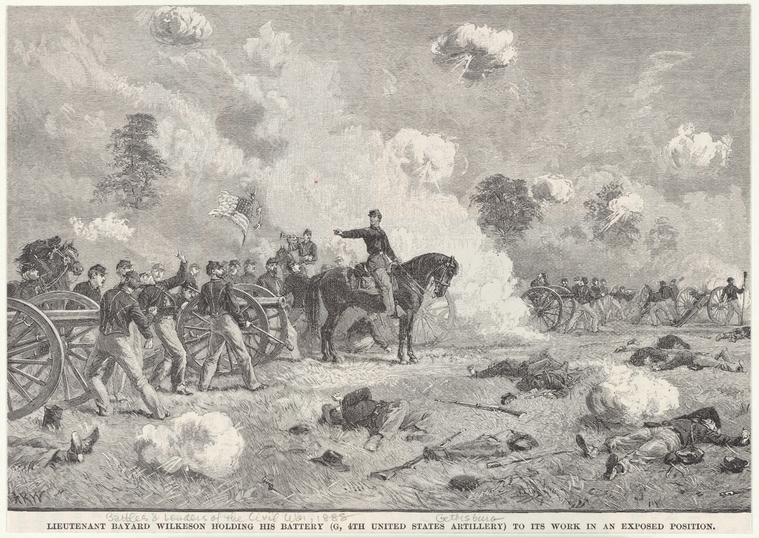
At the time of the Battle of Gettysburg, nineteen-year-old Lieutenant Bayard Wilkeson led Battery G, 4th U.S. Artillery, in the artillery brigade of the Army of the Potomac’s 11th Corps. The majority of the soldiers in the 11th Corps were immigrants from Germany, their regiments and brigades led by officers named Von Gilsa, Von Steinwehr, Schimmelfennig, Schurz, Amsberg. But many had combat experience and were excellent soldiers.
Their reputation as “cowards” came about during the Battle of Chancellorsville in early May of 1863. The Corps suffered the brunt of “Stonewall” Jackson’s surprise attack and were routed. This came about due to poor leadership by Corps commander, Major General Oliver Otis Howard, who dismissed reports of a large body of Confederate soldiers lurking in the thick woods on the exposed flank of the Corps. However, the rout earned the 11th Corps the nickname “The Flying Dutchmen” (Dutch being misrepresented for Deutsch).
During fighting North of Gettysburg on July 1st, Lt. Wilkeson and his battery rushed to aid the beleaguered division of Francis Barlow, who foolishly advanced to an exposed position. Wilkeson commanded his battery, from atop his white horse, with such devastating efficiency that he attracted the attraction of several Confederate artillery batteries. While exposed, a shell from a Rebel gun passed though Wilkeson’s horse and practically severed his leg. Carried to the nearby Adams County Almshouse, he removed the remains of his mangled leg with his pocket knife. Bayard Wilkeson died from shock and loss of blood a few hours later. His father, Samuel Wilkeson, was a reporter for the New York Times and was at Gettysburg covering the battle. He found his son’s body after the Confederate retreat on July 4, 1863.

 The Chatham Packet
What a story! If the facts alone were not amazing enough, you have added a relatable human layer that bring aspects of the war,s impact to life. Very well told.
LikeLiked by 1 person
Thank you John! Although I believe my story of self amputation and use of the word “damn” contributed to the demise of the “Easy Writers” group!
LikeLiked by 1 person
“Dang!” and established medical protocol might have saved the Easy Writers, but only at the cost of creativity and verisimilitude…
LikeLike
Nice job, Ernie. I think you found your niche
LikeLiked by 1 person
Thank you Jim! I have written several stories now with the James Bartlett character, as well as 5 chapters I wrote for a summer writing group 2 years ago that have not appeared on my blog.
LikeLike
I’ve enjoyed this. Keep them coming Ernie..
LikeLiked by 1 person
Real good story, Ernie. It’s almost hard to believe that states seceded from the USA, and that a long , hard internal war took place. Could something like that happen again? I think it’s possible.
LikeLiked by 1 person
Hi Neil! Again, I am really sorry we missed your visit to the Cape. Thank you for reading my story and your feedback. I fear the same as you, I don’t like how things are unfolding. Best wishes to you and your wife.
LikeLiked by 1 person
Engaging story making history current and real. Being squeamish, parts of this story were hard for me to read. Very appropriate content in light of the disturbing state of the world.
LikeLiked by 1 person
Thank you very much Nancy! I am pleased you read my story.
LikeLike