Art Projects

The Artless Dodger
A dearth of art skills plagued me through my school years from kindergarten through 9th grade – the last year that art was a required course. When it came to making a jewelry case out of a cigar box, I could paint it gold and glue various types of macaroni to it like a pro. When it came to drawing a landscape, or an image of the first Thanksgiving, I folded like a cheap lawn chair.

After a few years of basic art projects initiated by the teacher of the class, advancing into the 4th grade meant that we would now have more complex art projects, taught to us by a real art teacher who visited the school each week. Our first project of a higher level of art form was to create a Thanksgiving image on a 6” x 6” square of copper, using a variety of tools. When we were finished with the image, we would “antique” it by brushing on a liquid, bronze colored stain, then dab the excess liquid off with some old newspaper. The art teacher pointed to a stack of newspapers on the classroom teachers desk and said “use these”. Being the terrible sketch artist I am, I chose a very simple design of a log cabin, with smoke coming out of the chimney. A pilgrim hat hanging from a hook outside the cabin designated my image as having achieved the Thanksgiving theme. In my finished work, the cabin was not very symmetrical, the smoke looked as though someone stuck a head of broccoli in the chimney. The pilgrim hat resembled a flower pot. I applied the magic “antique” stain, took a few pages of newspaper and dabbed up the excess. While raising my my tooled copper piece of art to admire it in the fluorescent light of the classroom, I heard the art teacher screech, “My New York Times is missing a section! Who took my New York Times?” The paper I used to dab up my antique liquid was still balled up on my desk, the evidence was overwhelming, I was guilty as charged! The art teacher was livid. I was asked to go get the milk for our morning break, even though it wasn’t my turn to get the milk that day. When I returned with the milk, the art teacher had packed up and left. Events would play out in 5th grade that would lead me to believe she held a grudge against me for defiling her newspaper.

I had high hopes for my 5th grade art project. We were going to work with clay! We could make anything within reason. After creating our clay piece and applying the glaze, the art teacher would take the works of art and bake them in a kiln. At this point in my life, I was really interested in whales and the history of whaling. I had read Moby Dick and saw the movie version with Gregory Peck on TV. I was going to make a clay Moby Dick! I took my ball of clay and separated it into two pieces, one larger than the other. I took one piece and rolled the soft clay back and forth to make a cylindrical body shape. The other piece of clay I formed into Moby’s tail, somewhat crude looking, but a passable tail. All the time I was wetting the clay to keep it from hardening. On the cylindrical piece, I cut a mouth and made two divots for eye sockets. I then formed small humps on the back of the whale. I joined the tail to the cylinder, with difficulty, it fell off several times. Wetting the two pieces a bit more, I finally achieved the successful fusion of tail to body.

It was now time to apply the glaze. Because Moby Dick was white, I asked the infamous New York Times art teacher for white glaze. “Oh, I don’t have any more white glaze left,” she replied. Well, I would have to settle for a black whale, so I asked for black glaze. She was out of that too. She had pink, red, yellow…. Not typical whale colors, no blue either.

“How about brown?” She offered.

Brown it had to be, I guess. So, being mindful of the delicate tail piece, I carefully applied the brown glaze and gently carried my whale the art teacher to be packed up with the ash trays and pencil holders the other kids made. I saw several white and black glazed pieces. The art teacher announced she was leaving and asked two students to help carry our clay masterpieces to her car. She would return with the finished pieces the following week.

I was very excited and couldn’t wait for the week to pass. This was to be a Christmas gift for my Mom. The day of art class arrived, the New York Times art teacher breezed into class and selected two students to bring the boxes of ceramic artwork from her car. Once the boxes were in place, the art teacher removed the items one by one, calling the name of each student to come and claim their piece. She called my name and as I arrived at her desk, in an insincere tone said, “I’m so sorry, the tail fell off your piece and was not usable.” She handed me something that now looked like a glazed turd – with a mouth and eyes. I looked at her and asked if the tail could be glued on. She replied that it couldn’t, it had shattered in several pieces. I dejectedly returned to my seat. I don’t exactly remember what happened for the rest of the class, I may have become unruly, I vaguely recall a stint in the cloak room.

I wasn’t going to wait for Christmas, I had to show my Mom what happened to my whale. I believe we both began to giggle after it was revealed. It did look so much like a glazed turd. When I visited my Mom this past March, I was startled to see the brown, tailless Moby Dick on the bookshelf in her living room, next to the ceramic elephant I had given to her – a prize I won at Palisades Amusement Park.
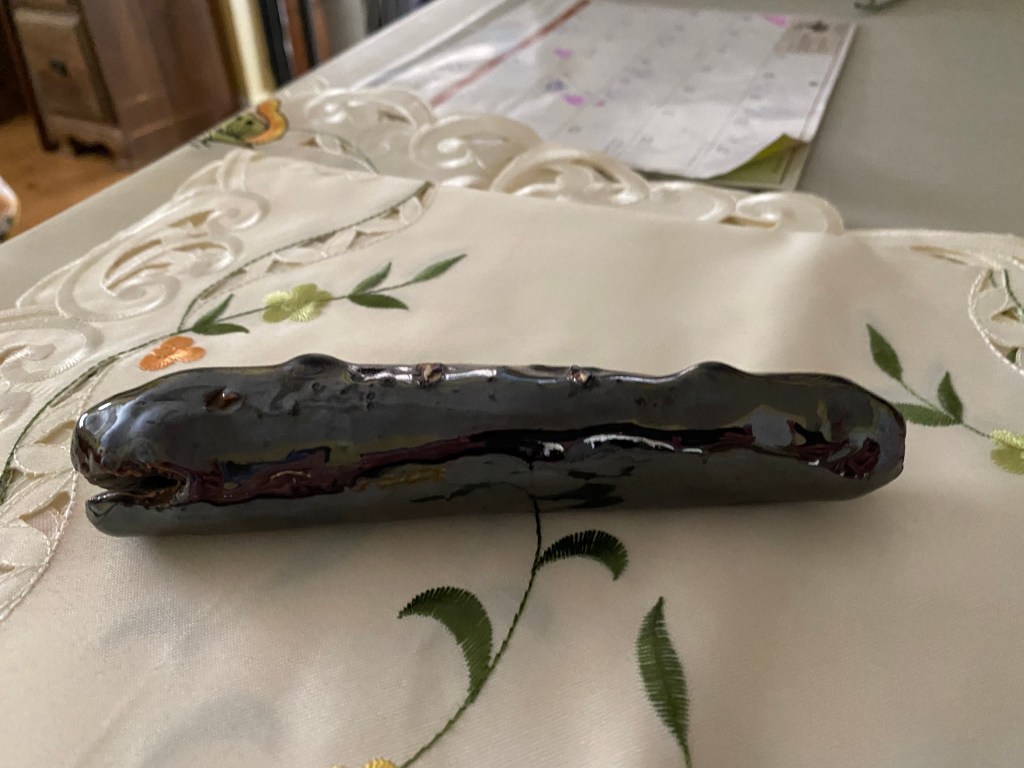
My 5th Grade Art Project – Moby Dick, or a Glazed Turd….

Ernie Stricsek
Chatham Memoir Group
April 28, 2022
First Time I Skied


The prompt for the Chatham Memoir Group was to write about the first time you skied. In January of 1972, I went to Ski Round Top, in south central Pennsylvania, with 3 of my friends. My story follows:


In the winter of my senior year of high school, two of my good friends tried to encourage me into joining them on a trip to a local ski area. They both knew how to ski, I didn’t. At that point in my life, I was not interested in learning.

“Oh come Ernie, it will be fun!” They said.

“For who?” I asked. “I have never been on skis in my life.”

“Oh, don’t worry about that, we’ll teach you.” They offered.

Their efforts to entice me to the ski slopes began began just before Christmas break. They were planning on going some time during the break. I was adamant in my refusal. During a New Year’s Eve party at the home of one of these skiers, the screws really got turned up. The two experienced skiers cornered two other friends and me and really talked up what great fun we would have. The reluctance of my two non-skiing buddies began to melt. Caught up in the enthusiasm displayed by the two guys who knew how to ski, they agreed to go.

The skiing buddies now concentrated their efforts on me. “See! We got Jim & Paul convinced it will be great! Come on Ernie!”

As the party wound down so did my resolve and I agreed to go. Everybody was elated, I still had great concerns and was more subdued. A day during the week was chosen, the ski area would not be as busy as the weekend. It would be great. Maybe.

On the day of the ski excursion, I was mildly surprised to discover that we would be all going in the same car. That was because my non-skiing buddy Paul couldn’t go with us, he had to work. The scalawag most likely snagged the McDonald’s shift I tried to get so I wouldn’t have to go. Off the four of us went, half of us excited, the other half wary.

There were several things I noticed when we arrived at the ski area. First, being south central Pennsylvania, the ski area was on several high hills – not mountains like Vermont or Colorado. But having never skied, these hills looked like Rockies to me. Secondly, the clothes I selected for this ski trip, jeans, an army fatigue jacket, leather gloves and a New York Giants ski cap, stood out in sharp contrast the the stylish insulated and water proof ski outfits everyone else seemed to be wearing. Lastly, it was really busy. Every school student on Winter break seemed to be there. After getting fitted for my rental skis, I met up with my friends at the beginner slope, supposedly to get ski lessons from the two experienced guys. They showed me how to grab the rope that would pull us to the top of the little slope. My skis crossed and I toppled to the side, getting dragged rather than pulled. Everyone on the lift behind me began to swear. “People will swear at you if you fall off the rope line.” Said experienced guy #1. To avoid being the target of further invective, I side stepped the rest of the way to the peak of the beginner hill.

Once there, the experienced guys showed us novice skiers how to snow plow down the hill. That was the extent of our lesson. Their parting advice before heading off to the more challenging trails, was to take a few snow plow runs, then try putting your skis parallel to gain speed, bye. Watching their colorful ski clothes disappear into the throng of other skiers, I turned to my novice buddy and asked, “How do we turn?” That would prove to be a challenge.

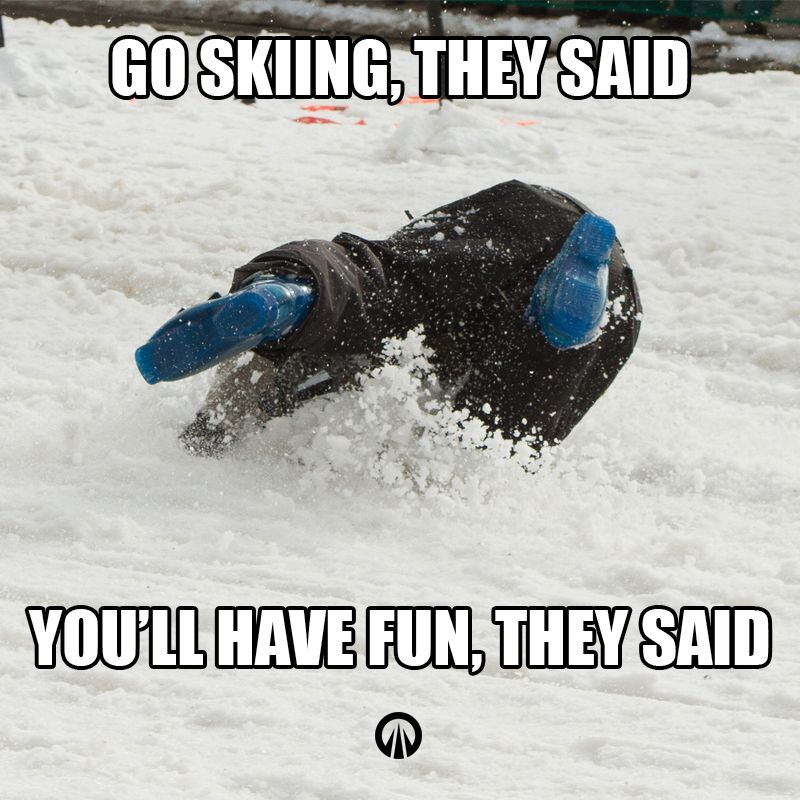
Cowed by the outcry after my fall from the tow rope, every trip I made to the top of the beginner hill was via side stepping on my skis. I would start to snow plow down, attempt to turn, fall. Get up snow plow, fall. My skis would usually come off after each fall. Eventually reaching the bottom of this small hill, I would sidestep back to the peak and repeat the process. Ski, fall, ski, fall, ski, sidestep. Some kind skier showed me how to make turns. Things improved somewhat. I wasn’t falling as much. However, my previous encounters of the ground kind had led to my jeans and long underwear being soaked through to my skin. I was wet, cold, exhausted from side stepping, the time was 10:00 AM. It was hard to believe I had been skiing for only two hours. Well, maybe not skiing, falling for two hours.

Gaining confidence in my ability to turn, I thought I would take a shot at a run with parallel skiing. I started out well, gaining speed as I progressed down the hill. I saw a ski school beginning to form in two lines, they were right in my path and I was now bearing down on one of the lines. I tried to make a slight turn, but lacked the skill to make it slight and was now barreling down on the middle of the other line. Desperate, I tried to make one of those Olympic stops that end in a shower of snow. I got the shower of snow, but it was because I catapulted over on to my side, eventually sliding to a stop between the two lines of beginners. I heard some gasps. Needing a moment to get my wind back, I stood up slowly, wobbled a bit, looked at the two lines of gaping skiers and introduced myself as their instructor. Eyes flew open wide, jaws dropped even wider. I said I would be right back after I got a different set of skis, these were making me fall.

I turned in my skis, went into the lodge and spent the remainder of the day sipping hot chocolate in front of the fireplace. It would be 25 years before I gave skiing another chance. I do know how to turn and parallel ski now. I still haven’t figured out how to stop falling.

Ernie Stricsek
Chatham Memoir Group
4/14/22

The Places We’ve Stayed


The prompt for The Chatham Writers Group this week was to write a story involving a hotel. I began to write a fiction story about two detectives searching for a missing child, but was having some trouble pulling the story together in 1000 words. I switched to memoir mode and wrote a vignette about the first hotel (motel) that I remembered spending the night in. The second vignette is Barb’s tale of a night spent in a low budget Barcelona hotel with her brother, Gerald, when they back packed through Europe one summer.

Oh the places we’ve stayed – hotel vignettes
Hotel #1
The first hotel I ever spent the night in was in the course of a trip our family made to upstate New York in the early 1960’s. The plan was to visit my Mom’s father and step-mother in Syracuse, NY for a couple of days, then travel to Lake George for the balance of the trip before heading back home to New Jersey. The jaunt to Syracuse would include stops at points of interest and require an overnight stay. I have no recollection of the points of interest we visited – obviously they weren’t interesting – but I do remember the hotel we stopped at. Well, it was a motel. I accompanied my Dad to the motel office to see if there were rooms available. The motel clerk/owner was anything but warm and welcoming. She spoke in a brusque, unsmiling manner. My Dad asked for a room with two beds, there would be four children and two adults staying. The clerk/owner peered over her glasses and stated and additional deposit was required then, because “you know, kids break things”, but it was refundable if “nothing was busted”. She said if we wanted to go swimming, there was a “beach” at the end of the parking lot, however there was no life guard, so be careful. It was a hot July day, My Dad was beat from the long day of driving, so he handed over the deposit and we went to our room. After dragging our luggage into the room, a quick trip was made to the end of the parking lot to check out this “beach”.

“What the hell?”, said my Dad. There was a sandy strip of land, which led into a narrow, lazy flowing stream. The stream was very clear, I remember. Clear enough to see that the sand converted to muck beneath the water’s surface. Submerged in the stream was a shopping cart and a flat tire on its rim. There may have been a couple of bottles too.

“We aren’t going in there,” said my Mom.

Dejected, we dragged ourselves back to our room. Our room! Two double beds! My Dad, Mom and sister would sleep on one bed, I would share the second with my two brothers. If a dime was deposited in the meter next to the bed, it would vibrate! My Dad was quick to cut off our fun, he didn’t want to pay for a vibrating bed if it broke. The air conditioner struggled to keep the room cool, I am guessing that its clattering fan was an early attempt at a white noise generator. Because we were in the middle of nowhere, the TV offered one grainy channel. Adjusting the rabbit ears proved fruitless. After a nearly sleepless night in the fleabag, we passed inspection the next morning and Dad got his deposit back. The car all loaded, he put the key in the ignition, turned to look at my Mom and declared that from here on out, we weren’t going to stay in anything but a Howard Johnson’s. He was good to his word.

Hotel #2 – My Wife’s Tale
The year before I met my wife, she and her brother had spent most of that summer backpacking through Europe. There was no careful planning involved, the one certainty was that they had almost no money for the trip. For the journey from and back to the U.S., they took up temporary lodging in Lakerville. Technically not a hotel, this was the name given to the large group of people who queued up on standby, with sleeping bags to camp on a street in Queens, NY, with the hope of snagging a seat on a Laker Air flight to London. Sir Freddie Laker’s budget airline. The Lakerville for the return flight was on a London street.

Barb, my wife, and her brother Gerald, were in England for an afternoon, then spent their first night sleeping on the ferry crossing the channel to travel the European continent. For transportation they had obtained Eurail passes before leaving the U.S. For accommodations, they would stay in hostels or cheap hotels. Some of their longer rail trips were taken overnight so they could sleep on the train. The accommodations were a mixed bag, some passable, others truly shitty – or as my wife says a hostile hostel. There was something about every place they stayed that provided a combination of entertainment, excitement, or horror and revulsion. A budget hotel they stayed at in Barcelona had the added attraction of a skills contest.

Upon entering their room, the first thing my wife and her brother noted was how stifling it was. Gerald went to open the window and get some air circulating. Throwing it open, he was confronted with a brick wall staring back at him from about a foot away. He could barely fit his out out of the window to see note the 1 foot gap was an airshaft that opened to the sky above. To be more precise, it was a shaft, air did not seem to be part of the equation. The second thing that Barb and her brother noted was an odd pattern of black marks, randomly placed on the walls of the room. What could those be they wondered. As they began to remove items from their backpacks, Barb spotted a fairly sizable beetle working its way up the wall near the window. She took her sandal off and smacked it. Where the bug once was, a black mark remained. Mystery solved! Despite the possibility of unwanted guests sharing the room, Barb slept soundly. Gerald, not so much.

The days of staying in dives, dumps and fleabags are all in the past now. What was an adventure, and the makings of a great story, when you are in your 20’s don’t have the same attraction when you are in your 60’s. And even the better hotels we have stayed at in recent years prove to be a crapshoot. We have become committed to Airbnb’s.

Ernie Stricsek
Chatham Writers Group
4/11/22

Fish Tales III – The Ones That Should Have Got Away

The prompt for the Chatham Memoir Group was to write a fish story, preferably about ”the one that got away”. My story follows:


After posting the last fish tale I wrote on my blog, a good friend asked what my first edible catch was. The question brought me back to one of the trips my friends and I made to Lake Waywayanda in the NW hills of New Jersey in 1967. We had made several trips to this lovely, pristine place, determined to catch some of the huge brown trout the lake was developing a reputation for. However, brown trout of any size continued to elude us. As a matter of fact, so did all the other game fish in the lake. In my mind, all these years later, I have this image of all the trout, bass, pickerel and perch in the lake, hanging together, smoking cigarettes, pointing at us with their fins and saying, “Here come those rubes again, pretend we don’t see ‘em.” This trip to the lake would be our first time renting row boats (for the princely sum of $3 for the day), our plan was to fish the entire lake. We were going to take it to those insolent prize fish.

The day was warm with barely a breeze, the forest surrounding the lake was mirrored in the calm waters. Emerging from the boat rental basin, we guided our tiny flotilla across the lake towards an unoccupied cove where bass supposedly resided. Our fishing lines dragged behind our two boats, hoping that trout would latch onto the lures trolling off our stern. The trip to the cove was uneventful, the trout we hoped to catch no doubt mocking us the entire way. After dropping our anchor, we switched out our lures to live worms. Almost immediately we began to catch fish! Not the prize fish we were seeking, but blue gills, AKA sunnies or sunfish. The crew in my boat were catching and releasing them when two friends from our partner craft shouted that blue gills were edible. Whoa! We could eat our catch? There was a problem however, we didn’t have the proper equipment with which to stow our catch; neither live wells, stringers, coolers, etc. Thinking quickly, I removed my lunch from my paper bag and began to drop the bluegills into it. Running out of room in the paper bag, I wolfed down my sandwiches and used the foil wrap to store my catch. He paper bag and foil wraps bounced around for a bit, but the contents eventually calmed down. We trolled the lake for the rest of the day, no trout or bass, but two dozen blue gills were stuffed in the items that once housed my lunch. Two dozen! I could feed my whole family, including my grandparents and uncle!

We were all abuzz on our trip home, talking about the best method to prepare our fish, the consensus of those in the know was to fry them. When my friend’s Dad pulled into their driveway, I grabbed my gear and abundant catch and sprinted to my house, only four doors away. I discovered my Mom was across the street at my grandmothers house, so I ran over there. Everyone was already in the kitchen, so I proudly dumped my fish out of the bag and removed them from the foil. My grandmother rubbed her chin and eyed them with great skepticism. My Mom stood with her arms crossed, shaking her head.

“Those fish aren’t any good,” said my grandmother.

“Yes, they are! They’re bluegills! Gary and his Dad said we could eat them!” I protested.

“But they look like they have been dead for quite awhile,” said my Mom. “How long ago did you catch them?”

It was true. These small bluegills were rather stiff. They looked like those decorative fish you might find at a craft store. A few of the fish had stiffened to the shape of the paper bag I had stuffed them in and curved like a small boomerang.

“They have been dead, and sitting in the sun for too long! They’re almost baked now!” exclaimed my grandfather.

My grandmother waved her hand at the fish bricks laying on her table and with finality said, “We’d all be sick if we ate those.” She quickly scooped them back into the bag and disappeared outside for awhile. I don’t remember what she did with them, either tossing them to the stray cats that dwelled on the other side of the fence in the back yard, or skimmed them into the yard of the neighbor she was constantly at odds with, I can only speculate. Technically then, these fish did get away in a manner of speaking. Just not in the way fish usually get away.

On a return trip to the lake a couple of weeks later, we were better prepared and had all of the necessary gear to better preserve our catch. I did get to savor the taste of something I caught, a bony little bluegill. Fried. It was not very savory. First time, last time. Bluegills, fish you hope and pray will get away.

Ernie Stricsek
Chatham Memoir Group
4/8/22

April Showers

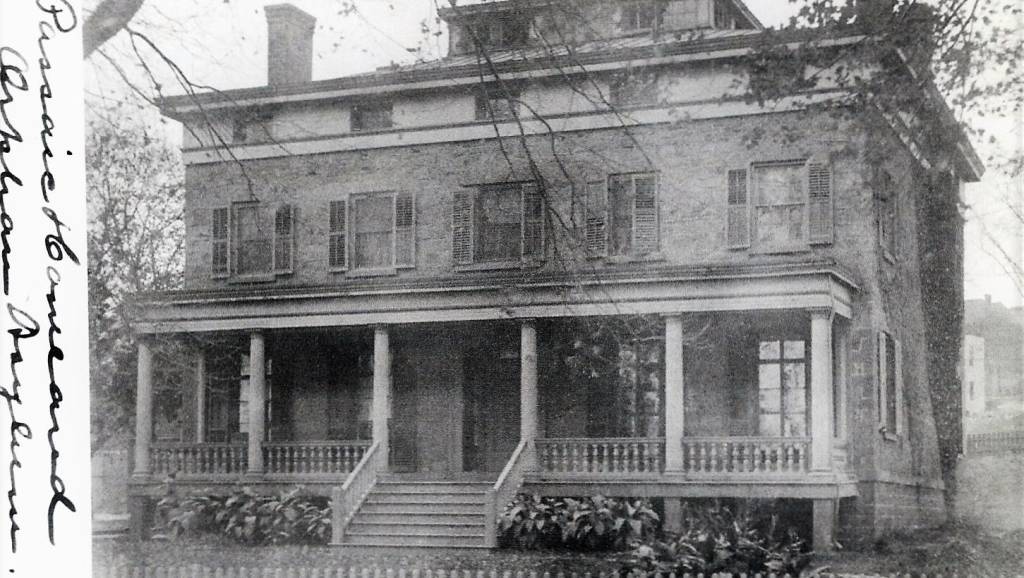
The prompt for this past Monday’s writing group was to write about flowers. My mother has a passion for flowers and flowering shrubs, her home resembles a small botanical garden. I spent a few days visiting my Mom, seeing her garden and talking about the six years she and her siblings lived in an orphanage, or ”as inmates in an orphan asylum” per the terminology of the day. After my visit, I researched the Passaic Home & Orphan Asylum, which began operations out of the Italianate mansion of the former W.S. Anderson estate in 1888. The orphanage remained on operation until 1962. While doing my research, I discovered an incident involving residents of the orphan home had garnered nationwide interest in the early 1930’s. The resiliency of my Mom and her siblings and my Mom’s love of flowers served as the inspiration for this fictional story that I wove around the true historic event that occurred in 1933. A brief recount of this incident will follow my story.

The Passaic Home & Orphan Asylum. Photo is undated, but is most likely prior to addition of gymnasium in 1920.

April Showers
The driver of the garden delivery truck beeped and waved at the column of children walking two by two on their way home from school. The children waved back. The driver shifted gears, the truck lurched and a small mesh bag tumbled from it and landed at the feet of Dorothy Jensen and her sisters. She grabbed the bag and shouted after the driver, but the truck chugged on. The contents of the bag looked like small gnarly onions, scribbled on tag tied to the bag was the word “daffodil”. Dorothy heard her name called and turned to see her older brother, Edward, jogging from the front of the column.

“Dorothy, Ruth, Marie! Get back in line, we need to get back to the Home in time for dinner!”

Dorothy held up the bag that had fallen off the truck. “Daffodil bulbs!” Exclaimed Edward.

“They don’t look like daffodils” said Dorothy.

“Not now they don’t”, said Edward, “people plant the bulbs in the Fall and in the Spring they sprout flowers. Maybe we can plant them this weekend. Let me take them.” He smiled at his sisters, shuffled them back into line and waved the column forward.

After dinner, Edward sought out Dorothy and gave her the sad news that someone told the Headmistress about the bag of daffodil bulbs. She made him turn them over to her, they would be planted in the asylum garden, because “technically, they belong to the orphan home.” Edward told Dorothy not to fret, he had managed to sneak four bulbs out of the bag, one for him and his 3 sisters to plant. He said he knew a special place to plant them, where the asylum administrators would not see them. That Saturday morning, Edward led his sisters over the railroad tracks behind the Orphan home and to a corner of the baseball field just past the rail line. He had already cleared a small patch next to the outfield fence and the 4 of them each planted a daffodil bulb. “In the Spring, we will have the most beautiful daffodils,” said Edward. They returned to the Home for lunch.

Over the next 6 months, Dorothy and her sisters visited the spot where they planted the flowers as much as they could, weather permitting, even though there was nothing to see. They were worried when the snow covered them, but Edward assured them all would be fine. “How do you know?” They asked. He told them they were their mother’s favorite flowers, they were too young to remember, but she had planted them in several places around the house.

In late March, Edward and his sisters were delighted to see green shoots sprouting out of the ground. Some of the boys from the Home who were playing baseball came over to see what the four of them were looking at. Edward told them the story of how he and and sisters came in possession of the bulbs. He ended the story by saying, “So this is our little garden, it reminds us of our mother.”

The baseball players were silent for a moment, there were six of them. Finally one asked, “Could we plant some things here too? It could be our garden, our Orphan Garden.” Edward and his sisters thought it was a great idea.

Not long after the daffodils bloomed, a rare Spring thunderstorm blew through. For two days, between the flash of lightning and the roll of thunder, the rain fell in torrents. When the storm subsided, the six baseball players asked Edward and Dorothy if they wanted to come join them, to see how the ball field and small garden fared after the storm. Pulling on their boots and yellow rain slickers off they went to investigate.

Crossing the railroad tracks, and climbing the small hill to the level baseball field, they were astonished at what they saw. The infield looked like a lake, but part of the outfield had disappeared. Where it had been was now a ditch about 10 feet deep. The fence had fallen over, the flower garden was no more. Even more astonishing was the ditch had gotten wider and continued under the railroad tracks, the gravel and a few ties had collapsed into the hole, the lengths of tracks hung suspended in the air. The sound of a distant train whistle brought them out of their shock.

On the 6:00 P.M. train from Jersey City, conductors walked through the cars telling the passengers they would be arriving at the station soon. Up in the engine, the engineer and the fireman squinted out of their windows at the track that faded into the mist. The engineer suddenly swore and jumped from his seat, the fireman’s eyes flew wide open. Running towards them, in a line across the tracks were 8 kids, wildly waving yellow raincoats over their heads. They weren’t getting out of the way. The engineer reached for the brake handle.

The train screeched to a halt. Jumping down from the engine and swearing great oaths, the engineer stomped towards the 8 kids, who still stood in a line across the tracks, gulping great breaths of air. They were trying to tell him something, pointing to the tracks behind them. Looking to see what the kids were pointing at, his hands flew to his face, he let out a shriek and collapsed to his knees.

It became the feel good story of the Great Depression, the quick thinking kids from the County Orphan Asylum bravely ran towards a train to prevent a disaster and potentially save 400 lives. Perhaps the most famous orphan of the time, Babe Ruth, came to visit treated the six members of the orphan home baseball team to a day at Yankee Stadium. Yankee owner, Jacob Rupert, presented them with $2000 savings bonds.

Edward and Dorothy Jensen would not be forgotten for their role in averting disaster. The nationally renowned botanist, Constance Endicott Hartt, would visit the home. Hartt, a native of the town where the orphan home was, would use her skills and influence to establish the Jensen Botanical Garden on land adjacent to the home. Edward, Dorothy and their sisters planted the first flowers that would comprise the garden. They were daffodils of course.

Postscript

Most of this story is fiction. The factual, historical portion of the story occurred in 1933, almost a decade before my mother and her siblings began living at the Passaic Home. On May 3, 1933, a torrential downpour had battered the region for most of day. By late afternoon, the storm had tapered off to light showers. Shortly before 6:00 PM, six boys who resided at the Passaic Home and Asylum donned boots and yellow rain slickers to evaluate what effect the storm had on a nearby ball field. The six boys were also students at P.S. #3 and played for the school’s baseball team. Arriving at the ball field, they were astounded to see the field was a muddy morass. But the most shocking thing of all was that the storm had washed out a 10 deep trench beneath the tracks of the nearby Erie Railroad line. In the distance, the boys could hear the clanging bell of an approaching train. It was the 6:00 PM train commuter train from Jersey City with 400 passengers aboard. Removing their rain slickers, six boys formed a line across the tracks and frantically waved them in an effort to stop the train. The train did brake to a halt, the engineer did exit the train to berate the 6 kids, the driver did fall to the ground when he saw he stopped just 50 feet from disaster. The incident did become the feel good story of the the time and the six kids were recognized as national heroes for their act of bravery.

The 6 heroes from left to right: Frank Mazzola, Jacob Melnizek, Doug Fleming, Rudolph Borsche, John Murdock, Mike Mazzola. From northjersey.com story by Mike Auerbach.
The six heroes at Yankee Stadium.

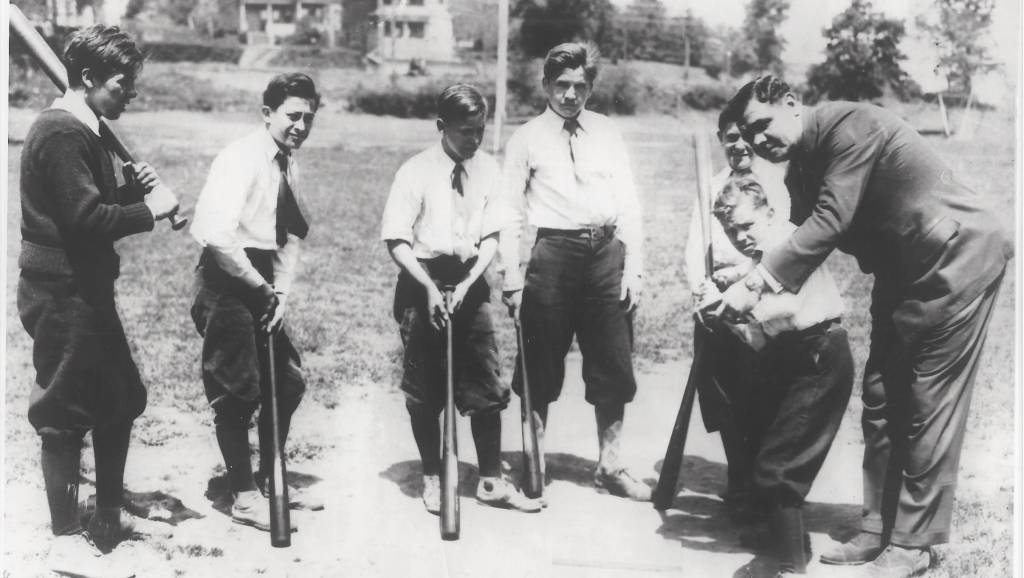
Babe Ruth visited the six lads at the Passaic Home & Asylum

Ernie Stricsek
The Chatham Writers Group
4/4/22

Fish Tales Part II

For the Memoir Group, I decided to write about some of my fishing experiences from the years 1965 to 1968. There were two brothers who were part of our little band of anglers, this is a story of some of their adventures.

Fish Tales II – The Swiller Brothers
There was a stretch of years where my friends and I were confronted with a serious logistical problem once fishing season began. The nearest trout stocked lakes and streams were at least an hour’s drive from our homes, and none of us drove. It would be 5 to 8 years before any of us would see a driver’s permit.

Undaunted, we would spend many hazy, lazy, crazy days of our school summer vacation, laden with fishing rods and tackle boxes, hiking to Saddle River or Dahnert’s Lake. Rumor had it the Saddle River was trout stocked. Another story, passed from a dubious source, went so far to say that salmon could be caught in the river as well. Let it be known, 54 years after the fact, that three years of dropping a baited hook in that meandering brook, revealed there were surely no trout in it, and salmon? Give me a break! We certainly did catch fish, a lot of fish, however it was that oily, bottom feeding species known as carp. Both the common carp and goldfish. Not trout, the catch & throw back carp.

The knowledge that it was highly unlikely our excursions to Saddle River, and later Dahnert’s Lake, would yield any edible fish did not diminish our spirits. As long as the Swiller brothers (name changed to protect the guilty) were part of our hearty band of anglers, we could count on plenty of entertainment. The antics and mishaps of the Swiller’s, Cliff and his younger brother Robert, are recalled with fond amusement to this day.

The Swiller boys were a disagreeable duo. To each other that is, they were never in agreement on any topic. They would argue and needle until one would take a swing at the other and then all hell would break loose. Brothers always fight, some pushing and shoving maybe, but the Swillers would really hit each other, like bare knuckle boxers. Being three years older and with a longer reach, Cliff would always get the better of his brother. After a smack to the ear, Robert would begin to emit a low moan which got progressively louder, culminating in a bellowing cry, almost like those old police sirens. The rest of us would stand there in shock at first, then cover our ears. Cliff would eventually comfort Robert and the crying would stop almost as quickly as it started. On average, this scenario would would play out 2 or 3 times on each fishing trip.

Perhaps the most curious occurrence on these fishing trips was that one the Swillers would always end up in the water. During a trip to the Saddle River, Cliff expressed a desire to claim a prime fishing spot and took off at a sprint, yelling taunts at us over his shoulder. The river flowed at the bottom of a slight bluff. Cliff badly misjudged his forward momentum and skittered down the bluff, finally stopping when he was waist deep in the water. His emergence from the river revealed mud encased sneakers looking more like Frankenstein shoes, which his brother began to giggle at. Fortunately, Robert was able to dodge Cliff’s ill aimed swipe at his ears sparing us from hearing his siren wail. On a fishing excursion to Dahnert’s Lake, Robert inexplicably ran off stone wall right into the lake. He then lost his footing on the slippery bottom, went under and came back up sputtering water out of his mouth. We helped him out of the water and the moment he was on solid ground, he expressed his gratitude by emitting that ear splitting siren scream cry. We wanted to shove him back in the lake, but Cliff again managed to settle him down and Robert fished away in his soaking wet clothes.

It was always our belief that fish resided in the deepest parts of the river and lake. We would weigh down our fishing lines with at least ten pounds of sinkers so our casts would land as close as possible to our intended catch. Standing on the shore of the Saddle River and desirous of his baited hook reaching the place where the fish obviously were, Robert crimped half a dozen small sinkers to his fishing line and, to 100% guarantee a successful cast, added a pyramid shaped one ounce sinker to the collection. The line slipped from his finger as he swung his rod over his shoulder, the weighted conglomeration flew backwards and struck his brother in the mouth. Cliff screeched “Owww”, his hand clasped his face and he doubled over. We ran to see if he was okay.
Except for Robert, he stood frozen in place, whimpering.

Circled by his fishing friends, Cliff straightened to a standing position and lowered his hand from his face to reveal a swollen lip, with a little trail of blood trickling from a small split. “You thtoopid idiot,” Cliff’s swollen lip making him lisp, “I’m gonna kill you!” Pushing us aside, he took off for his brother. Robert let out a scream, dropped his fishing pole and began running away fast as he could. Cliff’s long legged strides quickly closed the distance between them. With the inevitability of being caught by his brother and getting his ears boxed, Robert took what he felt was the best course of action and ran pell mell into the river. His plan worked because Cliff didn’t follow him. They stood looking at each other, gulping huge breaths of air.

“We should go home, Cliff, your lip is bleeding,” offered Robert.

“Yeah, I need to put thome ithe on it,” lisped his brother.

Cliff’s anger appeared to have deflated, but we all decided to leave with them to prevent any further bloodshed should emotions run hot again.

Never a dull moment fishing with the Swillers, more tales for another day.

My Great Uncle Louie provided us with the ideal recipe for a Carp meal:

3/4 to 1 lb. of Carp filet, make sure all of the bones are removed.
1 thin cedar plank, approximately 12 inches long. 2 tablespoons of olive oil. 1/2 teaspoon of salt. 1/4 teaspoon of pepper. 1/4 teaspoon of paprika. Sprinkle with Italian seasoning. Pre-heat oven to 350 degrees. Place Carp filets on cedar plank. Place plank in oven and bake for 30 minutes. When bake time is over, remove the plank from the oven, throw the Carp in the trash and eat the plank.

Ernie Stricsek
Chatham Memoir Group
3/31/22

The Number 1 & 2 Vacation

The prompt for the writing group today was to write about the worst thing, the saddest thing, or the happiest thing that we experienced while on travel or away from home. My story follows. My thanks to my wife, Barb, for her help in capturing the “essence” of this trip.

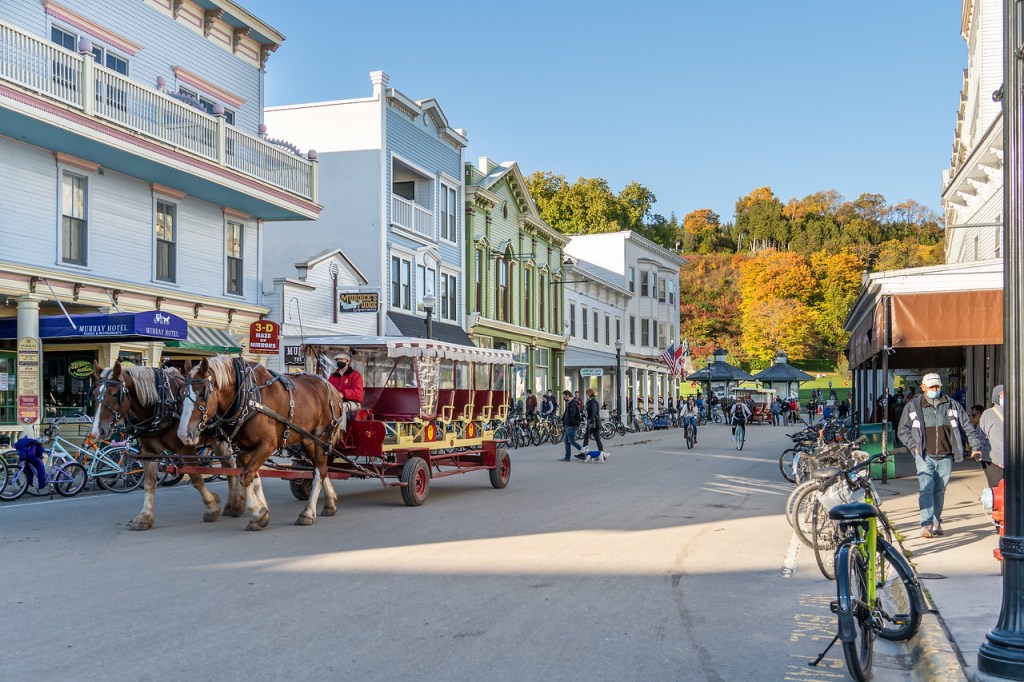
Downtown Mackinac Island. Note the long trail of horse road apples on the street in the middle distance between the dog walkers and bicyclists. You will get the point of my story.

The Number 1 & 2 Vacation

Our family has been very fortunate to have visited many places, to have seen extraordinary sites and to have met many interesting people on our trips. I remember how patient and kind the two women in a Paris bakery were to our youngest son when he practiced his French language skills to order pastries. How I got to see the gentler side of a Sumo wrestler-turned-restauratuer while in Japan. The 2 1/2 years my wife and I lived in Alabama was a learning experience for us as well. The people we met traveling the Civil Rights Trail related their personal stories of living through that era revealed to us a history we didn’t know or never learned, so many stories that my wife would frequently say, “we don’t know what we don’t know.” The opportunity to see and experience new things made every trip we took worthwhile, whether we enjoyed it or not. However, this principle of ours would undergo a severe test when we visited Mackinac Island.

After moving to Michigan in 1997, a number of our mid-Western friends encouraged us to visit Mackinac Island. Located on Lake Huron between the upper and lower Michigan peninsulas, the four square mile island was a summer hot spot retreat for many mid-westerners. The island was admired for its quaint, Victorian era trimmings and was a throwback in time because no motorized vehicles, save for island police and emergency services, are allowed. All non-emergency transportation consisted of horse drawn carriages and wagons, bicycles and shanks’ mare (walking). The year round population of 490 swelled substantially in the summer months. Mackinac Island is accessible only by ferry and in most winters, via an ice bridge. We did a little more research of the island using printed sources, Google wasn’t invented yet, and decided to make a weekend visit.

Being the peak of the tourist season, the ferry to the island crammed with people. Docked and secured at the island, the passengers spilled out onto the pier and flowed into town. There were horse drawn carriages waiting to take people to hotels and beaches, or to the golf course. We collected our luggage and bikes and began to make our way to our hotel. We hadn’t gone very far when our noses began to crinkle. The four of us looked at each other with furrowed brows and seemed to all ask in unison, “What’s that smell?” The downside of horse drawn transportation manifested itself in the aroma of horse urine. The breeze that gently buffeted the island would , at times, diminish the aroma, but this ammonia based odor would be the ambient atmospheric bouquet for our entire stay. A new bullet point was added to our definition of quaint.

After checking in at the hotel, we climbed on our bikes to ride the road that traveled the 8 mile circumference of Mackinac Island. The views of the Lake Huron were breathtaking, and being away from the horse piss smells of the town, we had more breath to be taken away. Arriving at the outskirts of the opposite end of the downtown we had departed only a half hour earlier, we were now faced with the, “well, what do we do now?”, scenario. We hopped back on our bikes and began to take the trails that diagonally crossed the island. I had a map that indicated locations of places of a historical nature or of particular topographic and botanical interest, but they were almost impossible to find due to lack of signage. We were able to figure out when we reached the highest point of the island, that was obvious. We rode back to town to check out the shops and get something to eat.

There are about 200 shops in downtown Mackinac. 190 of them seem to sell fudge, the others sell a variety of junky items and fudge. The place we had hamburgers at sold fudge. After dinner, we settled into rocking chairs on the front porch of our hotel to plan our activities for the next day. As darkness began to settle, we were surprised to see birds still flying about. A hotel clerk who had strolled out onto the porch to take a break told us to be careful, sometimes those bats flying around get aggressive. We beat a hasty retreat to or room. Air conditioned rooms are not so common on The island. We read that the cool breezes from the lake compensate for that. But by the time we went to our room, the cool breezes disappeared. Now heat, humidity and horse piss smells gently drifted through the open windows into our room. We discovered our room to be over the delivery bay to the hotel kitchens and stock rooms. We were gazing out the window at an evening delivery and observed Mr. Ed relieving himself while his cargo was being unloaded by the driver.

Our plan was to go to the beach in the morning and visit Fort Mackinac in the afternoon. The beach visit was enthusiasm deflating. Expecting a sandy underfooting like our beach back home, we were disappointed to find the beach to be really rocky and painful to walk on. Oh, and covered in Canadian Goose droppings. We crossed the beach to the water as though we were traversing a minefield. Taking a few steps we would evaluate whether the obstacle before us was goose droppings or long forgotten fudge before moving on to the next rock. The water was very clear and refreshing, but not easy to stand in. We decided to go to the fort earlier than planned.

The fort was an interesting visit. The living history volunteers working there were all dressed in outfits similar to what was worn in 1812 and stayed in the character of someone from that time frame. It was the most interesting part of our trip with music demonstrations, soldiers playing cards and other games with children and adults, and talks of what it was like to live in the fort during the war of 1812. The gift shop sold fudge.

After another balmy, aromatic night at the hotel, we arose the next morning to catch the ferry back to the mainland. Getting seated on the ferry, the four of us sat quiet for a moment, then we began to express our disappointment with the trip. It was not at all what we expected. Was Mackinac the Ojibwa phrase for horse urine and goose droppings? Getting in the car after securing our bikes to the roof rack, I was just about to grab the wheel and turn the ignition key when I noticed a strong, foul smell. It was my hands! Our bike tires were coated with horse piss, and now it was on my hands from handling the bikes! I ran to the parking lot rest room, my arms as far away from my body as possible, like my hands were on fire. The amount of time I spent in that bathroom washing my hands would put a surgeon to shame.

Going back to our principle about places we visited, I believe our takeaway from the Mackinac Island trip was that we got to experience what life must have been like in those frontier towns in the old west, with the smells of all types of livestock permeating the air. Life in Dodge City was not at all as glamorous as Errol Flynn and Olivia DeHavilland made it appear in the movies. It was probably quaint.

Ernie Stricsek

Chatham Writers Group

 3/14/22

Time Traveler – Part II


The prompt for the Chatham Writers Group today was to write about your favorite U.S. President. I chose to write a sequel to my Time Traveler piece about being present at Lincoln’s Gettysburg Address. It is a work of fiction, based on a trip our son, Geoff, and I made to Gettysburg for the celebration of the 150th Anniversary of the Gettysburg Address. I’ll let you figure out what the fiction stuff is😁.

November 19, 2013

Our oldest son, Geoff, and I rose early to make our way to witness the 150th Anniversary of Lincoln’s Gettysburg address. It was a spectacle of a day, speeches from politicians, Civil War re-enactors in full uniform marching to the presentation stage, Ken Burns filming a documentary of people reciting Lincoln’s address, hundreds of Lincoln impersonators, and a noted Lincoln re-enactor who would read the address to the several thousand in attendance. Geoff and I found a great spot on a slight rise of ground that allowed us a clear view of the stage where the speeches would be given.

“Is that stage in the exact location of where Lincoln gave his speech Dad?” asked Geoff.

“No, it was over where that tall monument is,” I replied, pointing to a spot about 100 yards away, “There’s a plaque indicating the location.”

Our cameras at the ready we snapped photos as the invited dignitaries gave their speeches. Finally, the crowning moment arrived and Mr. Kraus, the Lincoln re-enactor stepped up to the podium. Pulling a couple of folded pages from his pocket, donning his glasses, Mr. Kraus began to read. Quaking with emotion, I tried to remain steady as I snapped photo after photo.

A thunderous applause followed the completion of the speech after which the crowd began to disperse. I indicated to Geoff that I wanted to visit the spot where Lincoln gave his original address. Geoff said he would catch up with me, he saw Ken Burns and Justice Scalia and wanted to get some pictures. Arriving at the monument, I began to walk around it looking off to my left. Reaching a certain point, I stopped to look at the monument, then to my left, nodded and walked about 20 yards away. I turned to look back at the monument and closed my eyes.

A high pitched, reedy voice, with a mid-Western twang asked, “Excuse me sir, I believe we may have met once.”

I opened my eyes to see one of the Lincoln impersonators walking towards me. “I don’t believe we have sir,” I said with a smile, noting that he looked more like Lincoln than any of the posers I had seen that day.

Eyes twinkling, the Lincoln guy erupted, “Dr. Laszlo! It is you!” Confusion now spread over his face, “But I don’t understand, we met 150 years ago, I last saw you standing on this very spot…” he trailed off. My head began to spin, I sat down on the ground. I blacked out, for how long I’m not certain. I opened my eyes to the sensation of a light breeze on my face, which may, or may not, have come from the act of President Lincoln fanning me with his top hat. He appeared now as a shimmering image, somewhat pixelated.

“It seems someone is about as surprised to see me as I him,” chuckled the President. You have to tell me your age defying secret. I am dead, and you are very much alive. Looking only slightly older than you did 150 years ago!”

I shook my head to loosen the cob webs and looked around to see if anyone else was observing this exchange. Lincoln sensed what I was doing, “Only you can see me Doctor. That’s how I knew it was you. For quite some time, only loved ones and those I considered close friends could see me, converse with me. Now, only those in the same condition as I can see each other. Until today. what. Is. Your. Story?”

“I am honored, actually humbled, to learn that you consider me a close friend, Mr. President. We met only briefly.”

“Call me Abe, no need to be so formal. I’m no longer the President. We would have become great friends, I am certain of it.”

I gazed towards the stage where the speeches had been given, people were still milling about. I tried to spot my son. He would be looking for me soon.

“My story is short, but complicated. It may take some time to explain, Mr. Pres…, I’m sorry, Abe.”

“I understand. Look, others are beginning to approach. They’ll see you talking to no one and think you as crazy as my Mary. I’ll meet you at the gatehouse when the clock chimes eight this evening. We have much to discuss.”

“Eight P.M. it is sir.” As I got back to my feet, he smiled, nodded and dissolved. A few remaining sparks of light flickered like fireflies.

“Who were you talking to Dad?” I jumped at the sound of Geoff’s voice.

I smiled at Geoff, “I was practicing the Gettysburg Address so I can recite it for Ken Burns’ documentary.”

Geoff and I made our way over to the Visitor’s Center. We went to the Cyclorama show where I gave Geoff a running commentary of the massive, 360 degree painting, pointing out various personalities featured, especially the one the artist intended to be Lincoln dressed as a soldier brandishing a sword. We met Ken Burns and I stood before the camera to recite the Gettysburg Address. I became emotional and had to pause for a moment before completing it.

We made a brief visit to the book store/gift shop and left the visitor center to, as Geoff would say, “Grab some lunch.” On the path to the parking lot, we came upon a bronze statue of Lincoln sitting on a park bench. I took a couple of photos of Geoff sitting next to the bronze Lincoln, Geoff took a couple of photos of me with my arm draped over Lincoln’s shoulder. We accepted the offer of a passerby to take photos of both of us sitting on either side of the statue using both my digital camera and my cell phone.

At the Farnsworth House, waiting for our meals to arrive, I began to slide through the photos taken with my cell phone. When I arrived at the last photo in the set, my heart leapt into my throat and I had to fight back tears. Geoff and I sat on either side of the bronze Lincoln. Behind us, with what appeared to be a hand resting on each of our shoulders, and a big grin, was the shimmering pixelated image of my favorite President.

Lincoln re-enactor reciting the Gettysburg Address the 150th Anniversary of the famous speech, November 19, 2013

Geoff and I at Gettysburg, November 19, 2013. Lincoln’s ghost is behind us, smiling. Only I can see him, because we are friends…. you’ll have to take my word for it….😉.

Ernie Stricsek
The Chatham Writers Group
February 21, 2022

Vermont Winters

The prompt for the Chatham Writers Group this week was to write a story around a painting by Maxfield Parrish. The painting reminded me of my sister-in-law’s house in Vermont, and the many trips we have made there through the years. My memoir covers the years when our sons were in grade school. A copy of the Maxfield Parrish painting is included.

Winter Night Landscape by Maxfield Parrish

Vermont Winters

There it was, right in front of us, the embodiment of the Maxfield Parrish “Winter Sunset” painting.  The branches of the surrounding pines were heavy with a freshly fallen snow. Backlit by the setting sun, the house at the top of the hill appeared to have a gold arc behind it.  The arc faded to gradually darkening shades of blue. A thin line of smoke drifting from the chimney made it appear the house was tethered to the sky.  The lights behind the windows hinted at the warmth enclosed within the house.  A barn-like garage sat to the left of the house, the one way in which the image differed from the painting. We were appreciating the image of the quintessential Vermont country home in mid-winter twilight from our car, stuck in a snow bank a 100 yards away from warmth and comfort.  

My sister-in-law and her husband lived at the top of a hill on a 300 acre dairy farm in the Green Mountains of central Vermont.  The idyllic setting, for 3 seasons of the year, belied a treacherous winter.  It was not atypical for our car to get stuck on the approach to the house.  This was one of those occasions where cell service (Sprint at that time) failed us, so my wife and sons trudged through the chilly dusk to alert those in the house as to our fate.  My sister-in-law’s husband bundled up, backed his truck down the driveway as though he were on dry macadam, hooked a chain to our car and pulled it the rest of the way to the house.

We all remember those trips through snowy Vermont.  The cargo space laden with Christmas gifts and skis affixed to the roof, our car would wind its way along Route 103.  Our sons would giggle and poke fun at Gramp’s Riverside Disco in Chester, and begin to bristle with excitement as Okemo Mountain came into view.  In the distance, the skiers appeared like ants spilling out of the top of a giant ant hill.  Driving through Ludlow we would marvel at how high the plowed drifts were, and how that did not seem to have any effect on the people living or visiting there.  Every store, every restaurant was packed, the sidewalks busy.  The car would get silent as we approached my sister-in-law’s home in East Wallingford.  Despite the six degree temperature outside, the inside of the car felt tropical, all perspiring anticipating the unknown that awaited us.  

A collective gasp would escape within the car as I turned onto the hard packed dirt and gravel road that led up the hill to my wife’s sister’s house.  The road itself was fairly straight and not too steep, keeping a steady speed of 35 mph would get me to the entrance to their driveway.  That was where things would go to hell in a hand basket, for I had to make a sharp right turn to enter the driveway.  Losing all forward momentum, the tires would begin to spin, the car skew from left to right.  I would roll backwards to the road to get another running start at the driveway, but once again become stranded at the left turn, the Maxfield Parrish set house taunting us from 100 long yards away.  My sister-in-law’s good natured husband would dress warmly, drive his truck down and drag us up the hill once again.  This didn’t always happen, but it happened enough to make it seem like every visit resulted with us being stuck in the driveway.  I am told there were a couple of trips where there wasn’t any snow.  My wife attempted the driveway one year by herself, the car remained at the driveway entrance for the remainder of the visit.  It got to a point where my sister-in-law would watch for our arrival, her husband standing by like a fireman, ready to jump into his gear to save us.

On the other hand, the big sloping hill that would vex our car, turned to a sledding run that provided hours of joy to our sons.  They would rocket down the hill on flying saucer sleds like Chevy Chase in National Lampoon’s Christmas Vacation. When we would drive over to nearby Okemo to ski for the day, the thought of driving back up that driveway struck more fear in my heart than the double black diamond trails.  Calling my wife after packing it in for the day, I would say “We’re leaving now, tell Richard (her brother-in-law) to have the tow chain ready.”  We usually had a 10% chance of successfully making up the driveway.

I thought things would improve after we bought a front wheel drive vehicle.  The left turn kicked my hypothesis right in the kneecap on the first attempt to conquer it.  This time as I backed the car down the hill to make another run, it started to spin around like a slow top. We now had Verizon cell service and the call got through to the “family tow service”.  We called because it was too damn cold to walk up to the house.  I tried to talk to my wife’s brother-in-law law as I helped him hook the chains to our car, but the words froze into logs of ice as they came out of my mouth.  We gathered them up so we could melt them later to hear what I said.  

Through this narrative, please note I blame the car, it sure as hell wasn’t my fault!  We eventually did something we should have done years ago, we purchased an all wheel drive vehicle.  Recently, while reminiscing about the winter trips to Vermont, our youngest son Jeremy said of this picturesque setting between Okemo and Killington, “we had this great place to visit, that we loved to stay at, to but it was as though we had to earn that privilege.”

Ernie Stricsek

Chatham Writers Group

February 14, 2022

The ”Empower” Duet

There was prompt for the Chatham Memoir Group this week, ”what would you do if the Covid pandemic ended tomorrow”. For some strange reason, after the writers suggested it, the ”Flower Duet” from the opera ”Lakme” by Leo Delibes popped into my head. The Flower Duet is a beautiful piece, and is one of my favorite operatic pieces. Depending on who sings the duet, it could be elevated to an even higher level of beauty, which does not seem possible. What will follow below is a YouTube clip of the Flower Duet. The YouTube video will be first, my attempt at lyrics second. If you are gifted with an operatic quality soprano or mezzo-soprano voice, and have a friend equally gifted, my lyrics you can sing along to the melody. i spent a few days working on this, so my effort follows the melody pretty closely.

Empower Duet

Covid is gone

A new day has dawned

We rejoice, we raise our voice

And shout in glee

Toss your mask aside

It’s safe to go inside

To see a movie, or a play

Or a nightclub to dance the night away

Vax cards not needed 

Distance rules need not be heeded

All Covid variants are no more

No limits to customers in a store

Take a trip to see your parents, or your kids

Hug them, kiss them, how much you have missed them

Get on a train, or take a plane

On a whim go meet your friends once again

On a whim meet friends once again*

*can be sung to the Flower Duet melody from Leo Delibes’ “Lakme’”

Ernie Stricsek

Chatham Memoir Group

1/28/22