“I have always imagined Paradise as a kind of library”.

This was the prompt for the Chatham Writers today. I made the library as an oasis…

The Bannister Library

The interview had gone extremely well.  Library Director Beth Rowley reviewed the resume and references one more time and saw a solid work history and outstanding recommendations.  She felt that the best candidate for this job was sitting right in her office, yet she hesitated.  Looking at the person sitting across from her, she cleared her throat and said “Mr. Wink, I can’t believe our good fortune.  I would like to offer you the job of Assistant Director”.  Larry Wink beamed, “I am thrilled Mrs. Rowley”, he began, but trailed off when Beth held up a hand.  She said “I have to tell you something first, you may not want this job after you hear this”.  She tapped her pen on the desk three time before continuing, “As discussed, there will times that you will have to work evenings to secure the library after meetings or lectures.  The Bannister Library is haunted Mr. Wink.  Two previous assistant directors have resigned after having the daylights scared out of them”.  Larry thought for a moment and replied “I grew up here Mrs. Rowley, I have heard the rumors.  I don’t scare easily, I will be fine”.  Beth Rowley smiled, stood, shook Larry’s hand and welcomed him to the team.

Larry Wink knew that the library was created when steel magnate, Philander Bannister,  had bequeathed his Victorian mansion to the town of McKees Rocks in his will.  The library had expanded to several wings since its dedication, but the old mansion still formed the main part of the library.  When he entered the library on the day of his interview, Larry went into sensory overload.  The warm amber glow of the light reflecting off the mahogany paneled walls, the creak of leather as patrons shifted in their chairs, the faint smell of smoke from the fireplace in the periodicals room brought  back warm memories of his father and grandfather bringing him here.  He was ecstatic when he heard of an opportunity to work in the library that was such a big part of his childhood.

It was only a week into his new job that Larry had to work late to close up following a lecture.  After ushering out the guests and the lecturer, he began to make his rounds to turn off lights and lock doors.  He thought he would walk through the old house part of the library and leave by the front door.  As he was approaching the periodicals room, he stopped in his tracks. He heard a noise from the room, it sounded like a chair sliding on the floor.  He stood perfectly still, barely breathing, straining to hear.  There! That sounds like someone turning the pages of a paper!  Damn! How bold!  Walking quickly to the periodicals room he began to talk with a stern voice as he approached the arched doorway “Excuse me! The library is closed….”, he stopped as he rounded the corner.  His eyes bugged, his mouth dropped.  Sitting in a chair in front of the fireplace was, well, his Grandfather!  Or a softly out of focus, shimmering version of his grandfather, wearing his burgundy cardigan, white shirt and gray slacks, the Pittsburgh Post Gazette open on his lap.  His grandfather’s face had the same open mouthed bug eyed image.  “Larry!”, exclaimed his shimmering grandfather, “What the hell!  What are you doing here?”.  Larry tried to reply “P-P-P-Pop! What…., you’re dead! This can’t be real”, then he choked up and could not speak.  His grandfather spoke, “Well, yes I am not among the living, but I still visit my favorite place.  It is great to see you!  I have missed you so much, I would give you a hug, but I would end up on the other side of you!  Hah!  You would just feel a chill, I don’t want to do that!”.  Motioning to the other chair in front of the fireplace, his Grandfather said,  “Sit! Sit! Tell me what the hell you are doing here?”.  Larry felt like he floated across the floor to the chair and sat down.  He looked at his Grandfather, it was him, but it was as though he was looking at him through cheesecloth.  In a daze, Larry said,  “I work here now Pop, Assistant Director”.  “Hot Damn!”, said his Grandfather, “Hot Damn!  That is great news!  We will be able to see each other again!  Tell me more”.  Still not believing what was happening, Larry spent the next hour telling his Grandfather about his life events since his passing. Then he said, “Pop, did you scare those other assistant directors off?”.  His Grandfather chuckled and said, “Well, I guess. It’s not like I said “Boo” or anything like that.  I just said Hi, I am getting caught up on the news.  Then they ran off like they had seen a ghost or something”.  He really laughed at the irony.  “And I always fold up the paper and put it back neatly”.  The mantle clock chimed midnight.  Larry’s Grandfather said, “It is almost time for me to go.  I start to fade around this time, I mean really fade, it’s just part of the spirit world”.  “Will I, uh, will I see you again?”, asked Larry.  “Certainly”, replied his Grandfather”,  I will let your Dad know I saw you.  He is usually here.  We are usually here.  Only here.  It was our oasis when we were in your world, it’s still an oasis in our world.  He will be delighted to see you”.  In a puff of dust, Larry’s grandfather disappeared.  Staring at his reflection in the bus window on his way home, Larry whispered “Nobody will ever believe me, nobody”.  

Ernie Stricsek

Chatham Writers Group

5/2/21

A Bad Actor

The writing group prompt for today was to write a scene, or story about a bad person. I am going to begin my “fiction” stories with the same announcement that is made at the start of the “Law & Order” episodes – based on actual events. The Freddie Wright character is based on someone I worked with. His encounter with Bennie Schultz did actually occur, but under different circumstances.

A Bad Actor

Bill Dieffenbacher would always remember the bad feelings he had when he first met Bennie Schultz.  The FBI had arranged for the Chief to meet secretly with two of their agents and Bennie at a dive hotel just outside of Pittsburgh.  There the agents informed him that Bennie had entered the witness protection program and, for the time being, would be living in a safe house in the town where Dieffenbacher was Chief of Police.  “Why Wrightsville?” asked Dieffenbacher.  The agents both both raised their eyebrows, “It’s a podunk town in the middle of nowhere, a great place to be from”, one answered adding “and you are the only one in your town who knows about this arrangement.  You are personally responsible for his safety”.  The Chief looked at Schultz and noticed he was smirking at him.  Standing 6’6”, with cold gray eyes, shaved head, thick beard and tattoos covering his heavily muscled arms, Shultz was downright menacing.

On the ride back to Wrightsville, the gregarious Schultz bragged about his membership in the neo-Nazi Aryan Brotherhood and that he was to be protected so he could testify against a Los Angeles based drug kingpin in a trial later in the year.  Glancing at his passenger the Chief thought, “ain’t nobody in Wrightsville who comes close to looking like Schultz, he’ll stick out like a sore thumb”.  After leaving Shultz in his safe house,  the Chief could sense his oily repugnance on his skin. He rushed to get home before his wife and kids did so he could shower before greeting them.

It was not long after the arrival of Bennie Shultz in Wrightsville that bad things began to happen.  It started with foul words being scratched onto cars, then spray painted on commercial buildings around town.  Everyone thought it the work of juvenile delinquents.  Despite increasing the frequency of patrols, the town’s 10 person police department could not uncover any culprits, but with the increased police presence, the activity stopped.  After a relatively quiet period, several homes on the outskirts of town were broken into with jewelry and money as the primary target of the thief, or thieves.  Again there were no suspects. People began to buy dogs, big ones.  Chief Dieffenbacher was aware that the timing of these events coincided with the arrival of Bennie Shultz, but Shultz had been keeping a relatively low profile, rarely venturing out, even having his groceries delivered.  It was on one of his visits to check on the Skinhead that the Chief spotted a necklace fitting the description of one of the stolen items on the counter in the kitchen.  Dieffenbacher turned to face Shultz.  Before he could say anything, Schultz taunted the Chief, “And just what do you think you are gonna do about it?  Call the Feds, see what they say.  Show yourself to the door”.

After the encounter with the Chief, Shultz became a very unwelcome presence around town.    He was rude and arrogant to shop keepers, threatening them when they said smoking was not allowed in their stores, then either grinding out his cigarette butts on their polished floors, or flipping them at store employees.  He menaced women, asking them on dates.  If they were with someone else, he would intimidate or berate their significant others.  He began to hang out at the CVS in the center of town, and sometimes the mini-mart next door, insulting and intimidating customers.  He would reserve his most vicious verbal assaults for any customer who was not white.  When the police were called on to react to his behavior, he intimidated and taunted them.  When Chief Dieffenbacher tried to enlist the help of the FBI in reigning in their informant, they were no help and upbraided the Chief for not being able to control Shultz.

If at all possible, the Skinhead’s behavior became even more brazen.  He began to focus his attention on one person in particular, a regular CVS customer and a local farmer named Freddie Wright, a descendant of the town’s founders.   Although not as tall as Schultz, Freddie was a pretty imposing presence himself.  Squarely built, soft spoken and friendly to everyone, he had massive hands.  Shaking hands with him was like sticking your hand inside a Thanksgiving turkey.  Returning home after being severely wounded in the Gulf War, the discovery of large natural gas reserves on his family farm made Freddie a very wealthy man.  This new found wealth did not change Freddie one bit.  Schultz had heard of Freddie’s success, and also learned that in the summer months, he sometimes spent days in a cabin in the woods on his farm versus staying in the main house.  It was on one of these foray’s into the woods that Bennie Shultz decided to make a visit to the farm house.  Returning to the main house from his weekend in the cabin, Freddie discovered the break in.  He was dismayed to discover his Gulf War medals were missing, but oddly, that was all.  His next move was to call the police.

Leaning next to the entry to CVS, chain smoking, Bennie Shultz awaited his prey.  He shifted slightly when Freddie’s old Ford pickup chugged into the parking lot.  As Freddie approached the CVS, Shultz shouted “Hey Hillbilly, you missing anything?”, then laughed.  Freddie looked at him and spied a Purple Heart and Silver Star dangling from his shirt pocket.  Not saying a word, he strode into the pharmacy, the door closing on the taunts and laughs from Shultz.  Speaking to the store clerk, Freddie said “Please call 911, someone is about to get hurt”, then turned back to the door.  Walking out he was confronted with the big shit eating grin of Bennie Shultz.  He planted his massive right fist into the middle of the grin.  The police were the first to arrive at the CVS.  They were content to allow Freddie to continue his work until the ambulance arrived.  After being shoveled into the ambulance,   Mr. Bennie Shultz, Aryan Brotherhood skinhead, was never seen in Wrightsville again.

Ernie Stricsek

The Chatham Writers Group

April 25, 2021

Luck

The prompt for The Chatham Writers Group was “Luck”. A work related incident popped into my mind immediately. I set the true part of the story up with a fictional meeting of old friends in a bar setting. I will elaborate more at the end of the story.

Luck

It was about 7:00 PM when I left the offices of the Press & Journal.  I had stayed late to help the photo editor write captions for the morning edition.  The rumble in my stomach reminded me that I had not eaten since noon, so I beat a path over to Siler’s Café for a slice of pizza and a cold National Bohemian.  Entering Siler’s, I spied my friend, Richie, at the bar.  He seemed to be intent on the Flyer hockey game, in blazing color on the 19” behind the bar.  The glass in front of him was half full, to his right was an vacant stool with a full beer on the bar in front of it.  I assumed that was where Richie’s buddy, Phil, was sitting.  He must have stepped away for a second.  I had met Richie and Phil five years ago when I worked a summer at the Steel mill.  They must have seen a big kid, scared shitless of all the fire, smoke, sparks and the smells of melting steel, so they took me under their wings to make sure I survived the next 10 weeks before I left for college.  Working side by side at the mill for over 30 years, they  were almost inseparable.  Phil had retired 6 months ago and was waiting for Richie to retire so they could concentrate on their plans to fish, hunt, go to an occasional baseball game, and enjoy Friday Happy Hours at Siler’s.  It had been about a month since I had seen them, so I made my way over and sat down on the stool to Richie’s left. I patted his shoulder, stuck out my hand for a shake and said “Richie!  How are you? It’s been awhile.  Where’s Phil?”.  He smiled wanly, shook my hand and replied “Oh, I thought you heard.  Phil passed away 3 weeks ago.  He went to bed, kissed his wife good night and never woke up”.  I was floored.  I did not know what to say, other than how sorry I was, I felt feeble.  Richie smacked me on the shoulder, said thanks and bought me a beer.  The full glass next to him was a symbolic round for Phil.  We tapped the symbolic glass, said “To Phil”, and took a swallow.

Richie started to talk about the Flyers game, they had taken advantage of a few miscues by their opponents and turned them into scoring opportunities.  I asked him about a quote I heard attributed to the Flyers coach, Fred Shero, regarding luck being what happens when preparation and opportunity meet.  Correcting me, he said “No, Shero did not say that.  Two different football coaches from the Southwest Conference claim ownership.  But it was the Roman philosopher, Seneca, who first enlightened civilization with those words”.  After a few minutes of silence, Richie said “Although Seneca was right, there are times where there is just plane luck, or fate that decides an outcome”.  Another stretch of silence ensued.  He seemed to be troubled.  I did not want to leave him if he was upset, so I asked if he felt he needed to talk about Phil, to open up, I was a good listener.  He said “I do have something tell you.  I have not told this to anyone, you gotta promise me you won’t say anything until I give you the OK”.  “Sure” I replied.  The story Richie told me gave me chills, it still gives me chills to this day when I think about it.

A week after Phil passed away, Richie was at work repairing a motor on a machine in the steel mill.  He was kneeling on the floor unpacking a replacement switch.  A 5 ton gantry crane had stopped just to his right, the crane operator lifted a coil of wire and had started to traverse it over to a storage rack just behind Richie.  Focusing on his task at hand, he paid no attention to the crane.  Hearing  a snapping noise, he lifted his head.  Now the freaky part begins.  Richie tells me as soon as he heard the snap noise, as clear as a bell, he hears Phil’s voice scream “Richie! Move!”.  He scrambles forward.  There is a loud crash behind him and he turns to see the coil of wire had fallen and crushed the end of the machine where he had been kneeling only seconds ago, the broken end of the crane hook dangling from the strap around the coiled wire.  Other workers have rushed over and now surround Richie to see if he is OK.  Other than being covered in dust that cascaded after the incident, and of course badly shaken, he appears to be physically fine.  I stare bug eyed at Richie.  He is bug eyed staring back at me and in a rush of words exclaims,  “All the guys in mill are telling me how lucky I am, where the hell is preparation in that equation?  And the only opportunity was the one where I would be squashed like a bug!”.  He shakes his head, steadies himself and says, “I guess I was lucky, but that was more a quirk of fate.  And I did not move, I was moved, I could feel myself being pulled.  Phil saved my life not 5 days after his funeral.  How can I explain that without people thinking me nuts”.  Richie downs the rest of his beer and gets up to leave.  He grips my forearm tightly, shakes my hand and says, “Well, I am either the luckiest man alive today, or fate has bigger plans for me.  See you next week”.  I am in a fog as I leave Siler’s.  I don’t remember driving home, or walking into my bedroom.  I lay down, I cannot sleep.

Epilogue: the work related incident/accident described in the last paragraph actually did occur. The only change I made was to make a broken hook the cause of the incident, whereas in real life, the whole hoist mechanism fell off the crane rail. At the time the incident occurred, I was on the safety committee for my department, so I read the incident report. Later, one of the safety engineers who had interviewed the person involved in the incident (his real name is not Richie), told me that he heard “clear and loud as a bell” his late friend scream his name and tell him to move. “I could have easily jumped backward, left or right and I would have been killed. Something made me jump ahead, I felt like I was pulled forward, I had no idea the danger was from overhead….”. He claimed his late friend saved his life.

Ernie Stricsek

Chatham Writers Group

April 12, 2021

The End


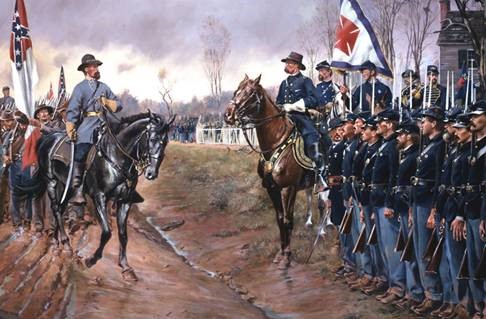
Major General John Brown Gordon, CSA

156 years ago today the Civil War ended in Wilmer Mclean’s parlor at the village of Appomattox Court House. It took 3 more days to draft the articles of surrender and it was determined that on April 12, 1865, the Confederate Army of the Northern Virginia would march to the Union line and surrender their weapons and flags. By this time Robert E. Lee had departed for ravaged Richmond, VA, and Ulysses Grant had returned to his headquarters at City Point, VA.

The honor of receiving the weapons and flags of the vanquised foe would be given to Major General Joshua Lawrence Chamberlain, the former Professor of Modern Languages at Bowdoin College in Maine. As an honor guard, Chamberlain chose 3 brigades consisting of regiments that had fought in virtually every battle in the eastern theater of the war.

On the Confederate side, the somber occasion was to be under the command of the fearless and oft-wounded General John B. Gordon with the procession being led by the famous Stonewall Brigade of Virginia regiments originally commanded by Stonewall Jackson.

Both commands were in view of each other, resting on hills across a small valley. In 1904 Joshua Chamberlain described the event to the Southern Historical Society Papers, up until that time, there was no official report, statement, article, etc. written about this occasion.

Chamberlain describes the process of the Confederate troops as “an impressive and striking” sight to see their formidable former foes approaching. Given the significance of the event, Chamberlain felt compelled to offer a proper salute to the Confederates as each unit passed by.

Again, Chamberlain describes: “General Gordon was riding in advance of his troops, his chin drooped to his breast, downhearted and dejected in appearance almost beyond description. When General Gordon came opposite me I had the bugle blown and the entire line came to ‘attention,’ preparatory to executing this movement of the manual successively and by regiments as Gordon’s columns should pass before our front, each in turn”. At the sound of the bugle, the first Union regiments in line, as one, snapped to attention, slapping their rifles to their right shoulders in the “carry arms” position. Chamberlain’s words: “At the sound of that machine like snap of arms, however, General Gordon started, caught in a moment its significance, and instantly assumed the finest attitude of a soldier. He wheeled his horse facing me, touching him gently with the spur, so that the animal slightly reared, and as he wheeled, horse and rider made one motion, the horse’s head swung down with a graceful bow, and General Gordon dropped his swordpoint to his toe in salutation. By word of mouth General Gordon sent back orders to the rear that his own troops take the same position of the manual in the march past as did our line. That was done, and a truly imposing sight was the mutual salutation and farewell. At a distance of possibly twelve feet from our line, the Confederates halted and turned face towards us. Their lines were formed with the greatest care, with every officer in his appointed position, and thereupon began the formality of surrender.”

What ensued was a very heart rending scene. As the Confederate soldiers broke ranks to stack their weapons and flags, many of them fell to their knees, clutching their tattered banners, weeping openly. Many of the Unions soldiers stood upright at “carry arms” but with tears streaming down their faces as well.

Salute Of Arms

The Stone Wall

The writing prompt for today was simply “a wall”. The following is historical fiction, mostly true, a comment at the end of the story and photos discloses what is true and fictional:

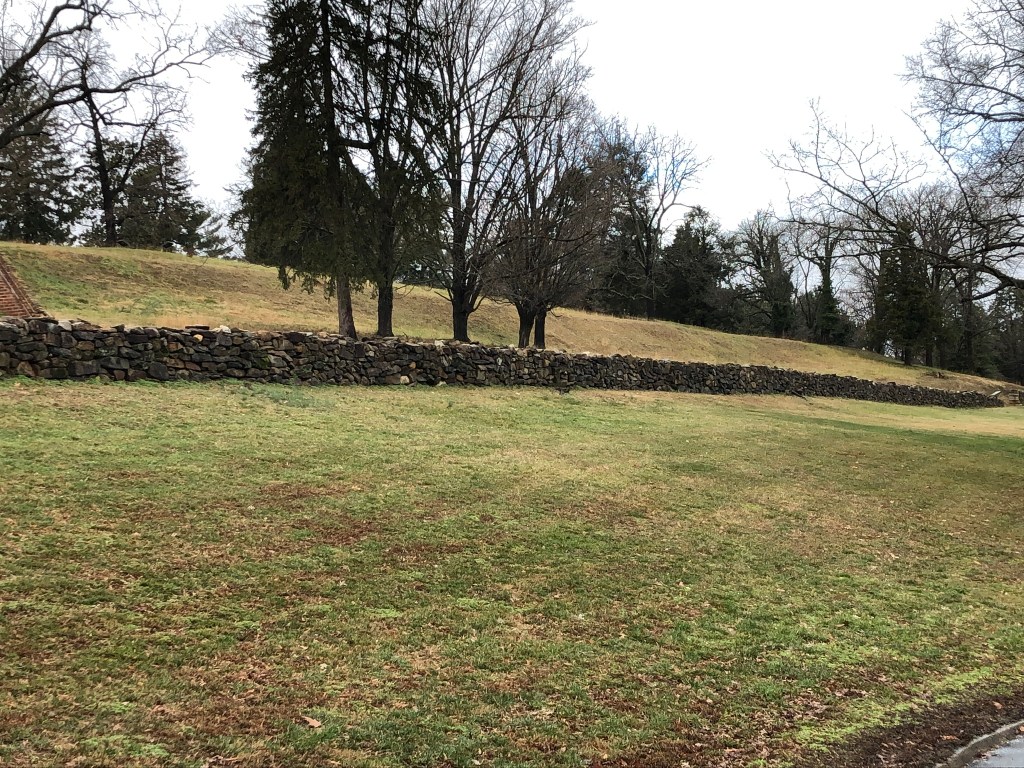
Marye’s Heights, Fredericksburg, VA. This stone wall, and a sunken road behind it, formed a natural fortress for Confederate soldiers during the Battle of Fredericksburg on 13 December 1862. Photo taken during a visit Barb & I made in January of 2019.

The Stone Wall

Fredericksburg, Virginia. December, 1862

For nearly a month, the two armies glared at each other.  Separating the Union Army of The Potomac and the Confederate Army of the Northern Virginia were the Rappahannock River and the historic town of Fredericksburg.  The natural barriers relegated the belligerents to hurling insults at each other versus deadly projectiles.  All of that changed on December 11th, as Union General Ambrose Burnside forced a crossing of the river and occupied the town.  The Rebel forces in the town withdrew to a low ridge called Marye’s Heights, just 600 yards south of the towns edge.  The new position, anchored behind a 4 foot high stone wall with a sunken road running parallel to the it, provided substantial protection for the Rebel defenders.  Nearly impregnable, the men behind the wall boasted “that a chicken could not live on that field when we open fire”.  On December 13, 1862, Burnside ordered 14 assaults across the field in a futile attempt to drive the Rebels from their near fortress.   

Major General Ambrose Burnside ordered 14 separate charges to try and overrun the center of the Confederate lines anchored behind the stone wall. The smoke from the trees in the middle distance is where the stone wall is located.

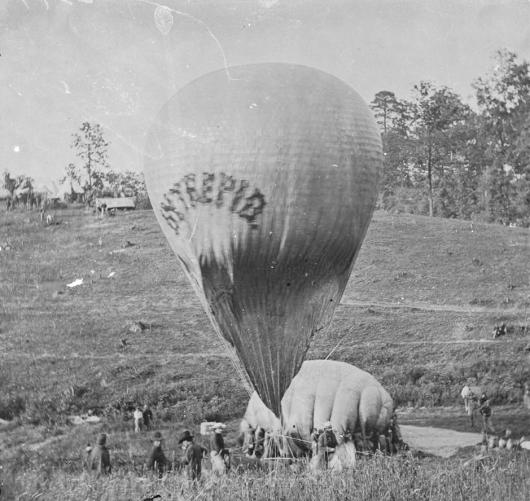
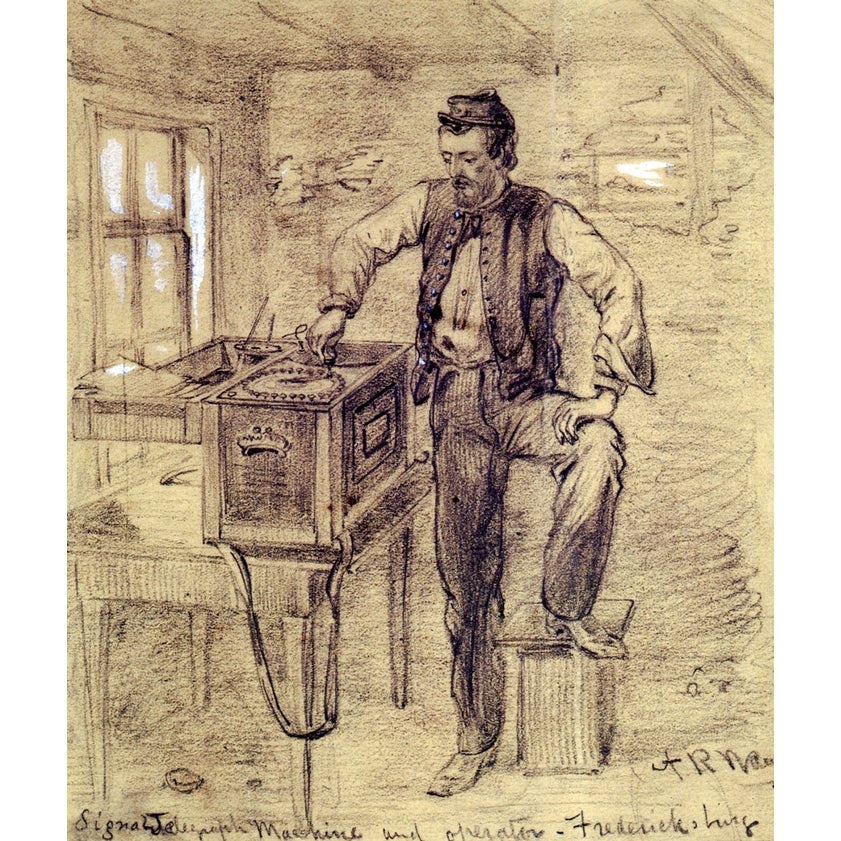
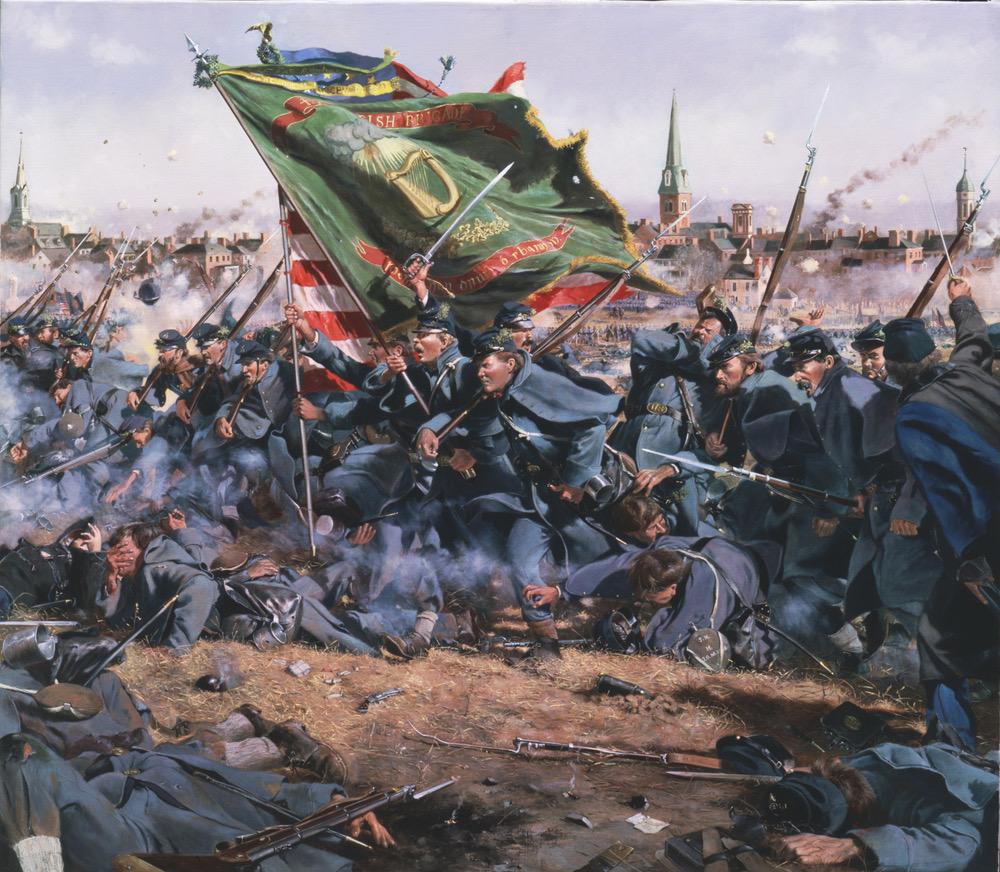
Colonel Roland Horvath had a bird’s eye view, literally, of this savage drama playing out.  Suspended in a basket beneath a hydrogen filled balloon called The Eagle, Colonel Horvath  tried to watch the battle’s progress.  He was supposed to telegraph significant details to officers on the ground, but the smoke from from rifle and artillery fire made it impossible to discern what was happening.  Through his field glasses,  Horvath could see blue clad men in perfect alignment disappear into the battle fog, flashes of flame, then disorganized mobs of men pouring back out of the smoke.  Some carrying or dragging wounded comrades.  Breaks in the battle fog were fleeting, Horvath could see that no Union troops had gotten close to the wall.  Training his glasses on the town’s edge, Horvath’s hands trembled as he watched the emerald green flag of the Irish Brigade and the men behind it get swallowed by the smoke. He prayed that his friend, Major Sean McMahon, had obeyed his orders and remained behind at the Irish Brigade Headquarters.  Horvath was startled by a sudden jolt to the basket.  The ground team was pulling the balloon down to replenish the gas.

The Eagle and The Intrepid were similar in design, a single occupant, hydrogen filled balloon. The balloons were used by the Union Army through the Battle of Chancellorsville in May of 1863. Transportation difficulties, battlefield topography, and personality conflicts ended their use in the Civil War.

Telegraphic messages were sent from the balloon to a receiver on the ground. The devices were similar to this. Instead of Morse Code, a dial was spun to a letter of the alphabet, and a key pressed to transmit the letter.

Once on the ground, Col. Horvath ran to his horse as fast as his wobbly legs would allow him.  He trotted across the pontoon bridge, then through the town to the Irish Brigade Headquarters.  Not able to find  Major McMahon, he asked a staff officer if he knew his whereabouts.  The staff officer replied “The scamp snuck out and charged with the brigade, I have not seen him, the survivors are coming back now, maybe he is with them”.  “Survivors?”, Horvath asked, his voice strained, “the charge failed then?”.  “It was doomed to fail”, said the staff officer sharply, “The regiments are reforming at the end of the street, maybe he is there”.  Horvath walked his horse to the end of the street.  Spotting an officer of the 116th Pennsylvania, he asked if he had seen his friend.  “Aye”, answered the officer, “He joined our lads on the advance, he fell near the wall.  Whether wounded or dead I do not know”.  Col. Horvath felt a heaviness in his chest.  Daylight faded, the temperature began to plummet.  Firing between the armies died off to just sporadic sniping.  When darkness finally fell, survivors began to trickle back to the town.  Horvath ventured out with members of the Irish Brigade to retrieve their comrades who were too injured to walk or crawl.  Rescue operations had to cease as dawn broke.  Major McMahon was not among those wounded retrieved that night.  Most of the survivors of the 116th Pennsylvania felt that he was close to the wall.

The Charge of Irish Brigade against the stone wall on Marye’s Heights. The charge resulted in a 45% casualty rate, virtually wrecking the brigade.

As the sun rose on Sunday morning, the 14th of December, the magnitude of the previous days failed assaults were staggering.  Col. Horvath’s commanding officer, General William Averell, had joined him in the early morning hours.  Gazing out at the field between the town and the wall on Marye’s Heights Averell, his voice heavy with emotion, said, “There are at least 8,000 men out there, a third of them dead.  The wounded trying to reach safety give this field a singular, crawling effect.  And your friend is out there…”.  Averell trailed off.  Both armies appeared reluctant to resume hostilities.  The cries of the wounded played on everyone’s emotions.  Horvath felt compelled to take action.  He loaded his horse with as many canteens and blankets as he could.  Removing his overcoat and sidearms, leading his horse, he began to walk out of Fredericksburg heading towards the stone wall.  As he cleared the town he saw a solitary Rebel soldier leap over the wall.  He had no weapons and from his extended arms hung canteens.  No one fired a shot, the Rebel knelt on the ground, lifted the head of a wounded man and appeared to help him drink.  Horvath hung some canteens over his extended arm, praying no one would shoot him.

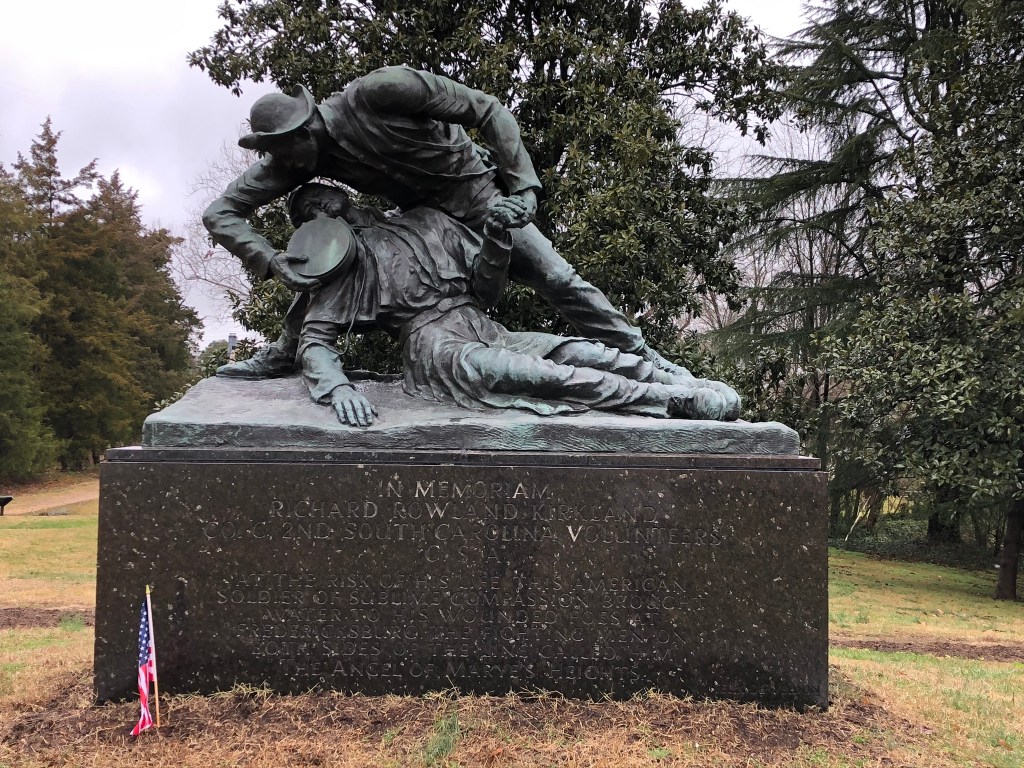
“My name is Colonel Roland Horvath, I am here to help you”.  The Rebel soldier stood, saluted and said “I am Sergeant Richard Kirkland, thank you sir”.  They were 50 paces from the wall, Horvath could see the hard stares from the men behind it.  For 1 ½ hours Kirkland and Horvath tended the wounded.  It was time for both men to return to their lines.  As they exchanged salutes and shook hands, Union and Confederate soldiers began to cheer and wave their hats at the duo.  Horvath removed his hat and bowed slightly to those behind the wall.  As he straightened, he heard an Irish brougue croak “Roland, your not gonna leave me now, you idjit!”.  It was McMahon, desperately wounded.  “Sean! You are alive!”, exclaimed Horvath.  “Your wife would kill me if I did not bring you back!  I would rather charge this wall than face her!”  Spotting a Confederate General standing at the wall Col. Horvath asked “I owe this man my life sir, on your honor, I ask if I can take him back with me”.  The General saluted Horvath and replied, “On my honor, of course. God speed to you both”.  Helping his friend onto the back of his horse, Horvath began the return to Fredericksburg.  Sgt. Kirkland climbed back over the stone wall, cheers again ringing again in their ears.

Sgt. Richard Kirkland leapt over the stone wall after the assault of the Irish Brigade. For 1 1/2 hours he gave water and blankets to the wounded Yankee soldiers.
The monument to Sgt. Richard Kirkland at Fredericksburg, VA. There is a similar monument at The Civil War Museum in Harrisburg, PA. Sgt. Kirkland would lose his life at The Battle of Chickamauga in September, 1863.


Although this is a work of historical fiction, much of the story is true: the quote about a chicken not being able to survive comes from Confederate Lt. Col. E.P. Alexander, commander of the Rebel artillery batteries on Marye’s Heights behind the stone wall, he made the comment to his commanding officer, General James Longstreet. The quote about Union casualties and the wounded “giving the field a singular crawling effect” was uttered by Union General William Woods Averell at The Battle Of Malvern Hill earlier in 1862. I thought it appropriate to insert in this story.
Colonel Horvath and his friend, Major McMahon, are entirely fictional, as is any of their dialogue. Sgt. Richard Kirkland conducted his mission of mercy completely alone, asking permission from his commanding officer – General Joseph Kershaw. There were four observation balloon ascents on December 13, either by the Chief Aeronaut of The United States Army Balloon Corps – Professor Thaddeus Lowe, or his associates.

Sources: “Fredericksburg, Fredericksburg” by George C. Rable, “Glory Road”, by Bruce Catton (Book 2 in his Army of The Potomac Trilogy), “The Immortal Irishman”, by Timothy Egan (biography of the colorful leader of The Iron Brigade at Fredericksburg- Thomas Francis Meagher), “Battles & Leaders of The Civil War, Vol. 3”, various contributors. Several Blue & Gray and Civil War Times Illustrated magazines relating to the Battle of Fredericksburg.

Ernie Stricsek

The Chatham Writers

March 21, 2021

Cornered

This is my story for both The Writers Group and The Memoir Group this week. Due to internet problems, I was not able to join the Writers Zoom. A tale my early career in the newspaper business…

Cornered

There were 10 of us gathered outside The Cherry Hill Elementary School.  It was a Saturday morning and we were in the act of picking teams for a game of stickball.  We were tossing the ball around when an errant throw sailed over my head.  Turning to chase it down, my back was to my friends when I heard one of them yell “Run”!  Thinking he meant me, I ran faster.  Retrieving the ball, I turned to throw it back only to see my friends retreating around the corner of the building, a dust cloud lingering in their wake.  As I stood there dumbfounded, I jumped when I heard a nasally voice shout “Hey sonny!  How old are you?”.  I looked to my left and there it was – the brown and tan Ford Falcon that was known to cruise the neighborhood, looking for kids of a certain age.  The car that my friends and I spent the late Spring and Summers months avoiding.  When spotted we would run like the wind to our homes, or to the nearest patch of woods or brush to avoid detection.   Leaning out the drivers window, a bespectacled face asked me again how old I was.  On the door beneath the face were the words “The Record”.  The color combination of the car reminded me of a Mars bar.  I was cornered, there was no place for me to run to, not a sapling to cower behind.   “Ten”, I replied, regretting giving my exact age.  But this same guy had cornered me at least twice in previous summers.  The last time was when I was 9 years old. But he doubted my story because he said I was a big kid. I figured he probably remembered me so I told the truth.   “Great!”, exclaimed the driver, then asked “How would you like to work for The Bergen Record?”.  “Umm, maybe”, I mumbled.  “Great!”, exclaimed the driver again.  He went on to introduce himself, Mr. Pantaleone, and said he would need to talk to my parents.  He offered to give me a ride home.  “I don’t ride in strange cars”, I said.  “Fair enough”, chirped Mr. Pantaleone, “give me your address and I will meet you there”.  I trudged home thinking about all of the summer fun I was going to miss.  I had a good run avoiding the job market, that was about to end as I arrived at my house to see the Mars Bar Falcon pull up.  Before noon that Saturday, in May of 1964, I became a paperboy, delivering the Bergen Record, “The Record” as the banner on the front page proclaimed.  The reason my friends ran?  They did not want to deliver newspapers.  They wanted to have fun.  When I finally re-connected with my chums after lunch, they all acted like I was sentenced to 20 years at Rahway State Prison.

Two Saturdays later, I completed my first full week as a paperboy and had collected the weekly paper fee – 33 cents.  Every customer gave me 50 cents, a 17 cent tip.  Counting up my coins when I got home, I had earned my first $3.50!  A whole new world had opened up to me.  Not one who received an allowance, I was no longer dependent on my parents for disposable income.  I did not have to ask for a dime to buy a bottle of Coke, 12 cents for a Marvel comic, or God Forbid, a whole quarter (Cheap!) for an issue of Mad Magazine!  I could go to the movies more frequently now, still had to rely on a ride, but for 60 cents I could get a matinee ticket and a box of Good ‘n Plenty.  I was now independently wealthy.  I would start a bank account and, as my Grandmother told me 500 times, earn interest on my savings!  Wow!  I decided that the first place I would part with some of my disposable income was Chizzie’s Gulf Station on Route 46. For 15 cents I treated myself to a Coke and a handful of pistachio’s from the vending machines in Chizzie’s office.  This was great!  I did not have to ask my Mom or, even worse, my Dad for any change and suffer through a harangue of how I was wasting their hard earned money.  I could waste mine!  This money that I earned was for me, to spend or save as much or as little as I chose. I was not encumbered as yet to be concerned with paying bills, putting food on the table, concerned with getting braces for anyone.  My only concern was to make sure I did not go crazy at Palisades Park and make myself sick on too much cotton candy or from the ride that turned people upside down.  

Carrying the Bergen Record was not a prison sentence.  I made money!  I even saved some.  I worked hard to grow my route to make more money.  Through rain, sleet, snow, on days I froze and days I baked in the heat, I delivered my papers.  My thoughts centered on how I was going to earn enough money to buy a silver Corvette and drive from Chicago to L.A. on Route 66.  Just like Marty Milner & George Maharis.  Life was great.

Ernie Stricsek

Chatham Memoir Group

3/16/2021

The Record 1964

The Thornton Street House

The Writers Group prompt for this week was to write about our “Golden Years” or a finest moment. In the past 2 years I have written to several finest moment prompts. I wanted to try something different. I am not a poet by any means, but I am trying to work on it. I wrote about one of our, Barb and I, finest moments from early in our lives together.

The Thornton Street House

The yard is an overgrown jungle

shaggy shrubs block the windows.

The backyard taken over

by vines of wild grapes.

A cast iron sink with a porcelain veneer

supported by unusually long legs.

The kitchen cabinets have glass doors

painted over, the color Grey Poupon.

Knotty pine paneled walls 

rest on a well travelled linoleum floor.

The wool carpet was once a lush emerald green

now faded to the color of canned green beans.

Installed before the invention of carpet adhesives

the seams held tightly together with wool twine.

Wallpaper peels in one bedroom, stained in another

My God! So much ugly wall paper in every room.

Calcimine peels from the ceiling

Windows are painted shut.

A single bathroom, fixtures circa 1925

Part business, part residence

The walls and ceilings have acquired

A patina of nicotine.

Someone is going to buy this house

Buy it before we do, we can’t sleep

Our first house

The first house our sons called home.

Our early Golden Years.

Ernie Stricsek 

Chatham Writers Group

3/7/21

A Risky Meeting

The writing prompt for today was to describe how we met our significant others, or BFF’s, what impact they had on our lives, etc. Since joining the writing group in 2019, I have written 4 stories to similar prompts, so I went off on a historical fiction track this time.

A Risky Meeting 

June 5, 1944, outskirts of St. Marie-Du-Mont, France

In the corner of their dining room, Francoise Bouchard sat huddled around a small wireless radio with his brother, Rene,  and father, Charles, listening to jazz being broadcast by the BBC in London.  Shutters drawn, blackout curtains pulled tightly close, the only light in the room came from the radio dial.  The musical program ended, the Bouchards leaned in closer to the radio.  A French speaking host announced “London calling with Frenchmen speaking to our countrymen, London calling with some messages for our friends”.  All messages from this point would be broadcast in French.  After a brief pause, the voice recited a line from a poem by Paul Verlaine “Wound my heart with a monotonous languor” then repeated it.  The Bouchards sat bolt upright, emitted a collective gasp and looked at each other’s faces with wide anxious eyes. They leaned back over the radio as a series of other abstract messages poured from the wireless.  “Molasses tomorrow will bring forth cognac” announced the voice. “My God!” exclaimed his father.  The next radio message declared that “the dice are on the carpet”.  Charles sobbed, stood and motioned for his sons to stand.  Hugging and kissing them both, through his tears, he said “the liberation of France is imminent.  We have a long night ahead of us, be quick we have work to do”.  Messages still were being transmitted when Francoise turned off the radio and hid it away.  It no longer mattered, they heard what they had to hear.  The messages indicated that the Allied invasion of France would begin before dawn, and that the Bouchards role in this drama would be to cut communications between the German army rear support depots and the coastal defenses at Normandy.  Armed with explosives, they set off for their targets.

Avoiding German patrols along the roads, the Bouchards followed obscure paths through the orchards and hedgerows to woods astride the rail line where the Germans had run their telephone lines.  At the edge of the woods they met their guide, a young woman named Margaux.  She was carrying a British made sub-machine gun.  Margaux led them to a second team of Resistance fighters tasked with blowing up the rail bridge over the Merderet River, close to the telephone poles the Bouchards were to destroy.  They carried weapons, there were German soldiers guarding the bridge.  The two teams reviewed the plan one more time.  The explosions of the bridge and telephone poles had to occur almost simultaneously.  The Bouchards would set their charges first, allowing the other group time to approach and set their bridge charges.  When the bridge team was ready, Margaux would jog back along the tracks and signal with a torch.  Seeing the signal, Francoise would turn to his brother and father and signal his torch.  The charges would be detonated and the Resistance fighters would melt into the darkness and return to their homes.  The groups separated.  

It did not take long for the Bouchards to have their explosives in place.  Crouching, Francoise scuttled alongside the rail line towards the bridge.  Hiding behind a utility box, he awaited the signal from Margaux.  “Where was she?”, he wondered, “this is taking too long!”.  

Shouts, German voices, from the bridge made Francoise’s heart skip a beat.  Gun shots now, more German voices yelling “Halt”!  He could see tracer bullets searching among the trees, there were gun flashes from the woods.  Someone was approaching fast along the rail line, he had no weapon to use if it were a German.  It was Margaux!  She began to signal with her torch, Francoise turned and sent his signal.  A stream of German machine gun fire spit down the tracks.  He heard Margaux cry out in pain, saw her tumble down the rail embankment.  At the same moment the explosive charges detonated, toppling the telephone poles and collapsing the bridge into the river.  In the light from the explosions, he saw Margaux lurch off in to the woods.  He stood and began to run towards where she entered the woods.  There were Germans on this side of the river!  They were walking in his direction with weapons at the ready.  Spotting Francoise, they shouted “Halt”, but began shooting wildly at him.  The burping of Margaux’s sub-machine gun from the woods to his  left made the German soldiers scramble for cover.  He sprinted into the woods, calling Margaux’s name.  He heard her call out “Here”!  Discovering her behind a fallen tree with a wound in her side, he bent to help her up.  Throwing her over his shoulders, he lumbered off deeper into the woods.  They would not be able to outrun their pursuers.  Margaux begged him to put her down.   German soldiers tracking them on both sides of the river now began to fire indiscriminately into the woods, the rounds striking very close to them.  Bursting from the woods, Francoise discovered the Merderet flowing right in front of them.  Without much thought, he plunged into the water and began swimming along with the current, his arm around Margaux. Soldiers following on the other side of the river saw them and raised their weapons to fire.  The sound of plane engines, hundreds of them, halted the German soldiers in their tracks.  They now stood gaping up at the sky.  Soon searchlights broke through the darkness, parachutes blossomed in the glare.  The Germans sprinted back to the smoldering bridge.

Francoise floated onto a shoal.  Catching his breath, he began to carry Margaux back towards town.  From the darkness came whispered voices,  Margaux let out a cry of pain.  Voices called from the darkness “Stop right there”!  Francoise shouted back, “I am French, I have a wounded friend”.  Three men appeared from the woods. Looking at their uniforms, Francoise saw a black patch with a white eagle one the left shoulder, on the right shoulder was an American flag.  Francoise exclaimed “Americans!”.  Seeing the wounded Margaux, one of the Americans yelled “Medic”!

Paratroopers of the 101st Airborne Division (USA) liberating Ste. Marie Du Mont, June 6, 1944

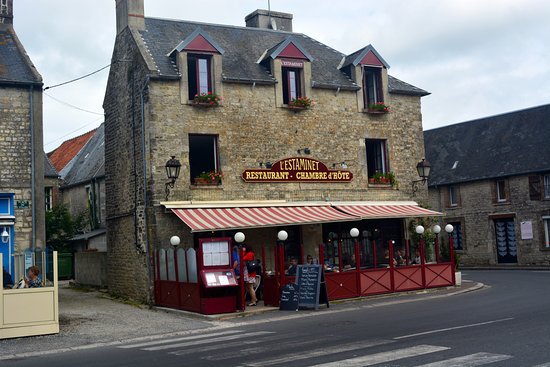
L’Estaminet Hotel, Sainte Marie Du Mont, June 1994
A couple in their 70’s were seated at a restaurant table.  “Hi, my name is Annette and I will be your server tonight.  Are you celebrating any special occasion this evening?”.  

They both answered “Our 50th wedding anniversary.” 
 
“Oh my!  How delightful!  Congratulations!  Can I ask how you the two of you met? I am always curious as to how people who have been together a long time met each other.”

With a twinkle in his eye, and a wry smile on his face, Francoise looked at Margaux and replied “Well, Annette, we met while swimming. It changed our lives forever.  We had a blast.”

Ernie Stricsek, Chatham Writers, February 8, 2021

The BBC radio broadcast to French Resistance fighters alerting them that the D-Day invasion was less than 24 hours away. The messages following this announcement were codes to various Resistance groups to begin sabotage operations against key Nazi military objectives:

The Chronicle of Don

The writing prompt for this week’s Chatham Writers Group was “write your own obituary”. That kind of bummed me out! I was going to go off topic and read the story I wrote about The Mud March, but thought some of the group might find it not exciting enough. I woke up at 7:30 this morning with a thought, and this is the product. I completed it by 9:45 this AM, with time to spare before the start of the 10:30 AM start time. Full disclosure, the Don in my story is a compilation of two guys named Don that I worked with years ago. The one Don did suffer an ashtray blow to the side of his head, he survived, albeit rather bruised. The other Don did stand up into the hose of a dust collector and it sucked down onto the top of his head to the bridge of his nose. He struggled mightily to get it off. It looked like an elephant’s trunk had grabbed his head. He finally got the hose off, and his hair was standing straight up. I had been laughing too hard to help. He asked me to promise not to tell anyone. I have been telling this story for 43 years now. At any rate, here is my fiction work for today.

The Chronicle of Don

When an unfortunate workplace accident contributed to the untimely demise of Donald Mallard, as a cub reporter for the Press & Journal, I was assigned the dual tasks of reporting the story and preparing his obituary.  This was not uncommon for Cub reporters in the early stages of their journalism careers, so I was prepared to do the scut work that would eventually lead to the sports writer desk.  The assignment was presented to me via my boss shouting form his office door “Stricsek!  Get over to Widget Powder Metals now!  There has been an accident.  Get enough info for a 500 word story and stuff for an obit.  They are expecting you”.  Of I went in my VW bug on what would prove to be a very curious journey of discovery.

 My journey began with the HR Manager of WGT, Incorporated, and I quickly discovered that Mr. Mallard was universally disliked.  “I really don’t know what to tell you” she began.  “What type of a person was he?” I asked, “was he a model employee?”. “No!”, she exclaimed, “No! He was the most odious person I have ever encountered!  I am going to send you over to his boss and perhaps he can provide more details.  Just mentioning the late Mr. Mallard’s name makes me want to take a shower…. I am sorry to speak ill of the dead…” she shuddered and trailed off.    

Those were the exact same words Mr. Mallard’s boss used to start our conversation before moving on to details. “Duck Mallard was loathed by everyone who worked here.  A more unsavory character you will never meet.  Profane, quarrelsome, I mean how would you feel if you were greeted every morning with “ah go to hell”.  Every word out of his mouth was coarse”.  I asked about the details of the accident.  His description of it made it very plain that he despaired more of the loss of a piece of equipment than the loss of Mr. Mallard.  “He got sucked into a dust collector unit, like a huge vacuum cleaner.  He damaged the filters when he lodged against them,  the broken pieces got into the Venturi unit and burned up the motor.  Damn! That dust collector was brand new and cost $250,000!  I am going to send you over to talk to his co-workers for more details.  I am too worked up to say anymore.  Nice meeting you”.  

Mallard’s co-workers made no attempt to hide their disdain for their recently departed crony.  The most talkative one of the group began “God that guy was a piece of work.  We would draw straws every morning to see which of us would have to assist him.  Men the size of a tank would break into tears after drawing the short straw.”.  Another volunteered “We called him Duck Mallard, or Donald Duck, it would drive him nuts.  I said good morning to him one time and he told me to eat shit, I never called him Don again.  I don’t know, maybe that is what led to the accident”.  He pointed towards a large hose suspended from a beam and said “That is the vacuum hose.  It broke loose from that beam and started to swing towards him.  I shouted “Duck!”.  I guess he thought I was mocking him because he turned and gave me the finger then he got sucked into the hose.  It was like watching an anaconda swallow a capybara”.  He caught me gaping at him and clarified “I watch Animal Kingdom every Sunday”.  “Anyway, that’s what happened” he continued, “Duck ended up breaking a quarter of a million dollar machine”.  I had all I needed for the accident article.  Nobody had anything charitable to provide for the obit.  I had phone numbers for Mr. Mallard’s mother and ex-wife, perhaps I would be able to glean something positive from them.  

Mallard’s mother dissuaded me of such noble thoughts. “Yeah, when I received the call I asked “what, did his ex murder him”?.  When they told me what happened I assured them that somebody must have stuffed him into that hose, that boy could piss off the Pope.  You know when he was born, and the Doctor smacked his butt to get him to take his first breaths, he actually said “You bastard!”, yes he did, clear as day.  I told the Doc he learned it from his father.  His little foot would kick in my womb whenever my husband said bastard.  Well, I got nothing else for you, my soaps are about to start, so, have a nice day”.

The last stop on my journey was Mallard’s ex-wife.  “My first thought was that someone killed him.  He had that effect on people.  You know he took me out for a lovely dinner, to The Victorian, you know the place, really nice.  After dinner he looks at me and says he wants a divorce.  He was holding his drink in his left hand, I reached over to grasp his right hand, then I hit him with an ash tray.  He ran out with a napkin over his eye.  I had to pay the bill”.  She stopped to catch her breath, then broke out into a fit of laughter.  “You know” she resumed, “How ironic.  Don encountered something that sucked more than he did.  Hey, I gotta run. General Hospital is starting soon.  Have a nice day”, and she hung up.

It was easy to type the story of the accident.  Not so easy for the obit.  With no one seeming to have anything good to say about the departed, or seeming to care, I channeled my inner Lincoln and began:

Donald Mallard:  April 1, 1950 – February 10, 1978

With malice for all

And charity for none

Don Mallard’s work in this life is done

Everyone he knew, begged to not be misunderstood

Don is dead, good

Even Doc Holliday, in his obituary

Was granted some Grace

With Don Mallard

People are glad not to see his face

Let it be known to all, that his remains were accorded a Christian burial.

Ernie Stricsek

Chatham Writers Group

1/25/2021

“Burny In Mud”

Storm clouds darkened Washington D.C. in December of 1862. The clouds were not formed by any weather or atmospheric conditions, rather they were formed by despair, partisan rancor, fear and loss of confidence in the U.S. Government’s ability to achieve a victorious end to the war that was about to enter its 3rd year. The cause of all of this turmoil was the defeat of the powerful Union Army of the Potomac at the Battle of Fredericksburg by the Confederate Army of Northern Virginia on December 13. Union commander, Major General Ambrose Burnside, sent his magnificent army of 122,000 men on a series of futile frontal attacks in an attempt to overpower and defeat the 80,000 Rebels under the command of General Robert E. Lee. Once that was accomplished, Burnside would push to capture the Confederate capital city of Richmond. Lee had other ideas and defeated Burnside in what was, perhaps, the most lopsided victory in the Civil War. For the balance of 1862 and into the start of the new year, the blame storming emanating from local, state and federal government officials, as well as northern newspapers would result in calls for the impeachment of President Lincoln and for several cabinet members to submit letters of resignation. Lincoln, of course, was not impeached and he did not accept the resignation letters. But now all eyes were on Ambrose Burnside and the Army of the Potomac.

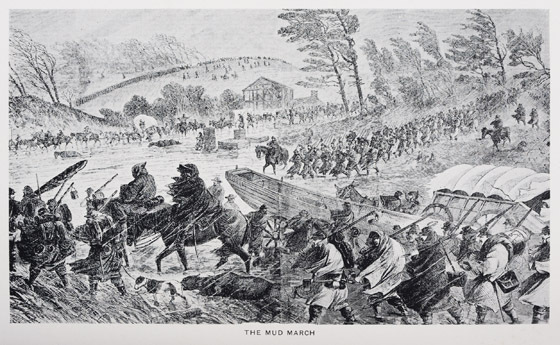
The Mud March

After his bloody defeat at Fredericksburg, General Burnside was determined to attempt another advance on Richmond. After vetoing one plan, Lincoln gave the nod for an alternative one and Burnside began his preparations. Winter campaigns during the Civil War were perilous ventures. The lack of any methods to accurately predict weather conditions could wreak havoc on the movements of armies. Freezing temperatures and snow fall could, and would, change to slightly warmer days with heavy rains. With nearly all roads being dirt, wet weather could make those roads almost impassable.

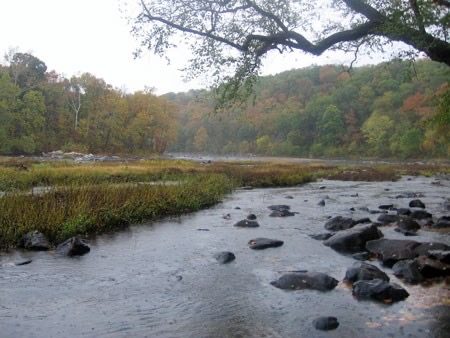
After sunny days with temperatures above freezing and roads in reasonably good shape, Burnside issued orders early in the morning of January 20, 1863 to begin the movement towards Richmond again. With regimental bands playing “The Girl I Left Behind Me”, the mighty Army of the Potomac marched out of their camps, although not starting until 11:00 AM. By the evening of January 20th, the leading elements had marched 12 miles, stopping just short of Banks Ford on the Rappahannock River. As darkness fell, the soldiers stacked arms, pitched tents, and cooked their suppers. While preparing to turn in for the night, a light rain began to fall. By midnight, the full force of an unexpected Nor’easter blew across northeast Virginia. The overnight torrents of rain flooded tents and campsites. The soldiers suffered miserably through the night as the cold rain soaked their heavy wool uniforms. The curtain of night lifted on January 21st to reveal a tableau of misery. The rain fell in sheets from a sky that was steel gray. Worse, the roads had become quagmires. Wagons, cannon and caissons sunk into mud that was hub deep and became stuck. Teams of horses and scores of soldiers could not get them unstuck. Trees were cut down and laid in an attempt to “corduroy” the roads and make them passable, but they were consumed by the quagmire. Mud oozed into boots and shoes or sucked them completely off the soldiers feet, lost forever. Streams and rivulets became raging rapids, the Rappahannock River rose and became too deep and swift to try and wade across Banks Ford. Pontoons were ordered up to bridge the Ford.

(The tune struck up by the regimental bands as they broke camp on 20 January 1863):

Shortly after breakfast on the 21st, Burnside and 3 members of his staff left his headquarters to check on the progress of his army. Burnside’s spirits began to flag as he passed pontoon trains mired in mud, unable to be pulled free by 100 soldiers and teams of 24 horses. Moving on towards Banks Ford, he passed more signs of misery, observing exhsusted, mud covered soldiers sitting on the roadside, indifferent to the torrential rains. The partially submerged carcasses of horses and mules who collapsed and drowned in the swampy roadways gave gruesome evidence to the toll paid by the animals trying to keep an army moving. Only three pontoons had made it to Banks Ford. Confederate soldiers could be observed on the other side of the Rappahannock, gleefully watching the Yankees wallowing in the mud. All elements of surprise were dashed. Burnside dejectedly rode back to his headquarters. Arriving shortly after 5:00 PM, he telegraphed the War Department in Washington D.C. with the information that heavy rains had delayed his progress. Government officials took note of this ominous report and sensed another failure in the making.

The Army of the Potomac spent another miserable night and awoke on January 22nd to the unrelenting rains. Rebel sharpshooters began to pepper the soldiers guarding the pontoons. Other Confederate wags had posted signs saying “Burny in Mud” and “This Way To Richmond”. Painted in huge white letters on the roof of a barn on the Rebel side of Banks Ford were the words “Burnside Is Stuck In The Mud”. With no chance of success, Burnside called off the advance. The soldiers turned around to return to their camps. This did not end the misery by any means, it was still pouring with “Mud, mud, mud. Everywhere mud”. On 23 January 1863, an exhausted and demoralized Army of the Potomac arrived back where they started, 3 miserable days earlier. The Official Reports of this action would refer to this as “The Mud March”, and 158 years later, it is still called “The Mud March”. On 25 January 1863, Ambrose Burnside was replaced by his bitter enemy, the conniving Major General Joseph Hooker, as commander of The Army of the Potomac.

Artist depiction of The Mud March
Banks Ford across the Rappahannock River, as it appears today

Major General Ambrose Everett Burnside

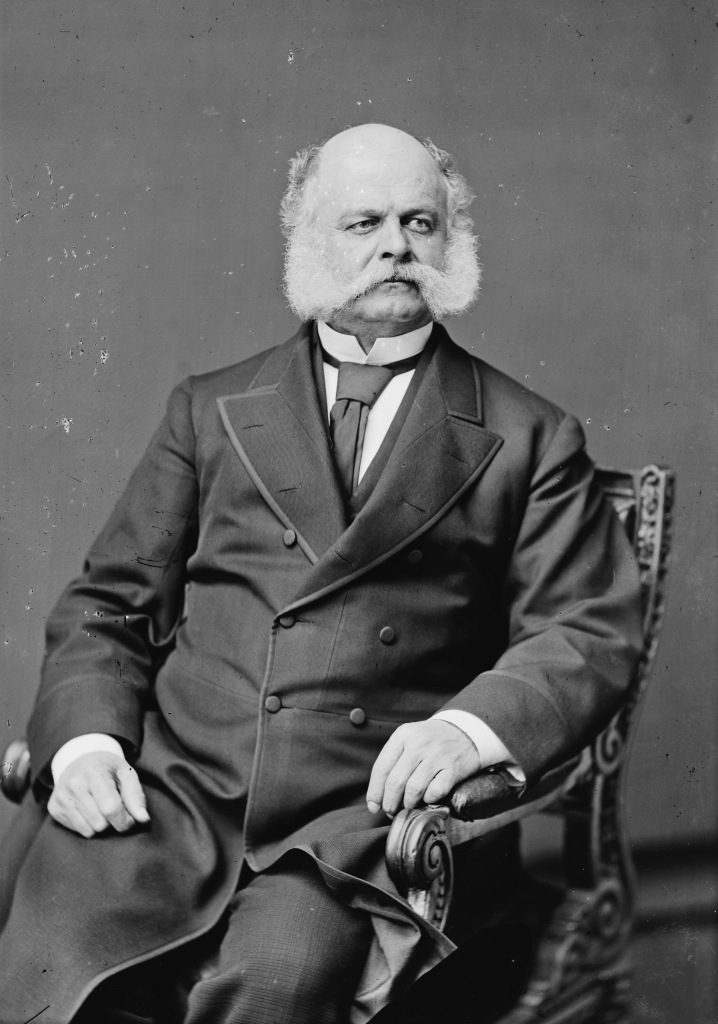
Ambrose Everett Burnside was born in Indiana in 1824. Attending the United States Military Academy at West Point, he graduated in Class of 1847, ranking 18th out of 38 students and was assigned to the artillery. After service in the Mexican War and on the Great Plains, he resigned and moved to Rhode Island. Inventing a breechloading rifle – The Burnside Carbine – he opened a factory in Bristol, Rhode Island to manufacture them. Treasurer of the Illinois Central Railroad when the Civil War began, he resigned to become Colonel of the 1st Rhode Island Volunteers. Because of his prior military service, Burnside was promoted to Brigadier General and led a brigade at the First Battle of Bull Run. Tall, outgoing, likable, impressive, Burnside’s Civil War career was up and down. He showed flashes of competence, in smaller scale Campaigns he led in Eastern Tennessee and along the North Carolina coast, but when he performed badly, he performed really badly. He was involved in two of the biggest debacles in the Civil War, the Battle of Fredericksburg and the Battle of the Crater at Petersburg, Virginia in 1864. Burnside admitted, many times, that he was not qualified to lead an army and had twice rejected the offer to command the Army of the Potomac. After the war, Burnside returned to Rhode Island where he served 3 terms as Governor before getting elected to the U.S. Senate, where he served until his death in 1881. His outstanding physical characteristics were his bushy, mutton chop whiskers which are still called to this day “Sideburns”. You will see in the following photo:

Major General Ambrose Everett Burnside, nicknamed “Burn” by his fellow officers
Senator Ambrose Burnside
Ambrose Burnside’s home at 314 Benefit Street in Providence, R.I. It is now an apartment building. As of 2 years ago, there was an effort underway to grant historical status to the home so it could be preserved. It was in pretty rough shape the last time I saw it.
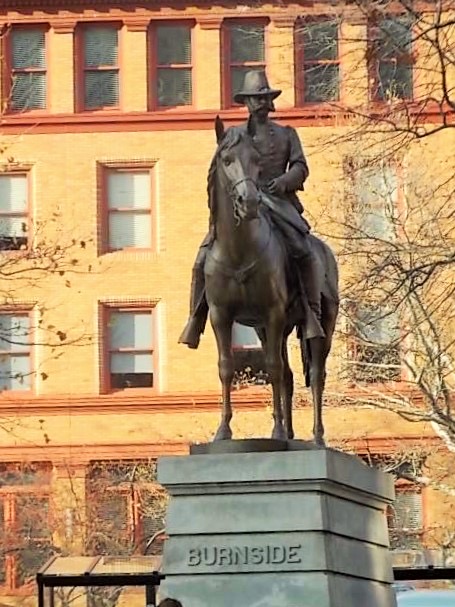
Equestrian Statue of Burnside in Downtown Providence, Rhode Island

Sources:

“Fredericksburg! Fredericksburg!” By George C. Rable. An excellent history of the Fredericksburg Campaign. “The Civil War Encyclopedia” compiled by Lt. Col.Mark Boatner. Several back issues of The Blue & Gray and Civil War Times, Illustrated relating to the Fredericksburg Campaign and The Mud March.

William Marvel wrote a biography of Ambrose Burnside, which I have, but I found it somewhat disappointing. Marvel tries to pin Burnsides failures on others. While there are many facts that point to Burnside being undermined by uncooperative subordinates, much of the blame does rest with him.